ROLLS-ROYCE 102EX - PHANTOM EXPERIMENTAL ELECTRIC Test Drive
ROLLS-ROYCE PHANTOM EXPERIMENTAL ELECTRIC |
Rolls-Royce Phantom Experimental Electric
Test Drive of the Largest and Most Luxurious Rolls-Royce EV (1)
Rolls-RoyceRolls-Royce Motor Cars recently unveiled the "102EX," also known as the "Phantom EE (Experimental Electric)," an electric vehicle for demonstration purposes. It was introduced to the Japanese press on September 30, 2011, at the Capitol Tokyu Hotel in Tokyo.
Text by Fumio OgawaPhotos by Masayuki Arakawa
Is an Electric Vehicle Compatible with Rolls-Royce?
The Phantom EE is characterized by its replacement of the conventional 6.75-liter V12 engine with an electric motor and battery pack.
"This is the world's first battery-powered electric vehicle in the ultra-luxury segment," proudly states Hal Serdin, Corporate Communications Manager at Rolls-Royce Motor Cars (hereinafter referred to as RR).
"RR produces cars that embody the highest luxury in the automotive world. At the same time, we recognize the need to look to the future and ensure the brand's long-term, sustainable growth. Investigating and considering alternative powertrains (such as electric vehicles) is an important step in that process."
The Phantom EE brought to Japan has toured Europe and the Middle East, and will continue to Asia and Europe, where it will be driven on public roads to investigate traffic conditions and electromagnetic influences. Simultaneously, it will engage with customers and journalists to gather opinions on whether an electric vehicle is a compatible concept for the Rolls-Royce brand, according to Mr. Serdin.
ROLLS-ROYCE PHANTOM EXPERIMENTAL ELECTRIC |
Rolls-Royce Phantom Experimental Electric
Test Drive of the Largest and Most Luxurious Rolls-Royce EV (2)
Equipped with a Lithium-ion Battery Pack with a Total Capacity of 71kWh
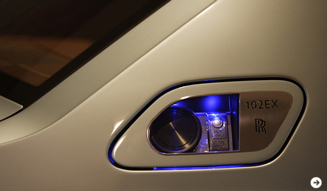
Rolls-RoyceThe Rolls-Royce "RR" brand logo historically changed from red to black in 1933. Various theories exist for this change, including better matching with car body colors or mourning for co-founder and engineer Henry Royce. The "RR" lettering engraved on the "Parthenon," as the front grille is nicknamed, on the Phantom EE is red, a color reserved for Rolls-Royce experimental vehicles. All Rolls-Royces bearing the red RR are special models.
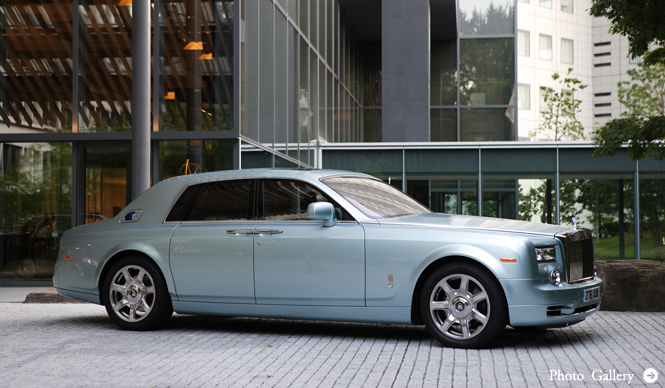
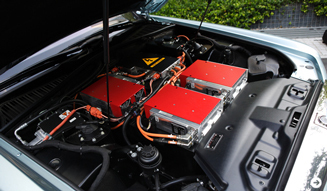
The Phantom EE's exterior is indistinguishable from the normal gasoline-powered version. However, beneath the front bonnet lies a lithium-ion battery pack with a total capacity of 71kWh, comprising 96 cells – described by RR as "the largest battery pack installed in a passenger car globally."
Non-Contact Charging Method Also Under Consideration
At the rear are two electric motors, each with an output of 145kW, and an inverter. The combined output of 290kW from the electric motors drives the rear wheels via the differential.
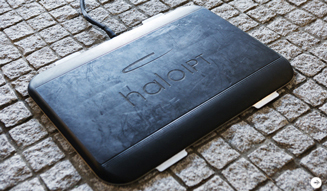
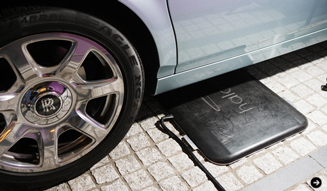
Charging time is stated as 8 hours for a three-phase connection and 20 hours for a single-phase connection. Additionally, a non-contact charging method called induction charging is being considered, where moving the vehicle over a ground-based transfer pad activates an induction pad on the vehicle, magnetically linking the power frequency via the transfer pad.
The currently projected driving range for the Phantom EE is approximately 200 km on a single charge. Meanwhile, acceleration from a standstill to 100 km/h takes less than 8 seconds, indicating that achieving a balance between power and economy is a key challenge.
ROLLS-ROYCE PHANTOM EXPERIMENTAL ELECTRIC |
Rolls-Royce Phantom Experimental Electric
Test Drive of the Largest and Most Luxurious Rolls-Royce EV (3)
A Massive 800Nm of Torque Effortlessly Moves the 2.7-Ton Body
The test drive of the Phantom EE took place in Tokyo. The course started at the Capitol Tokyu Hotel in Akasaka, proceeded through Akasaka-mitsuke, past the State Guest House, and along the ginkgo-lined avenue in Aoyama. Afterwards, for photography, we were able to drive several laps around the Jingu Gaien circuit.
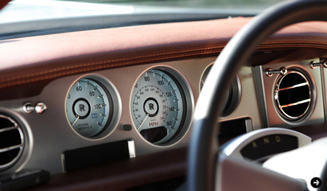
Once inside the Phantom EE, it's difficult to discern any difference from a conventional gasoline car at first glance. A closer look at the instruments, with their white dials and slender hands exuding the elegance of a luxury watch, reveals a battery level gauge subtly indicating the vehicle's unique nature.
The initial acceleration is smooth. With a curb weight of 2.7 tons, it's a heavyweight, but thanks to a maximum torque of 800Nm, the weight is imperceptible. The vehicle responds sensitively to the accelerator pedal, and the 5.8-meter-long body moves with effortless grace.
Pressing the pedal further results in a palpable surge of power, accelerating the car with a force that passengers can clearly feel. And it does so in silence. This sensation is likely the reason for the "EE" designation on the Phantom. The Phantom is already known for its exceptional quietness and immense torque, but the electric version further emphasizes these characteristics, leaving a lasting impression.
When I mentioned to the Phantom EE's development manager, Andrew Martin, who was accompanying me, "The gasoline version is already ultra-smooth, so the impression doesn't change much even with an electric motor," he chuckled and replied, "That might be true." If this impression is accurate,Rolls-Roycemay be the most suitable model for electrification.
ROLLS-ROYCE PHANTOM EXPERIMENTAL ELECTRIC |
Rolls-Royce Phantom Experimental Electric
Test Drive of the Largest and Most Luxurious Rolls-Royce EV (4)
Development Undertaken in a Short Time to Align EV with Brand Identity
In developing the Phantom EE, Rolls-Royce did not, for instance, place the battery pack under the floor as is common with electric vehicles. Development Manager Martin explained the reason: "Rather than investing in that, our objective for this project was to gather opinions on how the market perceives the compatibility between Rolls-Royce and electric vehicles, aiming for rapid development."Rolls-RoyceThis does not mean it's a hastily produced model; the fact that the weight distribution, a crucial factor, remains at 51:49, the same as the gasoline version, attests to this. Consequently, the driving feel is very similar to the gasoline car. This is, in a way, characteristic of the Phantom. The Phantom, at least the limousine version, is designed more for chauffeur-driven use than as a driver's car. When gripping the thin-rimmed steering wheel wrapped in fine leather, the primary method of control is hand-over-hand steering. Making large, abrupt steering inputs like one would in a conventional sedan can lead to significant body roll, potentially discomforting passengers. This was something I was reminded of anew.
When you think about it, Rolls-Royce established its reputation through car manufacturing that was astonishingly "smooth and quiet, like an electric car." In that sense, we anticipate that Rolls-Royce will offer a groundbreaking answer for the new era.
ROLLS-ROYCE PHANTOM EXPERIMENTAL ELECTRIC | Rolls-Royce Phantom Experimental Electric | 10