
Commentators Discuss the Automotive World Post-3.11—Part 1
Experts Discuss the Automotive World Post-3.11
Special Roundtable: Part 1 (1)
What Role Will Cars Play in a Renewable Energy Society?
The Great East Japan Earthquake on March 11th marked a significant turning point in how we consider the future of society. Amidst concerns about power supply, discussions around smart grids have gained momentum. What role will cars play moving forward, and what path lies ahead? OPENERS editor-in-chief engaged in a discussion with three leading experts.
Participants: Fumio Ogawa, Yasuhisa Shimashita, Toshihumi Watanabe, Koichi Yamaguchi (OPENERS Editor-in-Chief)Photos: JAMANDFIX (Portraits)Summary: Dai Matsuo
SNV: Automobiles as Social Network Vehicles
YamaguchiIn response to the recent earthquake, OPENERS aims to explore, report on, and provide information about new societal structures. We believe the role of automobiles will undergo a dramatic transformation. In the wake of the Fukushima nuclear accident, the necessity of building a society centered on renewable energy is being discussed across various media. As you know, the concept of smart grids is indispensable for this. Essentially, to stably utilize renewable energy, which is susceptible to natural conditions like weather, it involves storing electricity generated from solar and wind power in home battery systems and then sharing it within the community as needed, leveraging IT technology. Cars are expected to play a crucial role in this scheme.
OgawaSo, the batteries in EVs and plug-in hybrids would function as storage batteries?
YamaguchiYes. Think of it as getting a battery when you buy a car. Or perhaps, a mobile battery. Nowadays, social networking services (SNS) like Twitter and Facebook are gaining significant influence. Smart grids are translated as 'information-powered grids.' In the power systems of this new era, cars equipped with batteries will become part of the social networking infrastructure as storage units. By combining this with the concept of SNS, I'm considering proposing the term SNV (Social Network Vehicle).
WatanabeSNS fundamentally connects multiple small communities. Smart grids do the same. However, a key attribute of automobiles as products has been the opposite: they are personal vehicles, not belonging to a village. Logically, the fundamental nature of cars and the concept of SNS might be contradictory. I believe that's a crucial point.
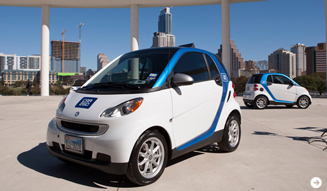
OgawaIn Europe, the 'point and line' structure works well due to walled cities. The 'line' connects cities, and for long-distance travel, you need a vehicle for that. Within the city walls, the 'point,' you need short-distance vehicles. This concept forms the basis for how electric vehicles will be used. It existed in Europe as early as the 1960s and 70s, known as park-and-ride or park-and-drive. Car sharing is also prevalent. Therefore, there's a foundation for the adoption of EVs for short-distance travel. However, the differing urban structures in Japan might pose a challenge for the widespread adoption of electric vehicles in the near future.
ShimashitaWhile EVs in Europe are primarily urban, I believe the opposite is true for Japan. Small EVs should be central to rural areas. The most serious issue in Japan today is rural depopulation, meaning a lack of mobility for the elderly and a lack of purpose for young people to stay in their hometowns. If towns offer enough value to remain in and if inter-town travel is facilitated, the towns will revitalize. EVs could be necessary to achieve both. For example, areas with many mountains and valleys, unsuitable for farming, might have abundant solar and wind power, with City A producing electricity but little food. City B might not produce electricity but have plenty of food. Cars could mediate the connection between these two cities. Could EVs be a solution to rural and aging population problems?
Experts Discuss the Automotive World Post-3.11
Special Roundtable: Part 1 (2)
What Role Will Cars Play in a Renewable Energy Society?
The Future of EVs
YamaguchiAccording to some statistics, cars spend an average of 23 out of 24 hours parked each day. In the past, cars were merely objects occupying parking spaces during that time. However, in the future, EVs can contribute to the local community even while parked, functioning as storage batteries.
WatanabeFor that to happen, there are aspects that depend on a dramatic improvement in battery and motor potential. Battery capacity would need to be halved, and range doubled.
YamaguchiWhen might that be?
WatanabePerhaps around 2013, cars like the BMW i3 (Note 1) might represent the most efficient vehicle package. Even then, the range is said to be around 160-260 km.

BMW's sub-brand "BMW i"
ShimashitaPerhapsLeafmight be a bit excessive. A more realistic approach might be to specialize EVs for commuting with a range of 100-160 km, and not necessarily use EVs for long-distance travel. They would be particularly useful in areas lacking transportation for the elderly. A serious problem in rural areas is that public transportation like buses and taxis are not economically viable. As a solution, the Governors' Association (Note 2) in February proposed something like an electric version of Mitsuoka's 50cc vehicles, aiming to facilitate individual mobility. While I don't fully agree with the specifics of the proposal, I concur with the concept.
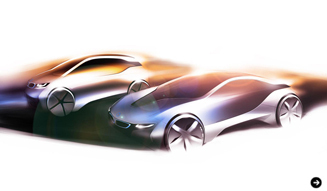
Illustrations of the electric vehicle "i3" and plug-in hybrid vehicle "i8," planned as the first lineup for BMW i.
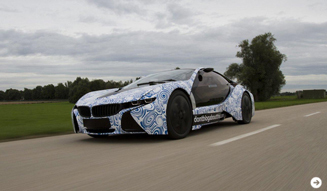
The concept car "Vision EfficientDynamics," which serves as the base for the i8.
WatanabeThe Ministry of Land, Infrastructure, Transport and Tourism is also considering a new vehicle class between mopeds and mini-vehicles. This could potentially be electric.
OgawaWhile perhaps not yet familiar in Japan, the question of egoism versus altruism is a challenge for smart homes, as discussed today. It's about how much responsibility one can bear within a community. To elaborate, a smart home has solar panels for power generation. Surplus electricity is stored in an EV. Furthermore, a community hub monitors each household's electricity consumption and surplus power in real-time using computers. If your home generates surplus electricity, you store it in your purchased EV. Would you be at peace if your neighbor used that electricity to run their air conditioner extensively? Would you feel like you lost out? Ideally, this is what a future society would look like, but can people afford to buy an EV for the sake of others?
ShimashitaDo you feel resistant to others using the electricity you've charged? I personally don't, but there are also strong voices of opposition. The traditional view of cars as personal property is deeply ingrained.
YamaguchiFundamentally, it's about buying and selling surplus electricity within the community, not just giving it away. Moreover, we may need to foster an awareness of mutual support, which is diminishing in modern communities.
*Note 1: An electric vehicle planned as the first model under BMW's sub-brand "BMW i." While BMW has not released specific details, it is said to have a maximum output of 150 ps and a top speed of 160 km/h. CFRP is used in various parts, and aluminum in the chassis for weight reduction. The battery is reportedly located under the floor, with a motor in the rear.
*Note 2: The "Governors' Association for Promoting the Development of Elderly-Friendly Automobiles," chaired by Governor Aso of Fukuoka Prefecture and comprising 35 prefectural governors nationwide, proposed in February a two-seater vehicle for the elderly, smaller than a mini-vehicle. It is said to have specifications such as a length of 2.3-2.8m, width of 1.3-1.4m, height of 1.5-1.6m, a top speed below 60 km/h, and a range of about 60 km.
Experts Discuss the Automotive World Post-3.11
Special Roundtable: Part 1 (3)
What Role Will Cars Play in a Renewable Energy Society?
Through Smart Grids, Cars Shift from Self-Interest to Altruism
WatanabeSmart grids will take time to become widespread, won't they? The technology for distributing electricity between homes doesn't exist in current power grids, so building that infrastructure alone will take time.
OgawaSmart meters, which monitor and control household electricity consumption, are essential, but their standardization is crucial. Replacing them in all households nationwide will take considerable time. Some predict it could take ten years for widespread adoption.
YamaguchiInstead of traditional large-scale power generation, small-scale, distributed generation from renewable energy is increasing and should increase in both the US and Europe. However, realizing this faces hurdles like the liberalization of electricity sales and vested interests.
WatanabeJapan prioritizes vested interests. And then there's public sentiment. Japanese people have a very strong sense of land ownership.
OgawaThere's also a strong sense of cars as property. Many people might say, 'I'd rather buy a gasoline car than charge my EV for someone else' (laughs).
YamaguchiAs I mentioned earlier, very few people truly understand smart grids. The idea that cars can become storage batteries, and that you can sell electricity generated at home from solar or wind power to your neighbors. That you can use what you need and sell what's left over. I believe that by deepening this understanding, a new sense of community will emerge.
ShimashitaThere seems to have been some counter-propaganda, discouraging understanding. Regional monopolies by power companies. Companies not buying electricity generated by individuals because it's not profitable for them. While there are many societal benefits, without profit, it's difficult. People generally aren't interested unless it directly benefits their lives. Feed-in tariffs are also progressing in Europe. Political leadership is indeed necessary.

WatanabeCurrently, even a 3kW home solar power system is quite substantial. However, charging a Leaf with it would take 8 hours at full operation. I believe smart grids will face many hardware challenges ahead.
ShimashitaRegarding cars, we must consider not only EVs but also other energy sources like hydrogen. That is, fuel cell vehicles (Note 4). It's unrealistic to assume all cars will be battery-powered.
WatanabeWe might also utilize liquefied natural gas or hydrogen, perhaps even methane hydrates. We need to think multi-dimensionally.
ShimashitaMany automakers are looking towards hydrogen.
*Note 3: A subsidy system that legally sets the purchase price for renewable energy, as part of efforts to secure energy sources and address environmental pollution.
*Note 4: Also known as FCV (Fuel Cell Vehicle). An electric vehicle that generates electricity using a hydrogen fuel cell to drive an electric motor.
Experts Discuss the Automotive World Post-3.11
Special Roundtable: Part 1 (4)
What Role Will Cars Play in a Renewable Energy Society?
The Relationship Between Power Supply and Automobiles
Yamaguchi: However, we cannot ignore the issue of nuclear power. In an extreme view, the widespread adoption of smart grids and the increase in EVs would reduce the risk of radiation. This would significantly alter the position of automobiles.
ShimashitaThat's certainly true. If something like smart grids were fully realized, the need for large-scale power generation at massive nuclear plants would disappear.
YamaguchiFor example,Porsche 918even if it's a plug-in hybrid capable of storing electricity, driving such a supercar could contribute to society.
WatanabeThe current Prius, even with a 2-3 kW battery system, can output about 1000W. The Estima Hybrid can output 1500W.
YamaguchiThe Estima Hybrid reportedly served as a household power source in disaster-stricken areas.
WatanabeToyota is reportedly considering enabling all its hybrid models to supply external power. They have the potential to power at least one household.
ShimashitaIf individuals can generate their own power with solar panels and store it in their plug-in hybrid vehicles, and thus cover their own electricity needs even during blackouts, this discussion can move forward.
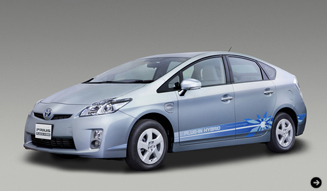
Toyota Prius Plug-in Hybrid.
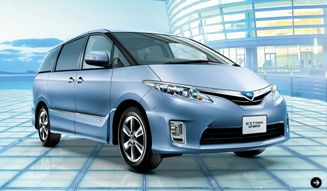
The Toyota Estima Hybrid, which proved very useful in the disaster-stricken areas of the Great East Japan Earthquake.
OgawaSmart grids may be important for breaking free from the control of oil-producing nations. Perhaps such factors were partly behind the original nuclear power policy. Crude oil prices will continue to rise. At the OPEC summit in June 2011, Saudi Arabia proposed increasing oil production, but many countries opposed it, leading to a split. Eventually, we may be forced into a society that cannot rely on gasoline. To that end, we must transition from a fossil fuel-dependent society to one that generates power through realistic and reliable methods like geothermal energy.
WatanabeFor the spread of smart grids, perhaps the old-fashioned sense of community is important. Overcoming the discomfort of borrowing electricity from a neighbor's home generation, much like borrowing soy sauce.
ShimashitaIf you and I agree, it would be great if my plug-in hybrid could power both our homes.
OgawaJapan couldn't develop nuclear power independently (laughs), but I hope engineers will make one last push to build a new low-carbon society.
WatanabeWhen millions of households are connected, IT's power will be unleashed.
ShimashitaCurrently, each power company operates as a regional monopoly. If we move entirely to localized production and consumption, who will guarantee stable supply?
YamaguchiIt's like the internet. Not a large-scale information network, but numerous small servers in various locations connected globally. Google's participation in smart meters is also due to their tens of thousands of servers. Concentrating servers in one location would cause them to fail during a blackout, but distributing them allows for risk management.
ShimashitaI see. I thought backup systems were necessary for places like hospitals where blackouts have a significant impact, but indeed, the internet already has such a structure in place through private enterprise.
Experts Discuss the Automotive World Post-3.11
Special Roundtable: Part 1 (5)
What Role Will Cars Play in a Renewable Energy Society?
Fuel Cells and Hydrogen: The Next Generation of Energy
OgawaEV technology is advancing rapidly. Lithium-ion batteries (Note 5) are finally emerging, but standardization is still lacking, and recycling issues remain unresolved. Yet, automakers' engineers are already discussing what batteries will come after lithium-ion. For instance, Toyota Motor Corporation suggests that air batteries (Note 6) might appear around 2018.
ShimashitaThere are magnesium-air batteries (Note 7), which could achieve an energy density ten times that of lithium-ion and are highly portable. More importantly, their resources are said to be inexhaustible. They are a type of fuel cell.
WatanabeIf the goal is to improve storage capacity, perhaps fuel cells are a better option.
ShimashitaTreating hydrogen as an energy storage medium, generating electricity when needed, and then using that electricity.
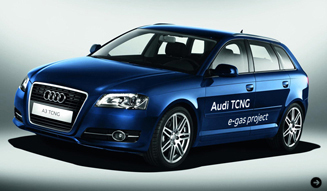
The hydrogen fuel cell vehicle "Audi A3 TCNG," scheduled for full-scale production from 2013.
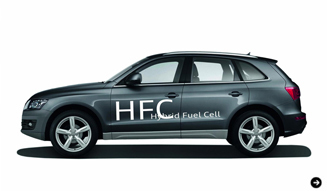
The Audi Q5 HFC, equipped with a fuel cell stack.
YamaguchiHousehold fuel cells, then?
WatanabeFor a typical household, during off-peak hours, 1-2 kW per hour should suffice with power conservation. They have that level of generation capacity.
ShimashitaPerhaps a major shift is coming for automobiles soon. Five years ago, a manufacturer told me, 'We'll break the 10 million yen mark for fuel cell vehicles by 2015.' At that time, the price was said to be 200 to 300 million yen. Now, they say, '10 million yen is no problem at all.'
WatanabeToyota has announced around 5 million yen by 2015.
YamaguchiWhat about infrastructure like hydrogen stations?
WatanabeThere are many vacant lots that were once gas stations, and if tanks can be buried underground, supply shouldn't be difficult. However, the image isn't great. With the recent nuclear accident, terms like 'hydrogen explosion' have surfaced, leading to a confused perception of hydrogen as dangerous.
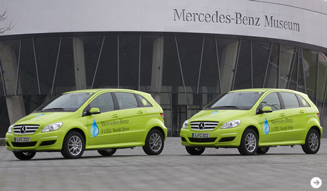
The fuel cell vehicle "Mercedes-Benz F-Cell," based on the B-Class.
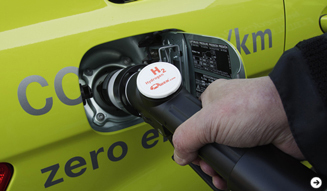
ShimashitaBut gasoline stations also store vast amounts of gasoline, and some argue that this is safer. Ultimately, the key is that it runs on electricity, and that's non-negotiable. Some people might think it's outrageous to drive an EV when there's a power shortage due to the nuclear accident.
YamaguchiThat's a simplistic argument. Peak electricity consumption is during the day, and there's surplus at night.
ShimashitaNuclear power plants are difficult to control, so they generate the same amount day and night. This leads to a surplus at night, and to sell it, they advertised charging EVs late at night for cheaper rates. But with hydrogen, you generate electricity to power the car, and the same applies to solar and wind power. In essence, EVs are not tied to nuclear policy; the key is powering cars with electricity generated from any source. The future is EVs for this reason. Some people will buy fuel cell vehicles, and when they return home, the car will connect to the house, providing power for the home. Others might generate electricity through solar power.
OgawaSo, the future isn't entirely bleak?
WatanabeEven if not for EV charging, the ability to supply 100W of power wirelessly when needed in an emergency will make communication and mutual support very important. It sounds old-fashioned, but it's a crucial keyword for the next-generation energy society.
ShimashitaIf such a society emerges, we can continue to drive gasoline cars.
*Note 4: Superior to NiCd and NiMH batteries in retaining charge energy, making them suitable for devices that require frequent charging (mobile phones, cars). They use a non-aqueous electrolyte, offering flexibility, such as usability in sub-zero temperatures.
*Note 5: In principle, it is possible to achieve the largest energy density among chemical batteries, allowing for greater capacity than lithium-ion batteries of the same volume. They are commonly known as button-type batteries used in hearing aids and watches.
*Note 6: A fuel cell that generates electricity by reacting magnesium and oxygen. Theoretically, it is said to perform about 7.5 times better than lithium-ion.

Fumio Ogawa
Worked for approximately 20 years at the editorial department of the car magazine "NAVI," which fused automobiles and culture, eventually becoming its editor-in-chief. He served as editor-in-chief for "Motor Magazine" and "Arigatto," and is now a freelance journalist. He writes for numerous magazines, including automotive publications like "ENGINE" (Shinchosha) and "EDGE" (Recruit), as well as covering a wide range of lifestyles such as gourmet ("Shukan Post"), hotels, and fashion.
Blog "Fumio Ogawa's Work": http://bluemeanie.cocolog-nifty.com/


Yasuhisa Shimashita
Motor journalist. His writing covers not only driving performance but also advanced environmental and safety technologies, brand theory, driving, and all social phenomena surrounding automobiles. He also gives lectures and works as an instructor on eco & safety driving. He was a judge for the 2010-2011 Car of the Year Japan. His recent publications include "Gokuraku Hybrid Car Driving Techniques" and "Gokuraku Gasoline Diet" (both published by Nigen-sha).
Blog "Blog Named Desire":
http://minkara.carview.co.jp/userid/362328/blog/

Toshihumi Watanabe
Born in Fukuoka Prefecture in 1967. After working in the editorial departments of motorcycle and car magazines at Kikaku Shitsu Neko (now Neko Publishing), he became a freelancer. His serialization "Car Nabe" in "Shukan Bunshun" is a popular read that vividly dissects societal trends and lifestyles through the lens of automobiles, appealing even to women. In addition to automotive magazines, he also writes for numerous general interest magazines such as "MEN'S EX" and "UOMO."