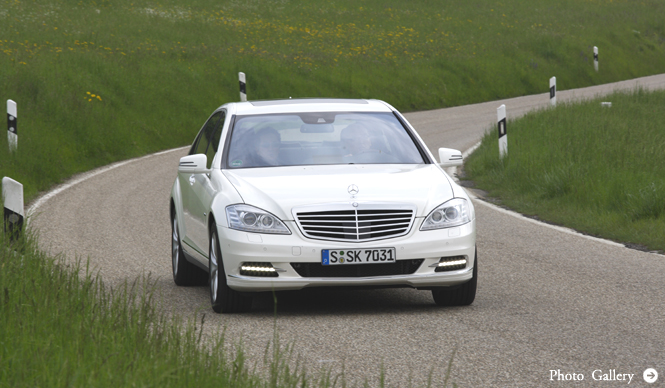
Mercedes-Benz S400 Hybrid | Mercedes-Benz S400 Hybrid (Part 2)
Mercedes-Benz S400 Hybrid (Part 2)
Driving Dynamics Befitting the S-Class Name
Hybrid cars are gaining increasing attention, with the Toyota Prius alone recording an unprecedented backlog of over 180,000 orders. Now, a new hybrid model has been released from a German premium brand.
What is the true value of the Mercedes-Benz S400 Hybrid, which debuted with a system different from Toyota's?
By Satoshi WatanabePhotos by Mercedes-Benz Japan
Smooth Idling Stop and Seamless Engine Start
The first thing that surprised me when I actually test-drove the Mercedes-Benz S400 Hybrid was the smooth idling stop and the extremely smooth engine start from it. The 12 years of Prius evolution clearly show that accumulated know-how in this area is crucial, and Mercedes' technical prowess in achieving such a high level of finish, especially in an upper-class vehicle where even the slightest vibration is an annoyance, is immediately apparent.
Unlike Toyota's system, the S400 Hybrid does not have an autonomous driving mode solely on electric power. The electric motor assists the engine's torque in the low-rpm range as soon as the engine starts. An ordinary person might not even realize it's a hybrid. However, the resulting acceleration is undeniably more powerful than a standard 3.5-liter engine, while maintaining the smoothness expected of a saloon in this class. Consequently, by being mindful of accelerator input, equivalent performance can be achieved with less pedal travel than in a conventional V6 model. When driven skillfully, it can provide a comfortable mobile space comparable to a V8 model.
A Rational Approach, True to German Engineering
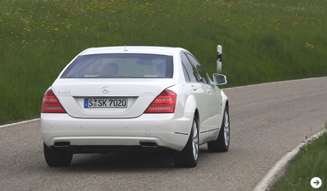
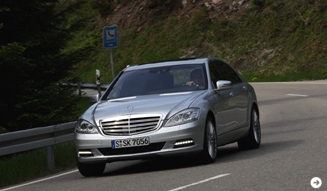
As the vehicle accelerates towards high speeds and high RPMs, the engine's workload increases. However, even in these conditions, the V6 engine in the S400 Hybrid performs beyond that of a conventional gasoline engine. In cruising conditions with minimal accelerator input, it switches to the Atkinson cycle, controlling valve timing to manage the expansion ratio in the combustion chamber, thereby achieving superior thermal efficiency compared to a standard V6 model.
In Toyota's hybrid system, the Atkinson cycle and motor assist work together almost continuously through a power split device. In contrast, the S400 Hybrid assigns tasks to each component based on its strengths. To put it crudely, this is the general concept.
While Toyota's approach, though complex, offers advantages such as superior regenerative efficiency. However, by compromising on certain aspects, they have achieved a simpler mechanism and a lower price point. This can be seen as a rational approach, very much in the German style.
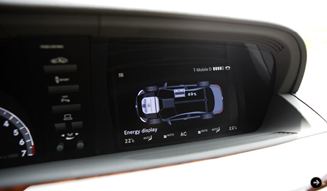
Priced Between the V6 and V8 Models
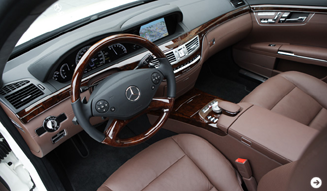
While there were moments of slight jerkiness in deliberately challenging situations, such as sudden restarts from a near standstill, the overall drivability is worthy of the S-Class name. Furthermore, fuel economy on the Autobahn and winding roads averaged around 10 km/liter, a performance that is certainly commendable considering the driving conditions.
In the European market, the S400 Hybrid is priced between the V6 and V8 models. If this pricing translates directly to the Japanese market, it would place it squarely in the ¥10-15 million range, directly competing with the LS600h. It will be interesting to see how the Japanese market, which holds the S-Class in high regard, responds.
MERCEDES CALL
0120-190-610