April 23, 2015
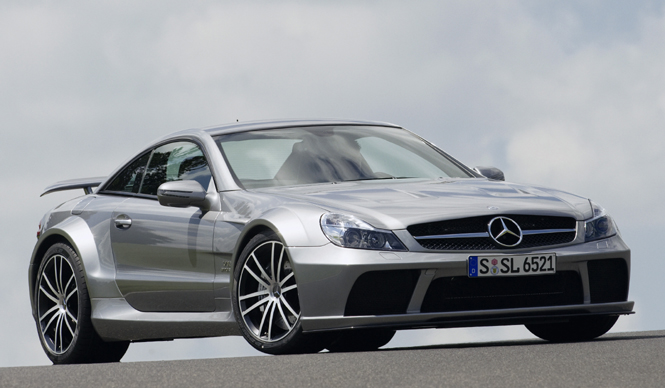
The "SL65 AMG Black Series," which debuted in July 2008, arrives in Japan.
Mercedes-Benz SL65 AMG
The SL65 AMG Black Series, Debuting July 2008, Arrives in Japan
A Special Among Specials
Mercedes-BenzOn November 4, 2008, Mercedes-Benz Japan launched the "Black Series," a special model of the high-performance sports car "SL65 AMG."
By Giraffe
Maximum Torque Limited to 102kgm by Limiter!?
The "Black Series" is the name given to special models developed by AMG Performance Studio. The SL65 AMG Black Series being released this time features significant enhancements in power and dynamic performance.
The engine, based on a 6-liter V12 producing 612 hp, has been upgraded with larger turbochargers and a more efficient intercooler, boosting the maximum output by 58 ps over the standard model to 670 ps. While maximum torque is electronically limited to 1000 Nm (102 kgm), it is available from 2200 rpm to 4200 rpm.
The chassis has also undergone thorough revisions, including a weight reduction of approximately 250 kg, an increase in front and rear track widths (97 mm front, 85 mm rear), upgraded brakes, and the adoption of adjustable sports suspension.
Performance data released in its home market in July 2008 indicated a 0-100 km/h acceleration time of 3.8 seconds and a top speed of 320 km/h.
Priced at ¥48.8 Million, Deliveries Begin Spring 2009
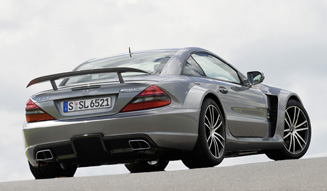
Visually, it features distinctive changes such as widely flared front and rear overfenders, a large carbon-fiber spoiler, and a fixed carbon-fiber roof. The tire sizes—265/35 R19 at the front and 325/30 R20 at the rear—give it a racing car-like presence.
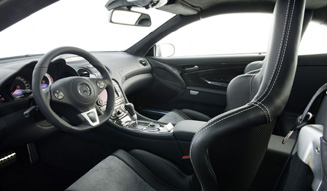
Complementing the extensively carbon-fiber-trimmed interior are sports seats also made of carbon fiber. The interior is unified with a sporty aesthetic, including a speedometer marked up to 360 km/h and a small, flat-bottomed steering wheel.
The price is ¥48.8 million, available only in left-hand drive. Deliveries are scheduled to begin in spring 2009, with 12 units planned for the Japanese market.
BRAND HISTORY
When tracing the history of automobiles, we arrive at two German pioneers: Gottlieb Daimler and Karl Benz. It goes without saying that these two men independently created gasoline-powered automobiles between 1885 and 1886, laying the foundation for our automotive society. Although their respective car companies were sometimes seen as rivals, they joined forces to overcome the post-World War I recession, leading to the establishment of Daimler-Benz AG through their merger in 1926.
The name "Mercedes" given to the products originated when Emil Jellinek, a customer of Daimler's, named the cars after his eldest daughter in exchange for taking over their distribution outside Germany. The name was trademarked by Daimler in 1902.
Thus born, Mercedes, and subsequently Mercedes-Benz, has consistently led the way in automotive development, actively introducing cutting-edge technologies such as the safety passenger cell, airbags, ESP (Electronic Stability Program), and Night View.