April 13, 2015
Mercedes-Benz SLR MCLAREN ROADSTER | Mercedes-Benz SLR McLaren Roadster
Mercedes-Benz SLR MCLAREN ROADSTER
Mercedes-Benz SLR McLaren Roadster
0-100km/h in 3.8 Seconds: A Super Sports Car
In the 1950s, the "300SLR" was known as a racing car born from the technology of the "300SL" and Formula 1. The "SLR McLaren" is the revival of that legend as a 21st-century road-going sports car.
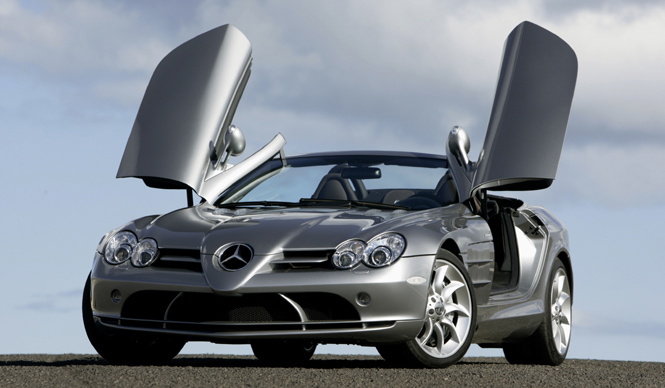
As the name suggests, this car is a super sports car jointly developed by McLaren of the UK, a partner in Formula 1, and Mercedes, and is produced in a factory in the UK. Like a Formula 1 machine, the body structure is made of a carbon monocoque, and the outer panels are also carbon. This achieves extremely high body rigidity while successfully reducing the vehicle weight to half that of a steel construction.
The engine is a 5.5-liter V8 supercharger specially developed by Mercedes-AMG, boasting a maximum output of 626 ps and a maximum torque of 780 Nm. It accelerates from 0 to 100 km/h in just 3.8 seconds and reaches a top speed of 334 km/h.
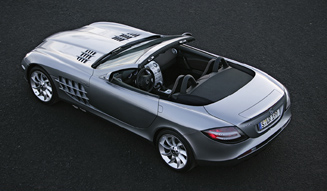
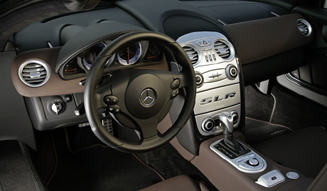
The coupe model was released in 2003, followed by the open-top "SLR McLaren Roadster" in 2007, as its successor. To achieve a sleek roofline and reduced weight comparable to the coupe, a canvas top is used. Operation is simple, involving locks above the windshield and a switch on the center console, with opening and closing taking only 10 seconds. While the 0-100 km/h time of 3.8 seconds is slightly slower than the coupe, it undoubtedly still boasts top-class acceleration.

Mercedes-Benz SLR McLaren Roadster
Body | Length 4675 x Width 1925 x Height 1295mm
Engine | 5.4-liter V8 Supercharger
Maximum Output | 460kW [626ps] / 6500rpm
Maximum Torque | 780Nm [79.5kgm] / 3250-5000rpm
Drivetrain | FR
Transmission | 5-speed Automatic
Price | 70 million yen
(As of May 26, 2008)
BRAND HISTORY
When tracing the history of automobiles, two German pioneers emerge: Gottlieb Daimler and Karl Benz. It is common knowledge that these two men independently created gasoline-powered automobiles between 1885 and 1886, laying the foundation for the automotive society. Although their respective automotive companies were sometimes seen as rivals, they joined forces to overcome the post-World War I recession, leading to the establishment of Daimler-Benz AG through a merger in 1926.
The name "Mercedes" given to the products originated when Emil Jellinek, a customer of Daimler's, named them after his eldest daughter in exchange for taking over sales outside of Germany. The trademark was registered by Daimler in 1902.
Thus, Mercedes and Mercedes-Benz have consistently led the way in automotive development, actively introducing the latest technologies such as the safety passenger cell, airbags, ESP (Electronic Stability Program), and Night View.