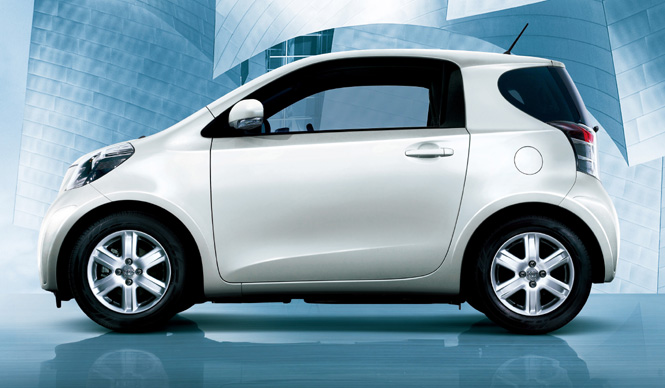
TOYOTA iQ | The 26th Installment (Part 2) | One of the Most Eco-Conscious Cars
The 26th: TOYOTA iQ (Part 2)
One of the Most Eco-Conscious Cars
In an era of "moving beyond oil" and "leaving oil behind," Toyota released the microcar iQ. How does this car, touted as a new generation of premium vehicle, perform?
By Yasushi ShimonоPhotos by Toyota Motor Corporation
Excellent Stability on the Highway
The engine tucked into its short nose is a 1-liter, 3-cylinder DOHC unit also found in the Vitz and Passo. The transmission is the familiar CVT. While there's a faint vibration characteristic of a 3-cylinder when stationary, the power is more than adequate. Quietness is also a focus, with features like a highly sound-insulating windshield.
The ride comfort surpasses that of the Smart. There's none of the choppy bouncing common in cars with short wheelbases. Despite its compact dimensions, the width is generous, contributing to stable handling. Its highway stability, including resistance to crosswinds, is superior to the rear-engined Smart. A U-turn on a narrow road revealed it could turn more sharply than the Smart, which was surprising.
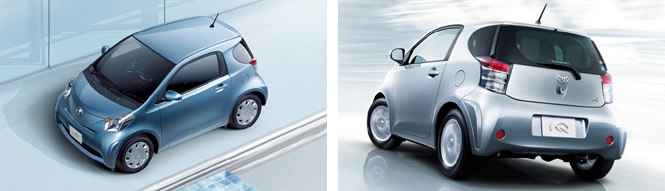
Body dimensions are 2985mm long, 1680mm wide, and 1500mm high. The 1-liter inline 3-cylinder DOHC engine produces a maximum output of 50kW (68ps) at 6000rpm and a maximum torque of 90Nm (9.2kgm) at 4800rpm.
CO2 Emissions Exceed the Prius
CO2 emissions, directly linked to fuel efficiency, are 99g/km. This means it emits an average of 99 grams of carbon dioxide per kilometer. This is an excellent figure, surpassing the Japanese-spec Smart and the hybrid Prius. After driving about 200 kilometers and measuring fuel consumption, it was just under 14km/liter. It can't compete with the Prius, but it's better than the Smart. Since it weighs about 100kg less than a 1000cc Vitz, its fuel economy should naturally be better. In any case, it is undoubtedly one of the most eco-conscious cars available.
My reason for sticking with the first-generation Smart wasn't just its size or fuel economy. While those are certainly major draws, they weren't the sole reasons. The biggest charm point was simply that it was "fun to drive." The original Cabrio was a true open-top two-seater. The current Brabus is a two-seater sports car. In that regard, I found the iQ a little lacking. But then again, it prioritizes "premium" over "fun-to-drive," so perhaps that's unavoidable.
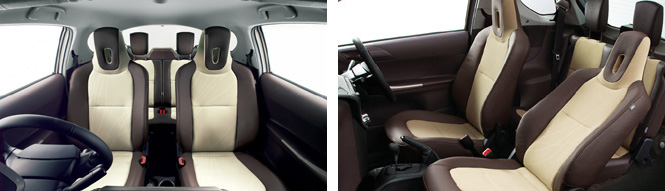
It achieves seating for four within a body less than 3 meters long. Safety features are also thorough, including nine airbags. Prices range from 1.4 million to 1.6 million yen.
One point that bothered me was the visibility, which isn't great despite its ultra-compact size. The waistline is high compared to recent cars, and the vertical dimension of the windows is narrow. The dashboard is also quite high, making the cabin feel less open. For this reason, I wish they would offer an open-top model like the Smart. A sophisticated high-performance variant might also be interesting. I'd like to support "fun-to-drive" over "premium."
Toyota Motor Corporation Customer Relations Center 0800-700-7700
http://toyota.jp