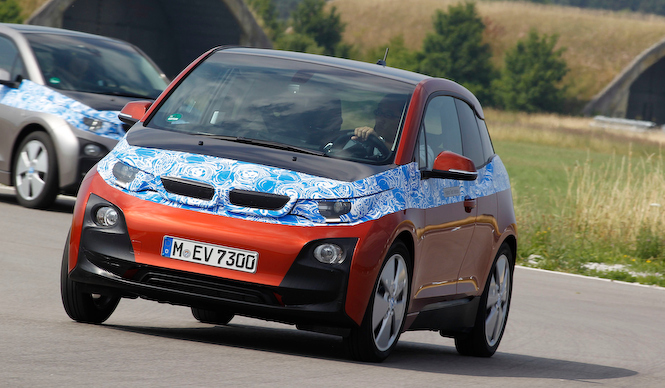
Test Drive of the BMW i3 Just Before Launch | BMW
BMW i3 | BMW i3
Test Drive: The BMW i3, Just Before Launch
BMWBMW has unveiled its long-awaited sub-brand, "i." Leading the charge is the compact "i3." On July 30th, a global announcement connected New York, London, and Beijing online,Global Launchand in September,Frankfurt Motor Showit wasFirst Public Revealpublicly revealed for the first time. Ahead of the delivery of the i3 production model, Toshifumi Watanabe, who had previously witnessed its production firsthand at BMW's Leipzig plant,Witnessed Production at the Leipzig Planthas finally test-driven the prototype. He reports feeling BMW's ambition, which extends beyond the typical "city commuter EV" framework.
Text by WATANABE Toshifumi
The "i" Strategy: More Than Just Building Cars
BMW has launched "i" as a new brand for next-generation sustainable mobility and driving pleasure. The first model in this initiative,the "i3," had its overview announced at the end of July.This announcement wasn't just about the physical existence of an electric commuter; it was also the core of a grand concept that encompasses integration with IT and infrastructure development.
For a pure EV, the most pressing concern is range. The EU-measured range of 130-160 km, as announced, is largely in line with initial expectations. However, the drive modes include two stages of Eco Pro mode for managing driving efficiency. Through integrated control, including air conditioning, the system can extend the range by approximately 20 km by maximizing power consumption efficiency.
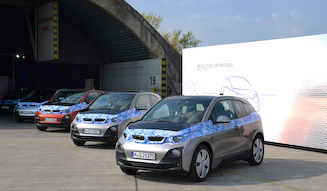
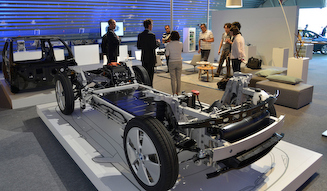
Furthermore, for users requiring extended range for continuous long-distance travel, an optional 650cc two-cylinder engine, used in BMW's motorcycles, can be fitted. This engine functions purely as a generator to supply power to the battery, extending the range to 300 km as a range-extended EV.
Charging time is approximately 6 hours for a standard charge using a 20V household power source, and 30 minutes for an 80% charge using a Combo DC fast charging standard. For the Japanese market, the CHAdeMO standard for DC fast charging with equivalent capability is expected to be adopted. The battery unit in the i3 uses Samsung lithium cells, assembled in-house with liquid cooling, and power management is handled by proprietary software, highlighting a high degree of in-house production. The battery unit weighs between 230-250 kg. While the battery capacity has not been announced, based on these specifications, it is likely around 20 kWh.
Including these components, the vehicle's weight is kept to 1,195 kg according to EU measurements. This is more than 20% lighter than comparable EVs with similar ranges, a figure that underscores the advanced nature of the i3, which is largely constructed from carbon and aluminum materials.
BMW i3 | BMW i3
Test Drive: The BMW i3, Just Before Launch (2)
The Unique Characteristics of EV Driving Enhance the Fun
At the prototype test drive event held prior to this announcement, the i3 clearly demonstrated itself not just as an advanced EV, but as a compact car that proposes a new way to enjoy driving.
Its most unique feature is the character setting that actively utilizes regenerative braking as a driving factor. The deceleration G-force experienced simply by lifting off the accelerator is so strong that it sometimes activates the brake lights.
Once accustomed to this driving feel, it becomes possible to stop the car using only the accelerator pedal without touching the brake, and to manage weight transfer during corner approaches. By intentionally leveraging this characteristic, which would normally be eliminated as a peculiarity, BMW has enhanced regenerative efficiency while simultaneously elevating the driving experience.
The Dedicated Tires Show Their Serious Intent
The unique aspects of the i3's mechanics extend beyond its body structure.
Based on a new vehicle concept, the tires play a crucial role. To reduce air and rolling resistance, and to function as a buffer in collisions, the car is equipped with unusually large yet narrow tires for its class. The size, 155/70R19, is not a standard off-the-shelf size and is a custom product developed jointly with Bridgestone.
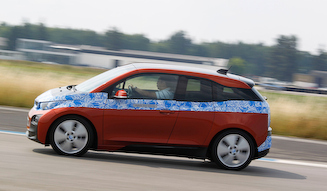
It was highly intriguing to see how these tires would handle the power equivalent to 170ps and the substantial torque delivered from a standstill. Given the large footprint, while front and rear grip seemed adequate, there were concerns about lateral load capacity.—However, the conclusion is that these concerns were unfounded.
BMW i3 | BMW i3
Test Drive: The BMW i3, Just Before Launch (3)
Now a Sports Compact
BMW, with its extensive experience in tire technology, including pioneering the standardization of run-flat tires, effectively leveraged Bridgestone's expertise. They tuned the casing rigidity and sidewalls of these motorcycle-like tires to withstand high loads.
Additionally, the low center of gravity, inherent to EVs with batteries integrated into the floor, and the i3's lightweight design contribute significantly.
Although the test track was marked with cones, the course was quite demanding for a prototype, involving acceleration to nearly 130 km/h followed by hard braking and turn-in. The performance in these conditions was not only stable and agile but also so enjoyable that it felt more like a sports compact than a mere commuter.
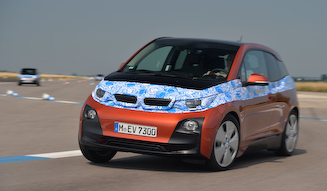
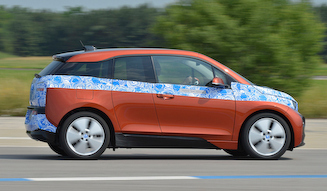
Beyond its EV capabilities, the appeal of the i3 is not limited to its driving dynamics. The interior and exterior design, which feels refreshingly modern and departs from current trends, is likely to captivate many.
The i3 was conceived with the highly public concept of a "Mega City Vehicle" for intra-city mobility in large urban areas. However, it shows no intention of blending in as just another component of society. Both visually and in terms of driving experience, the i3 offers a world entirely different from conventional compact cars. Its introduction to Japan is scheduled for next spring, and anticipation for the market's reaction is high.

BMW i3 | BMW i3
Body Dimensions | Length 3,999 x Width 1,775 x Height 1,578mm
Wheelbase | 2,570 mm
Minimum Ground Clearance | 140 mm
Minimum Turning Radius | 4.93 meters
Trunk Capacity | 260-1,100 liters
Weight | 1,195 kg (1,315 kg)
Maximum Output | 125 kW (170 ps)
Maximum Torque | 250 Nm
Drivetrain | RR
Tires | 155/70R19 (Front 155/70R19 Rear 175/65R19)
0-100km/h Acceleration | 7.2 seconds (7.9 seconds)
Maximum Speed | 150 km/h
*Specifications are for the production model