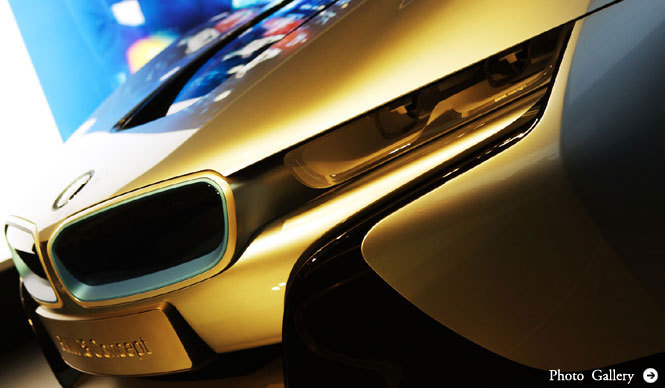
BMW i3 & i8 Arrive in Japan | BMW
BMW i3 | BMW i3
BMW i8 | BMW i8
Two Futuristic Mobility Concepts Arrive in Japan! (1)
Text by Fumio OgawaPhotos by Masayuki Arakawa
Cleaner, More Power
Let's briefly explain BMW i. For BMW, it forms a third pillar alongside "M," which focuses on performance, as a sub-brand. The core of BMW i is described as "futuristic mobility." The drivetrain shifts from internal combustion engines (gasoline or diesel) to plug-in hybrids or electric motors.
"BMW Japan plans to launch models aiming for high fuel efficiency in 2012, such as the diesel engine model of the X5 and the 5 Series Hybrid. By newly developing BMW i, we can further strengthen our product policy based on the 'Cleaner, More Power' concept we are currently pursuing," explained a spokesperson.
BMW i3 | BMW i3
BMW i8 | BMW i8
Two Futuristic Mobility Concepts Arrive in Japan! (2)
The Plug-in Hybrid 'i8' Balances Acceleration and Economy
Of the two models announced this time, the i8 is developed based on the concept of a plug-in hybrid sports car. A 2-door body measuring 4,632mm long, 1,955mm wide, and 1,280mm high sits on a relatively long wheelbase of 2,800mm. The hybrid system is also reflected in the drive system: a 96kW electric motor drives the front wheels, while a 1.5-liter 3-cylinder gasoline turbo engine drives the rear wheels, with a total system output announced at 260kW. A benefit of this system is its ability to switch between front-wheel drive, rear-wheel drive, and all-wheel drive depending on driving conditions.
The i8, advertised as "the best of both worlds," achieves 0-100 km/h acceleration in under 5 seconds, despite being a 4-seater, while also offering remarkable fuel economy of 33.3 km per liter (EU mode). This is the result of adapting the "eDrive" hybrid system, already introduced in Japan with models like the X6, and combining it with an electric drive system. The range on electric power alone is approximately 35 km.
Embodying the Next Premium: The Blue Color
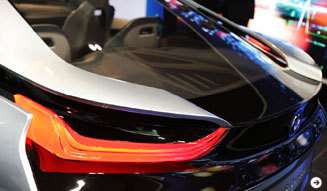
BMW describes it as "the birth of the most advanced and innovative sports car of our time." The styling is also bold, with a visual characteristic being the "stream flow" lines that, along with blue accents, form a flowing line towards the rear.
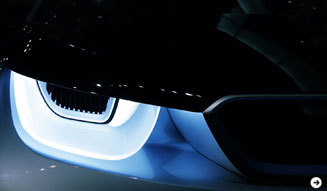
Blue is the key color for BMW i, used on the badge on the front hood and the kidney grille. BMW explains, "(The use of blue) embodies the 'next premium.' The color blue serves two functions. It is a color that signifies a connection to the traditional BMW badge, and it is also the familiar color associated with concepts like EfficientDynamics, Clean Drive System, and Zero Emissions."
Incidentally, the i8 also appears in the latest installment of the "Mission: Impossible" series, "Ghost Protocol," starring Tom Cruise. Internal information suggests that the production version will have a styling not significantly different from this concept model.
BMW i3 | BMW i3
BMW i8 | BMW i8
Two Futuristic Mobility Concepts Arrive in Japan! (3)
The Compact Pure EV 'i3' for Urban Mobility
The i3 is an electric vehicle (EV) concept with a development philosophy centered on urban mobility. It features a chassis with a 2,570mm wheelbase, and its 4-door hatchback body measures 3,845mm long, 1,766mm wide, and 1,537mm high. Propulsion comes from a 125kW electric motor mounted on the rear axle.
"Unlike internal combustion engines where torque increases with engine speed, electric motors deliver maximum torque from a standstill. Therefore, the BMW i3 concept is extremely agile and offers overwhelming acceleration. The 0-60 km/h acceleration time for the BMW i3 concept is under 4 seconds, and 0-100 km/h is under 8 seconds," states BMW.
By mounting the electric motor at the rear, BMW maintains its commitment to rear-wheel drive, emphasizing "light and agile driving characteristics" as a key feature.
The accelerator pedal serves both acceleration and deceleration functions. When the driver lifts their foot off the pedal, the electric motor acts as a generator, converting kinetic energy into electrical current through a regenerative system, which simultaneously provides a braking effect. "In urban driving, approximately 75 percent of all deceleration can be performed without ever touching the brake pedal," says BMW.
Optional Range Extender Capability
Another unique aspect of the i3 is the option to include a range extender version with an internal combustion engine to charge the battery. "An optional gasoline engine will be available, catering to users who require longer driving ranges." explained the spokesperson who flew in from Germany for the press conference in Tokyo. However, the number of cylinders and displacement of the engine "cannot be announced at this stage."
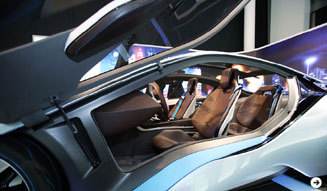
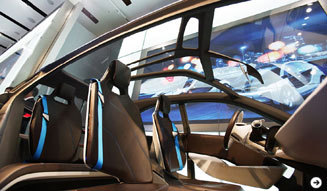
The interior is spacious, aided by the use of thinly designed front and rear seats.
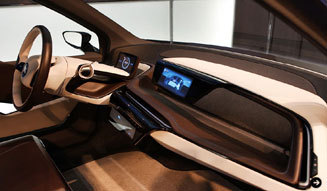
The use of a bench-type seat in the seating area allows "passengers to slide across and exit from the safe side in crowded urban areas. This is also an important function for a city commuter," says Daniel Storke, head of interior design.
Adoption of 'LifeDrive' Body Structure Divided into Two Modules
Another significant feature of both BMW i models is the body structure named "LifeDrive." This is the practical implementation of a bold concept: dividing the car into two major modules – the "Life" module for the occupants and the "Drive" module encompassing the drivetrain and chassis.
The "Life" module is made of lightweight yet rigid CFRP (carbon fiber) and is designed according to the car's concept. Since the i3 is a city commuter, it has a high roofline for comfortable seating for four people. In contrast, the i8, being a sporty GT, has a deliberately snug shape with legs extended forward. Both allow for a much more purposeful design than a monocoque structure.
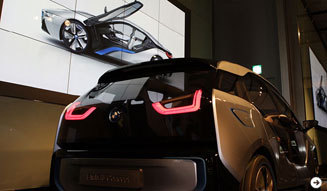
While many electric and hybrid vehicles are conversions of existing internal combustion engine cars, the "conversion concept leads to increased weight due to necessary modifications. However, the LifeDrive concept avoids this. Simultaneously, for both models, we have been able to completely offset the added weight from the electric motor through innovative use of materials and intelligent lightweight design," says Bernhard Dressler, head of body equipment for Project i.
Another goal of BMW i is the development of sustainable production systems, which can also be described as minimizing the environmental impact of the manufacturing process. Specifically, values per car are calculated based on criteria such as energy consumption, water consumption, wastewater discharge, solvent emissions, and landfill waste generation. The BMW Group also monitors CO2 emissions associated with energy consumption. The stated goal is to "reduce resource consumption and emissions per production vehicle by 30 percent by 2012 compared to 2006 levels." It is added that "we plan to exceed this even further in the production of the BMW i series."