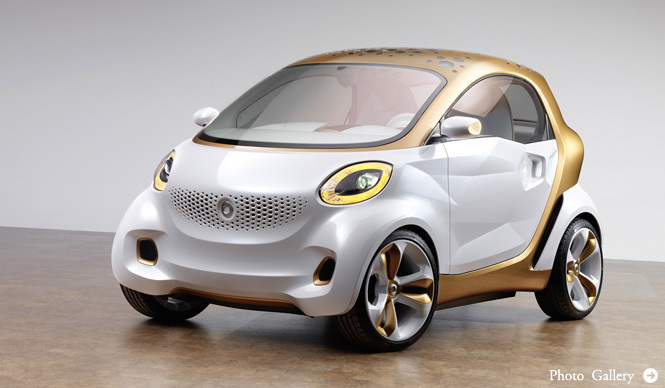
smart Forvision EX concept | The ultra-lightweight EV smart
smart Forvision EV concept| The Smart Forvision EV Concept
Introducing the "Smart Forvision EV Concept," Presenting the Future of Electric Vehicles
German automaker Daimler will unveil the "smart Forvision EV concept," a concept car touted to present the future of electric vehicles, at the upcoming Frankfurt Motor Show.
By Ryoko Koike
Looking Towards the Future of Electric Mobility
Annette Winkler, head of smart, stated, "The smart Forvision is a new electric vehicle that proposes a sustainable way of mobility in urban environments. To extend its range, we have completely re-examined the base model, the smart fortwo."
This time, smart collaborated with BASF, the world's largest chemical company headquartered in Germany, to develop the smart Forvision. The concept model has been finished with a focus on improving energy efficiency and lightweight design, as well as thorough research into thermal management.
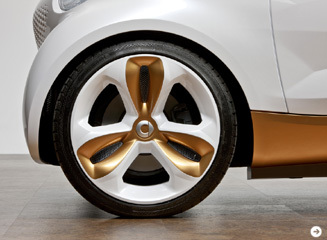
Thanks to the provision of high-performance materials from BASF, the world's first mass-produced all-resin wheels have become possible, achieving a weight reduction of 3 kg per wheel.
Furthermore, resin containing carbon fiber is used for the tridion safety cell and doors. This achieves a weight reduction of approximately 50 percent compared to conventional materials, and about 30 percent compared to aluminum.
A New Trend, Futuristic Design
While the exterior retains the smart image, it features a futuristic design. The pearl white and bronze metallic paint contains aluminum flakes and is finished with a scratch-resistant coating. The side doors, with their three-dimensional contours, ensure strength while allowing for a thinner manufacturing process than before. The rear combination lamps, like those on the latestMERCEDES-BENZconcept models, are designed to evoke the image of aircraft turbines.
One of the notable features of the smart Forvision is the transparent hexagon arranged on the roof. In fact, these "hexagons" are all solar cells, and the power generated can be used to drive the multimedia components and air conditioning.
The interior matches the exterior color scheme, with the cabin entirely covered in pearl white, accented with bronze in various places. The steering wheel, reminiscent of an aircraft's control stick, is also quite striking.
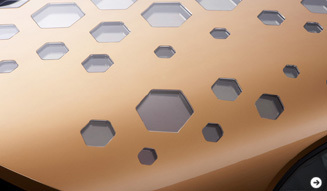
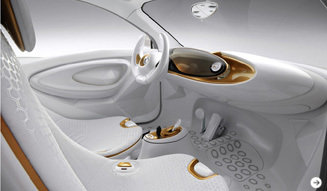
Beneath these solar cells are OLEDs (Organic Light-Emitting Diodes). They illuminate the cabin when the doors are opened or a switch is activated, and also provide pleasant ambient lighting at night. The OLEDs allow for color selection and consume about half the power of conventional lighting.
Since the cabin's heating and cooling systems require significant energy, improving the efficiency of interior temperature control was a key development focus. Based on research indicating that the human body can only absorb heat in limited areas, the seats are equipped with "e-textile," a heat-conductive coating material. By directing warm air directly to the occupant's back, it creates a feeling of warmth. This material is also used on the armrests, warming the parts of the body that come into contact with them in cold weather.
Furthermore, the front and side windows feature "heat shields" that reflect infrared rays, preventing the cabin temperature from rising. These shields react only to infrared rays and do not affect radio waves from GPS, Bluetooth, mobile phones, or ETC.
Through such weight reduction and improved temperature management efficiency, the driving range, a major challenge for EVs, has been improved by approximately 20 percent compared to conventional models. If commercialized, its playful smart design and thorough energy efficiency would make it an ideal model for urban mobility.
It has not yet been announced whether this smart EV will feature Vehicle-to-Home (V2H) functionality, which supplies household power from the battery's stored electricity. However, as OPENERS, we will be keeping a close eye on these features as indicative of a new era for EVs.