Monitor Report | Kaori Nakano (Fashion Historian, Project Professor at Meiji University) _ Vol. 1
Truefitt & Hill: A Monitor Report
Kaori Nakano (Fashion Historian, Meiji University Professor) _ Vol. 1
Aromatic Explorations: '1805' and 'TRAFALGAR'
Introduction
Emile Yamano, whose aristocratic business acumen allowed him to introduce "Santa Maria Novella" to Japan, was initially drawn in by his passion for classic cars. His next venture? Shaving goods and eau de cologne from "Truefitt & Hill," the world's oldest barbershop.
The proper noun "Truefitt" appeared in the original works of Thackeray and Dickens. It wasn't listed in the academic dictionaries relied upon by English literature scholars, leaving me to believe that grasping the full scope of 19th-century gentlemanly culture was beyond my reach. Ah, so Truefitt was this very barbershop!
To have the fog of years lift was moving enough, but to be granted the unexpected opportunity to report on all seven fragrances from this brand, making its debut in Japan, was truly a gift. After a meticulous presentation by Nina Yamano, Emile's daughter, and Marketing Manager Koki Nojima, and as we sampled the scents, the monochrome and sepia-toned world of gentlemen began to bloom into vibrant color. Each of the seven fragrances seemed to revive the spirits of past gentlemen for the modern era. The dandies of old, whose impressions were strongly associated with the scent of dust and old book mold (!), must have worn fragrances as fine as these... my imagination (or perhaps delusion?) takes flight.
Below, I report on a portion of the gentlemanly world that unfolded in my mind, thanks to the olfactory influence of "Truefitt & Hill."
Text and Photography by Kaori Nakano
1805
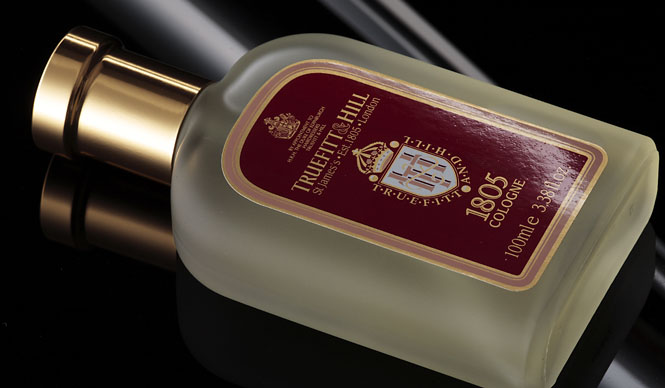
Upon application, a refreshing bergamot aroma emerges, followed by the subtly sweet notes of clean sage and lavender, finally settling into a quiet, lingering base of sandalwood and a hint of musk. It evokes the timeless image of "The Gentleman"—clean, restrained, and capable of transforming trustworthiness into sexy allure. I found myself wishing for a man who would suit such a fragrance to escort me to a party attended by the pillars of politics and economics. It's no surprise, then, that this is the brand's signature fragrance.
The year 1805 marks the opening of "Truefitt & Hill" on Long Acre in London's Mayfair district. The establishment has since moved through several locations, including Old Bond Street, New Bond Street, and Burlington Arcade. St. James's Street, its current home, remains a veritable mecca for gentlemen, and "Truefitt & Hill" is apparently one of the "Magnificent Seven" venerable establishments (the other six include John Lobb for shoes, Lock & Co. Hatters, and Robert Lewis for cigars).
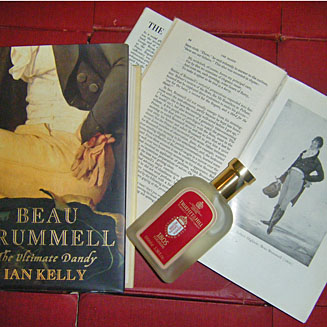
The year 1805 was shortly after the French Revolution, a time when the aesthetic standards of Western men's fashion began to shift. It was the dawn of British dandyism. Replacing the pre-revolutionary aesthetic of displaying wealth through gold and silver embroidery and ostentatious luxury, a new sensibility emerged: understated wealth was hinted at through immaculately clean linen shirts and neckcloths, maintained at considerable cleaning expense. This fragrance allows us to glimpse the ideal man of an era when such critical thinking underpinned a nascent "new gentlemanly standard" of cleanliness and restrained beauty. Add the scent of the finest champagne used for boot polishing, and the image of "Beau Brummell's scent" is complete.
TRAFALGAR
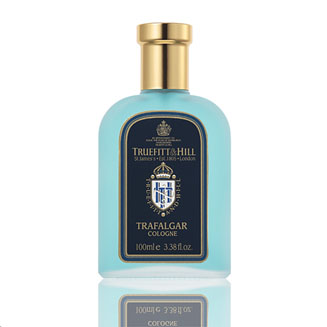
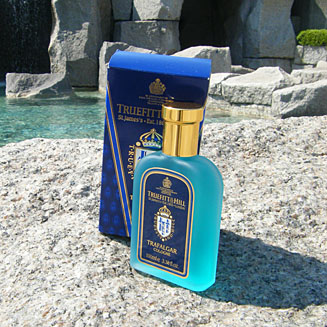
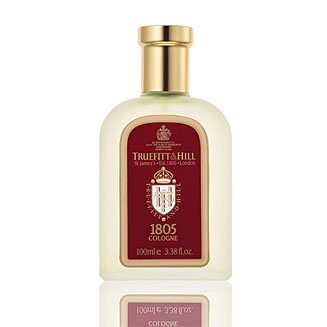
A single spray conjures the image of the sea before me. Not just a blue ocean, but an azure expanse. Perhaps it's the effect of jasmine with its spicy citrus notes. Eventually, a gentle sandalwood remains. I envisioned a man of encompassing warmth, bold and fearless, as if drawing one into his embrace. It's a scent that feels perfectly wearable for women, and in fact, it was the one I used most myself during the monitoring period. I believe it offers an understated yet resolute elegance, ideal for when one needs to be in work mode.
The maritime imagery makes sense, I realized, upon learning that this fragrance was created to commemorate the Battle of Trafalgar (1805). Admiral Horatio Nelson, who achieved a dramatic victory by intercepting the Franco-Spanish fleet off Cape Trafalgar, might well have suited such a scent. Admiral Nelson was a man who, at the outset of battle, did not issue detailed, complex orders to his soldiers but simply sent a single, clear message via signal flag.
“England expects that every man will do his duty”
“England expects that every man will do his duty.”
On the eve of a crucial battle, not a word of detailed instruction, just this powerful message of expectation and trust, delivered with impact. Could any subordinate fail to be inspired? The thought of the effect of these words from a commander during a moment of intense pre-battle tension sends shivers down my spine. He stood tall on the flagship 'Victory,' adorned with four medals on his chest (making him an easy target!), and led his forces to victory at the cost of his own life. While his affair with Emma Hamilton, a married woman, is also famous, he seems to have embodied an ideal of the British gentleman.
This fragrance, linked to Admiral Nelson, gives one the illusion of being powerfully supported in those critical moments when one must fulfill one's duty with gentlemanly resolve (whether male or female).