March 27, 2015
SEIKO | Galante "Astro Boy" Limited Edition
SEIKO
A Fighting Atom's Expression Powers Up Your Spirit!
While high-end sports watches for adults are released by various brands, SEIKO's "Galante" collection, launched in 2005, is one of the most unique.
Text by Yasuto Shibuya
SEIKO GALANTE Mighty Atom Limited Model
SEIKO GALANTE "Mighty Atom" Limited Model
With the concept of "SEXY RICH," it features SEIKO's proprietary Spring Drive movement and pursues impactful designs with structures, color schemes, and materials not found in existing models. Its unforgettable style has earned strong support from playful, adult men.
This year's new release is a collaboration model with Osamu Tezuka's "Mighty Atom," a cornerstone of Japanese animation beloved worldwide, and a cherished childhood memory for many adult men.
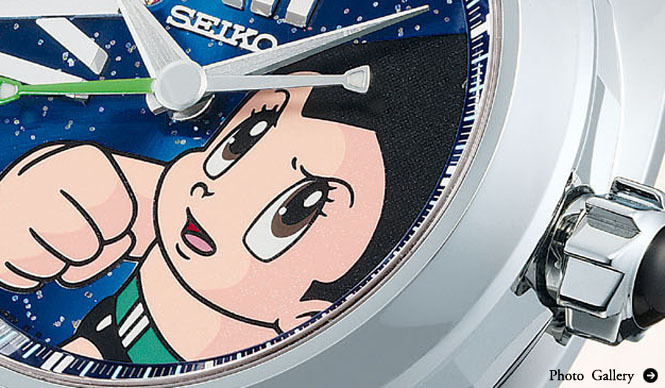
The dial features a newly drawn illustration, supervised by Tezuka Productions, of Atom in a fighting pose against a shimmering blue cosmic background. The crocodile strap is also unified in the same cosmic blue as the dial.
Furthermore, the movement is mechanical, emitting a ticking sound for the first time in the Galante line, with its balance wheel, the heart of the watch, visible through an opening at the 10 o'clock position on the dial. The see-through case back also features a red print of Atom's "heart," symbolizing his passionate spirit despite being a robot. The special box even includes the phrase "Let's go! Galante." This is a "Japanese artistic wristwatch" that we highly recommend to adult men who appreciate such playful craftsmanship.
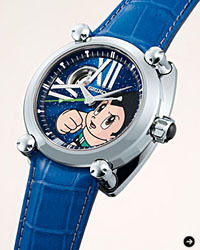
SEIKO GALANTE Mighty Atom Limited Model
SEIKO GALANTE "Mighty Atom" Limited Model
Automatic Winding
Stainless Steel Case & Crocodile Strap
Case Diameter 45mm
See-through Back
Price | ¥472,500
BRAND HISTORY
The history of SEIKO, a leading watch brand in Japan, began in 1881 when founder Kintaro Hattori established Hattori Clock Shop in Ginza, Tokyo (then Kyo-bashi Ward, Umanomachi). In addition to selling and repairing watches, the company actively imported foreign timepieces, steadily growing its business.
In 1892, he established the "Seikosha" watch manufacturing factory, realizing his long-held dream of producing his own products. In 1895, the first in-house manufactured pocket watch, the "Timekeeper," was born, followed by Japan's first wristwatch, the "Laurel," in 1913. From 1924, the brand name "SEIKO" began to appear in Roman letters on watch dials.
After the war, SEIKO began to consider a full-scale global expansion, aiming to catch up with and surpass Swiss watchmaking. With a slogan emphasizing high precision and quality, the company worked to upgrade its products. This relentless development led to the birth of Grand Seiko, SEIKO's highest-end product, in 1960. The company established a strict 15-day quality standard within the company, comparable to the "Chronometer" certification standards set by official Swiss organizations at the time, to ensure high precision.
Since then, SEIKO has continued to implement rigorous inspection standards known as the "GS standard," maintaining thorough quality control to this day. Around the same time, SEIKO began participating in the "Neuchâtel Observatory Competition" and the "Geneva Observatory Competition" in Switzerland, achieving excellent results and surprising the Swiss watch industry.
In 1964, SEIKO was the official timekeeper for the Tokyo Olympics. The need for even greater precision and portability during this period led to research and development that ultimately resulted in the creation of the world's first quartz wristwatch, the "Quartz Astron."
This model was launched in 1969. It triggered the major movement known as the "Quartz Crisis" in the Swiss watch world. Even after establishing its global position, SEIKO has continued to explore various groundbreaking approaches for both mechanical and quartz movements. In 1974, it launched "Credor," its highest-grade luxury watch brand.
Furthermore, in 1999, SEIKO released "Spring Drive," a third type of drive system that combines the advantages of mechanical and quartz movements. In 2004, Spring Drive was also incorporated into Grand Seiko, SEIKO's flagship line, once again demonstrating its advanced technological capabilities to overseas competitors.
Founded: 1881
Founded in: Tokyo, Kyobashi Ward, Japan
Main Series: Grand Seiko, Credor, SEIKO Galante
Inquiries: SEIKO Watch Customer Service Center 0120-061-012
Official Website: http://www.seiko-watch.co.jp/