March 27, 2015
OMEGA | De Ville Hour Vision
OMEGA
A New Perspective on the "Microcosm of Mechanics"
By Yasuto Shibuya
De Ville Hour Vision
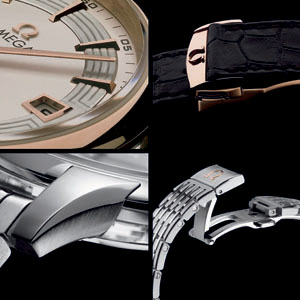
The De Ville Hour Vision, true to its name—an "hour's vision"—is a timepiece that allows one to appreciate the workings of its new-generation automatic movement, equipped with the Co-Axial escapement, not only through the case back but also from the sides of the case.
This year, a new limited edition model has been released, further enhancing the enjoyment of "telling time" offered by this elegantly simple yet captivating watch, first introduced in 2007.
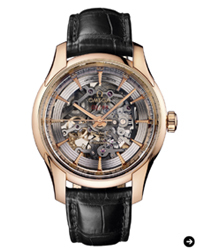
The dial boldly embraces a see-through design, leaving only the indices and the ring that holds them. The movement itself has also been modified for visual appeal, with the mainplate extensively skeletonized and treated with a grey galvanic finish, while the gears and other components are coated in red gold.
Furthermore, the automatic winding rotor, visible through the see-through case back, features a sapphire crystal insert in its center, allowing a view of the mechanism beneath. This is likely a world-first.
For those who wish to fully immerse themselves in the "microcosm of mechanics" that is the movement, there is no more fitting model.
Automatic winding, red gold case, alligator strap, 41mm case diameter, limited to 88 pieces worldwide, ¥3,801,000 (estimated retail price), scheduled for December release.
BRAND HISTORY
A brand with one of the highest recognitions in the Swiss watchmaking industry. Its roots trace back to a small workshop opened in La Chaux-de-Fonds, Switzerland, in 1848 by watchmaker Louis Brandt.
Initially specializing in assembly, the workshop soon pioneered a sales strategy targeting all of Europe and America. As the business steadily grew, it was renamed "Louis Brandt & Fils" in 1877.
In the 1880s, the company relocated its headquarters to Bienne, where it remains today, establishing a manufacture factory for complete in-house watch production. The "Labrador" movement, boasting the highest precision standards of the time, also emerged from this factory.
Later, the "Caliber 19" (commonly known as the Omega caliber), developed during the era of "Louis Brandt & Frère" which was renamed in 1890, led to the adoption of "Ω = Omega," the Greek letter signifying the ultimate, as the company name in the early 20th century.
Since its first official timekeeping at the Olympic Games in Los Angeles in 1932, Omega has been a global presence, responsible for timing numerous international sporting events. In the realm of wristwatches, the "Speedmaster" was selected as official NASA equipment in 1965 after enduring rigorous testing, and in 1970, the "Seamaster" was used in the "Janus Project" deep-sea exploration for a 250m depth experiment, marking a series of significant achievements.
Having steadily increased its devoted clientele, Omega did not rest on its laurels but continued to pursue the perfection of its own products.
In 1999, Omega succeeded in the mass production of the Co-Axial Escapement, invented by watchmaker George Daniels, once again proving its technological prowess to the watchmaking world. Since the 21st century, this escapement has been incorporated into a succession of new models. Furthermore, in 2007, Omega unveiled its first new in-house movement in 30 years, demonstrating an unceasing drive for development.
Founding Year: 1848
Place of Founding: La Chaux-de-Fonds, Switzerland
Main Series: Speedmaster, Seamaster, De Ville, Constellation
Inquiries: Swatch Group Japan Omega Customer Center 03-5952-4400
Official Website: http://www.omegawatches.jp/