March 27, 2015
OMEGA | Speedmaster Professional Apollo-Soyuz 35th Anniversary Limited Edition
OMEGA
A Rare Gift from Space Adorns the Dial
By Yasuto Shibuya
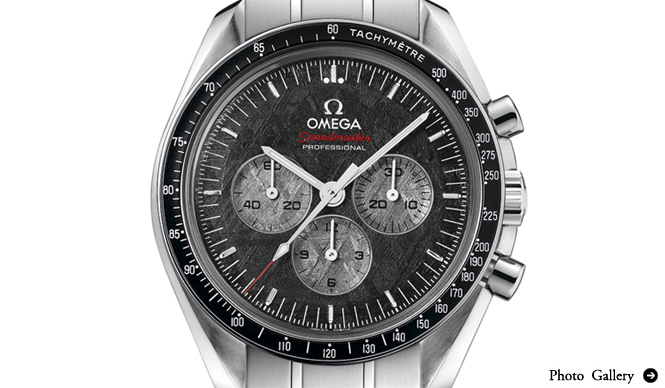
Speedmaster Professional Apollo-Soyuz "35th Anniversary"
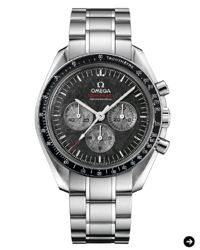
Speedmaster Professional Apollo-Soyuz 35th Anniversary Limited Edition
The Speedmaster Professional was adopted as the official equipment for America's space program in 1965 after passing NASA's rigorous tests. On July 20, 1969, it marked a step on the lunar surface with the Apollo 11 crew, becoming the "Moon Watch." Limited editions of this historically significant timepiece, favored by active astronauts, are presented to collectors almost every year at Baselworld.
This year's 2010 limited edition commemorates the historic rendezvous and docking in Earth orbit on July 17, 1975, between Apollo 18 and the Soviet spacecraft Soyuz 19, which symbolized the easing of East-West tensions. The dial features a thinly sliced meteorite, a gift from space to Earth. The unique crystalline patterns of the meteorite, revealed through special processing, add further depth to the watch's narrative, inviting the owner on a journey to the stars.
The case back is engraved with a depiction of the Apollo-Soyuz spacecraft docking and the names of the five American and Soviet crew members. Manual winding, stainless steel case and bracelet, 42mm case diameter, 50m water resistance, presented in a special box. Limited to 1,975 pieces worldwide, priced at ¥850,500, with a planned release in July.
BRAND HISTORY
A brand with one of the highest recognitions in the Swiss watchmaking industry. Its roots trace back to a small workshop opened in La Chaux-de-Fonds, Switzerland, in 1848 by watchmaker Louis Brandt.
Initially, the workshop specialized in assembly. As time passed, it pioneered a sales strategy targeting both Europe and America. The company steadily grew, and in 1877, it was renamed "Louis Brandt & Fils."
In the 1880s, the company relocated its headquarters to Bienne, where it remains today, establishing a manufacture factory for complete in-house watch production. The "Labrador" movement, boasting the highest precision standards of the 1880s, was born in this factory.
Later, the "Caliber 19" (commonly known as the Omega caliber), developed during the era of "Louis Brandt & Frère" which was renamed in 1890, led to the adoption of "Ω = Omega," the Greek letter representing the ultimate, as the company name in the early 20th century.
Omega began its global journey in 1932 by serving as the official timekeeper for the Olympic Games in Los Angeles, and has since continued to time major sporting events worldwide. In timekeeping for wristwatches, the "Speedmaster" was selected as official NASA equipment in 1965 after enduring rigorous testing among numerous chronographs. In 1970, the "Seamaster" was used in the deep-sea exploration "Janus Project" for a 250-meter depth experiment, marking a series of remarkable achievements.
Omega steadily gained a loyal following, but without resting on its laurels, it continued to pursue the perfection of its in-house products.
In 1999, Omega succeeded in the mass production of the Co-Axial Escapement, invented by watchmaker George Daniels, once again proving its advanced technical capabilities to the watchmaking world. Since the 21st century, the Co-Axial Escapement has been progressively incorporated into new models. Furthermore, in 2007, Omega unveiled a new in-house movement after a 30-year hiatus, demonstrating an unceasing drive for development.
Founding Year: 1848
Place of Founding: La Chaux-de-Fonds, Switzerland
Main Series Names: Speedmaster, Seamaster, De Ville, Constellation
Inquiries: Swatch Group Japan Omega Customer Center 03-5952-4400
Official Website: http://www.omegawatches.jp/