March 27, 2015
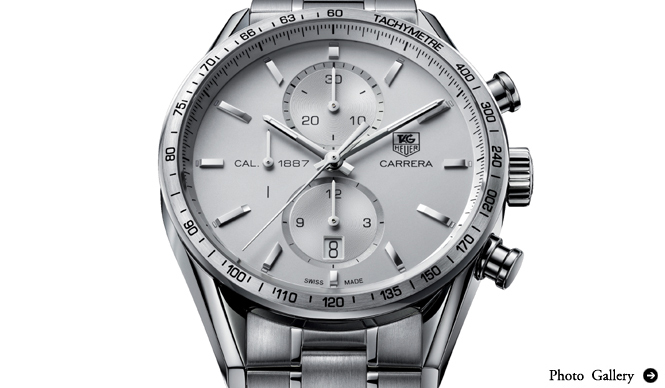
TAG Heuer | Carrera 1887 Chronograph
TAG Heuer
Where Cutting-Edge Technology Meets Brand Heritage
A New Standard in Mechanical Chronographs
By Yasuto Shibuya
Carrera Calibre 1887 Chronograph
The latest Carrera Chronograph is powered by TAG Heuer’s “Calibre 1887,” developed to embody the ideal modern chronograph movement in every aspect—from its construction and price to its ease of manufacturing and maintenance. Despite a price under 400,000 yen (tax included) for the stainless steel case and bracelet model, it features a column wheel mechanism, typically found in high-end chronographs, for smooth and reliable operation. This epoch-making new model shatters the limits of previous mechanical chronographs in terms of accuracy, reliability, and cost performance, establishing a new benchmark.
The name “1887” given to the movement originates from the year TAG Heuer invented the “vibrating pinion,” a clutch mechanism that operates the chronograph, which has been refined and adopted in this model. It’s also a pleasing detail for us in Japan that intellectual property developed by SII in Japan in the 1990s has been incorporated and utilized in various aspects. Undoubtedly, this is one of the most value-for-money mechanical chronographs available today.
TAG Heuer CARRERA 1887 Chronograph
Automatic winding
Case diameter: 41mm
Case: Stainless steel case
Water resistance: 100m
Price: ¥399,000
BRAND HISTORY
TAG Heuer is a brand that has been actively involved in sports since its inception, particularly supporting the evolution of motorization, earning respect from many athletes, including racers.
Its predecessor, Heuer, was founded in 1860 in Saint-Imier, Switzerland, by Edward Heuer, who was only 20 years old at the time. The company quickly distinguished itself, obtaining a patent for a key-wound pocket watch in 1868 and exhibiting a split-seconds chronograph at the Paris Exposition Universelle in 1889, where it received a silver medal.
In 1916, it unveiled the “Micrograph,” a masterpiece stopwatch still talked about today. With this groundbreaking measuring instrument capable of measuring to 1/100th of a second, Heuer became globally recognized as an indispensable brand in the world of sports.
Indeed, in recognition of this achievement, the company was appointed as the official timekeeper for three Olympic Games, starting with the Antwerp Games in 1920.
Although the company had already introduced the “Time of Trip,” a dashboard clock for automobiles, in 1911, its deep involvement with motorsports continued.
In 1964, it launched a chronograph named after the legendary road race “Carrera,” which was favored by many racers at the time.
Then, in 1969, it introduced the “Monaco,” equipped with the world's first automatic chronograph movement. It is also well-known for being personally and professionally favored by Hollywood star Steve McQueen, its image forever etched in the minds of race fans worldwide through the classic film "Le Mans."
Following the quartz crisis of the 1970s, which affected many other brands, Heuer faced a period of financial difficulty. However, in 1985, it made a remarkable comeback with investment from the TAG Group, which also owned the F1 McLaren team, and was renamed the current TAG Heuer.
The brand deepened its ties with motorsports even further and actively promoted its image by appointing ambassadors such as Tiger Woods, Maria Sharapova, Brad Pitt, and Uma Thurman. In terms of mechanics, it has garnered significant attention with the unveiling of the “V4” prototype in 2004, which utilized timing belts and ingots, and in 2005, the automatic chronograph “Calibre 360,” capable of measuring to 1/100th of a second—a first for a wristwatch.
Founded: 1860
Place of Founding: Saint-Imier, Switzerland
Main Series: Grand Carrera, Carrera, Link, Monaco, New Aquaracer, Formula 1
Inquiries: LVMH Watch & Jewelry Japan, TAG Heuer Division, 03-3613-3951
Official Website: http://www.tagheuer.com/