March 31, 2015
ROLEX | Oyster Perpetual Date GMT-Master II
ROLEX
OYSTER PERPETUAL DATE GMT-MASTER II
Text by OPENERS
The "GMT-Master II" was born in 1983 as the successor to the "GMT-Master," Rolex's first aviation watch, which was released in 1954.
The original GMT-Master's most distinctive feature was the addition of a 24-hour hand that completed one rotation in 24 hours, in addition to the basic three hands displaying hours, minutes, and seconds. Furthermore, equipped with a rotating bezel, it could display the time in other time zones (a second time zone). It was highly praised by professional pilots, being certified as the official watch of Pan American World Airways in the 1960s.
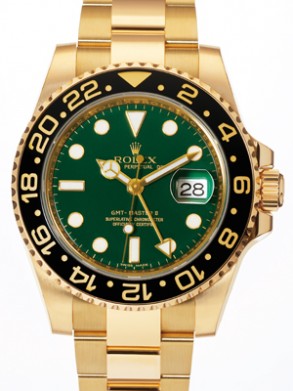
18K yellow gold model with a green dial, priced at ¥2,940,000.
The GMT-Master II also incorporated functions that allowed the hour hand to be moved independently by operating the crown, establishing the fundamental functions of a GMT watch ahead of its competitors. Incidentally, the "GMT-Master" ceased production in the latter half of the 1990s.
Since then, the GMT-Master II has garnered support from many users, including business travelers who frequently go abroad. In 2005, a new model equipped with a scratch-resistant ceramic bezel was introduced. The lineup ranges from stainless steel models with black dials to an 18K yellow gold model with a green dial (left in the photo, priced at ¥2,940,000), offering a wide selection.
ROLEX OYSTER PERPETUAL DATE GMT MASTER II |
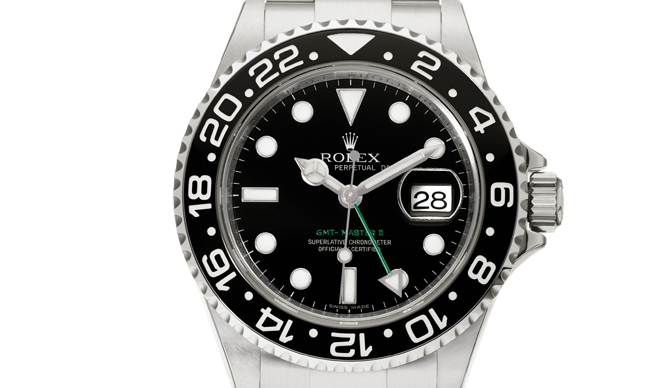
ROLEX OYSTER PERPETUAL DATE GMT MASTER II (top photo)
Self-winding
28,800 vibrations per hour
Case diameter 40.0mm
Stainless steel case & bracelet
Water resistant to 100m
Price | ¥714,000
BRAND HISTORY
Founded in the early 20th century, when wristwatches were still a nascent invention, Rolex has walked alongside them for over 100 years, achieving remarkable advancements.
The history of Rolex began in 1905 with the establishment of "Wilsdorf and Davis," the precursor to the brand, in London, England. The founder, Hans Wilsdorf, was a visionary entrepreneur who recognized the potential of wristwatches in an era when pocket watches were still the norm. By 1907, he had already moved the company's operational functions to Switzerland to begin serious watch manufacturing. The following year, he conceived the brand name "ROLEX" and registered it as a trademark.
In 1910, Rolex obtained the official certificate of chronometer accuracy from a public accuracy inspection, a first for a wristwatch, attesting to the high precision of its products. In 1926, it invented the "Oyster" case, featuring a hermetically sealed, dustproof structure, overcoming the vulnerability of wristwatches to water and dust.
Subsequently, Rolex developed the "Perpetual" self-winding system, which uses the rotation of a rotor to wind the mainspring, and the "Datejust," which features a digital display at the 3 o'clock position that automatically changes the date at midnight. The role Rolex has played in the evolution of the wristwatch is immense.
In the 1950s, the product line diversified, with watches designed for professionals undertaking specialized missions, such as the "Submariner," the first diving watch in history, and the "Explorer," a wristwatch for adventurers. The development of watches designed for extreme conditions also enhanced the reliability of Rolex products for general users.
This spirit of ambitious development continues today. In 2000, Rolex achieved in-house production of chronographs. In 2007, it unveiled next-generation models of the anti-magnetic watch "Milgauss" and a new chronograph for regattas. While consistently at the center of attention in the watchmaking world, Rolex continues to steadily produce practical timepieces.
Founding Year: 1905
Place of Founding: London, England
Main Series Names: Oyster Perpetual, Cellini
Contact: Rolex Japan Public Relations - 03-3216-5671
Official Website: http://www.rolex.com/ja/