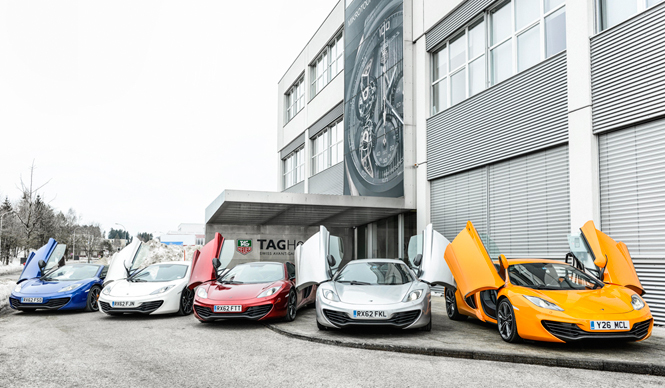
TAG Heuer × McLaren | A Visit to TAG Heuer's Hometown
Driving Through Switzerland in the McLaren MP4-12C Spider
A Visit to TAG Heuer's Homeland (Part 1)
Known as a watch brand with deep ties to motorsports, TAG Heuer. This time, motor journalist Tatsuya Otani takes the latest model from McLaren, a partner of TAG Heuer, the "MP4-12C Spider" to head to La Chaux-de-Fonds, home of TAG Heuer's factory. In search of the essence of watchmaking in the homeland of TAG Heuer.
Text & Photographs by OTANI Tatsuya
TAG Heuer: Deeply Connected to Motorsports
I was invited to tour the TAG Heuer factory in a McLaren MP4-12C supercar, and I gladly accepted.
To be upfront, my profession is as a writer reporting on automotive topics, and I'm not a watch expert. However, as fans will know, TAG Heuer's connection to automobiles is exceptionally strong.
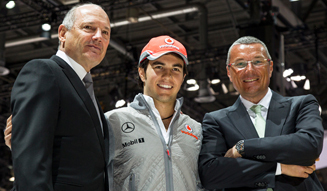
TAG Heuer partners with McLaren. Pictured from left to right are McLaren Chairman Ron Dennis, F1 driver Sergio Perez, and TAG Heuer President and CEO Jean-Christophe Babin.
For example, in the 1970 film "Le Mans," star Steve McQueen wore a TAG Heuer (then Heuer) "Monaco" wristwatch, and from 1971 to 1979, when Heuer sponsored the F1 team "Scuderia Ferrari", the Heuer logo was displayed on the "prancing horse" emblem.
Later, in 1985, the company name was changed to the current TAG Heuer following an investment by the TAG Group, which also owned the McLaren F1 team. From 1992 to 2003, TAG Heuer served as the official timekeeper for the F1 Grand Prix.
Thus, TAG Heuer has strong ties not so much with automobiles as with motorsports. The partnership with McLaren, now in its 28th year, continues, and this "Let's Go to TAG Heuer in a McLaren!" tour was conceived out of the deep friendship between the two companies.
While staying in Geneva, Switzerland, I boarded the "McLaren MP4-12C Spider," an expensive open-top car with a list price of 30 million yen, and headed for the TAG Heuer factory in La Chaux-de-Fonds, approximately 140 km away.
As this is a report on watches, I won't go into detail about the car. However, for those planning to visit Switzerland, please be aware that this country's highways are heavily monitored by speed cameras (so-called "Orbis"). There were cameras placed roughly every 5 kilometers.
Incidentally, the speed limit on Swiss highways is 120 km/h. Driving the MP4-12C Spider, with its top speed of 329 km/h, felt incredibly slow, almost as if standing still. But patience was key. It took me about two hours to leisurely reach my destination.
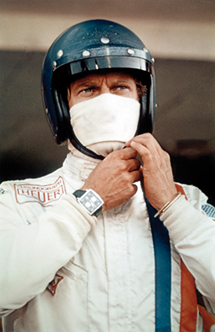
Steve McQueen, star of the film "Le Mans," wearing the TAG Heuer (then Heuer) "Monaco" wristwatch.
Driving Through Switzerland in the McLaren MP4-12C Spider
A Visit to TAG Heuer's Homeland (Part 2)
A Lineup of Past Masterpieces
TAG Heuer's factory in La Chaux-de-Fonds was surprisingly compact for a watch manufacturer that ranks as the fourth largest in the world. However, this was merely my own preconception, perhaps influenced by the vast scale of automobile factories. Watches are inherently small, and they also possess a substantial factory in Cornol, near the French border in Switzerland's Jura region. Therefore, as an outsider, I had no need to worry about it being "small."
Nevertheless, once inside the building, I was utterly captivated.
First, we were guided to the "TAG Heuer 360 Museum," opened in 2008. In the dimly lit interior, numerous showcases gleamed like stars in a night sky, displaying a stunning collection of TAG Heuer's historical masterpieces.
The highlight among these was undoubtedly the actual Monaco used by McQueen in the film "Le Mans." As fans know, McQueen owned several Monaco watches, one of which was used as a spare during filming.
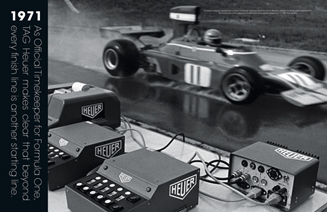
In 1971,FerrariTAG Heuer served as the official timekeeper for the F1 team.
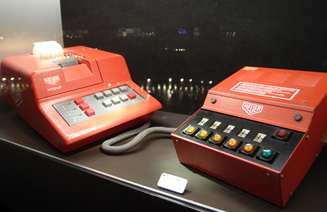
The digital watch "Le Mans Centigraph" on the left is also on display in the museum.
This spare reportedly fetched $799,500 at auction last August (approximately 63 million yen at the exchange rate of 78.7 yen to the dollar at the time), causing quite a stir. However, the watch displayed here is not the spare but the one actually used in the film. Its value is undoubtedly beyond imagination.
Other notable pieces included the "Hervue and Autavia," created in 1950 for car and aircraft dashboards, and the "Monte-Carlo Master Time," a watch for rally car competitions made in 1960. My eyes were drawn to these numerous timepieces that played a role in motorsports.
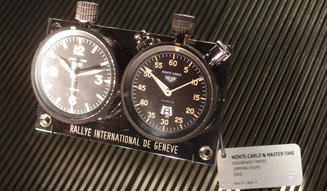
The "Monte-Carlo Master Time," a watch for rally car competitions produced in 1960.

The actual "Monaco" used by Steve McQueen in the film.
TAG Heuer, which achieved an accuracy of 1/100th of a second with mechanical stopwatches around 100 years ago in 1916, was also an early pioneer in the development of electronic stopwatches. This museum also features the "Microtimer" from 1966, the world's first compact electronic watch capable of measuring to 1/1000th of a second, and the "Le Mans Centigraph" from the 1970s, which Ferrari used in F1 testing.
Driving Through Switzerland in the McLaren MP4-12C Spider
A Visit to TAG Heuer's Homeland (Part 3)
Inside the TAG Heuer Factory
Next, we finally stepped inside the watch factory. To enter, we had to wear white coats, similar to those worn by university researchers. This measure is to prevent dust from visitors' clothing from contaminating the clean environment.
Here, the assembly of the "Calibre 1887" movement, used in the Carrera, was taking place. The scene was, in some ways, exactly as I had imagined, and in other ways, completely contrary to my expectations.
To begin with the "as imagined" aspect: the sight of technicians meticulously assembling minuscule components, almost invisible to the naked eye, was precisely what I had envisioned for a watch factory.


On the other hand, what "surpassed my imagination" was how surprisingly modern the equipment supporting the technicians' manual work was. For instance, in the section handling delicate components, a special CCD camera captured images of the workbench, and assembly was performed while viewing these images on a monitor.

Furthermore, the assembly process is sequential, with movements being passed from one workstation to the next. The operation of the state-of-the-art conveyor belt was remarkably precise and fascinating. This conveyor belt is installed "underground" relative to the workstations, but when a technician is working, the movement surfaces from below, and once the work is complete, it submerges back down to move to the next station.
The process closely resembled the control room of a spaceship in a science fiction movie, where necessary instruments and levers appear only when needed and retract beneath the desk when not in use. It gave a distinctly futuristic impression.
Driving Through Switzerland in the McLaren MP4-12C Spider
A Visit to TAG Heuer's Homeland (Part 4)
Beating 28,800 Times Per Hour
The Calibre 1887, produced through this process, is known for its oscillation of 28,800 vibrations per hour. During the assembly, there was a stage where the mechanical sound emitted by the movement was electronically processed to measure any discrepancies.
According to the technician in charge, the daily rate must be within 2 to 8 seconds. Upon hearing this, one of the tour participants immediately removed his watch and handed it to the technician, saying, "Then, please measure my [watch model]!"
The technician, having no choice but to accept, placed the watch on the testing device. To his surprise, the daily rate was 21 seconds – an error that would be considered outside the specifications for the Calibre 1887. It was understandable that the participant was disappointed upon learning the result.
However, the accuracy of mechanical watches can vary depending on maintenance and condition. This result was truly unexpected.

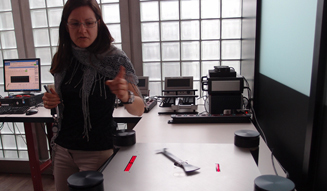
The tour continued to the quality assurance department, where we saw special watches synchronized with GPS signals that serve as the time standard in the factory. What struck me most was the pride and dedication of the company, which has been devoted to improving watch accuracy since its founding in 1860.
As the tour concluded, I had the opportunity to examine the new Carrera up close. I couldn't help but sigh at the exquisite finish of its face, case, and bracelet, while also contemplating the precision of the movement beating 28,800 times per hour within.
TAG Heuer Concierge
Tel. 03-3613-3921
http://www.tagheuer.co.jp