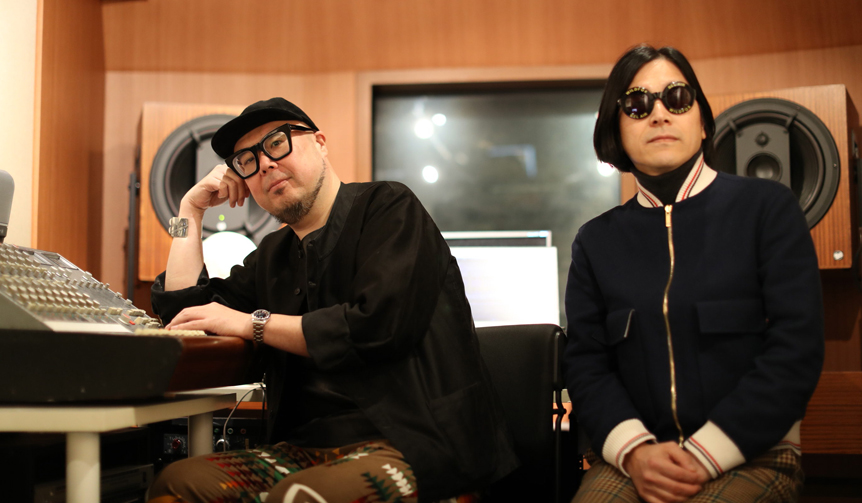
Tomoki Sukezane & Editor Daimao Talk | Vol. 36 Tomoyuki Tanaka of FPM (Part 2)
Page. 1
Previous、Previous PreviousContinuing from the previous and the one before that, we welcome Tomoyuki Tanaka of FPM—Fantastic Plastic Machine—as our guest for this conversation with Editor Daimao. We delved into a wide range of topics, from the origin of the name FPM to his current album production and his cherished vintage collection. This exclusive content, available nowhere else, is a must-read.
Interview by SUKEZANE TomokiPhotographs by MAEDA AkiraText by ANDO Sara (OPENERS)
Relocating to Japan after 9/11, he found fame across Asia
YUMA Tomoki (hereinafter, Yuma)How did you come up with the name FPM?
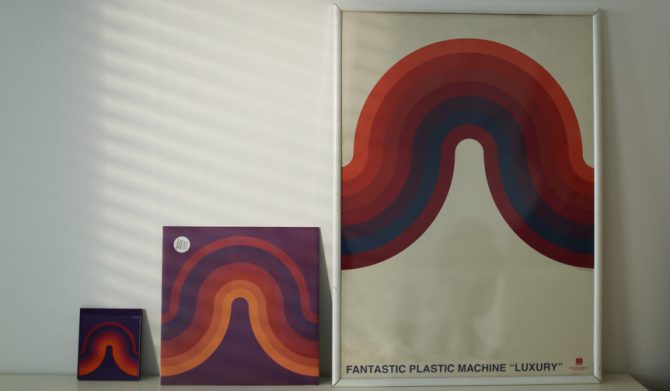
TANAKA Tomoyuki (hereinafter, Tanaka)In '94, when I started making demos, the three of us—Mr. Konishi from Pizzicato Five, music producer Mr. Sakaguchi, and myself—released three compilation albums on Sony. We simultaneously released a compilation of movie soundtracks, a compilation of Burt Bacharach covers, and a Christmas song compilation. Around that time, I had the soundtrack to the filmBurt Bacharach※1of Burt Bacharach covers, and a Christmas song compilation. Around that time, I had the soundtrack to the filmThe Fantastic Plastic Machine※2The Fantastic Plastic Machine. The music was fantastic, so we were discussing putting it on the album when Mr. Konishi said, 'It would be great if there was a band called Fantastic Plastic Machine,' and I agreed, 'Yes, that would be nice.' Then, when I started making music, I just borrowed that name. I never thought I'd debut, so I didn't give it much thought.
YumaTo get back to the topic, was 2001 a turning point for Japanese music spreading globally?
TanakaSpeaking just for myself, I feel it was. The lounge movement, so to speak, had reached its peak and started to wind down. After that, I shifted my base of operations to Japan and Asian countries, moved to Avex, and parted ways with lounge music. When I released the albumbeautiful.※3focusing on funk, disco, and Philadelphia soul, it became a hit in Asia.
YumaAt that point, why did you turn your attention to Asia rather than Japan?
TanakaIt was by chance. As I started creating different music, DJ requests from Asia increased. Amidst this, I was invited to DJ in Seoul, South Korea. I wasn't told much about where or how I'd be DJing, and I figured there couldn't possibly be anyone in Korea who knew me. I thought I'd be taken to some small club. But when I arrived, it was at a hotel. I thought, 'Do I check in here first?' Then I was led to a ballroom at the back, and I figured, 'Ah, I must be the opening act for some big event.' They said, 'We'll have you for an hour and a half,' and I went on stage. When the curtain rose, there were about 3,000 to 4,000 people. Even then, I thought they must be fans of someone else. As I started DJing and glanced behind me, my album cover was displayed prominently, and that's when I realized everyone there was my audience (laughs).
YumaSo you were already popular in Korea?
TanakaIt was because I had releases in North America and Europe. Due to the conscription system in Korea, many people seem to study abroad. Kids who bought my records in North America or Europe while studying there brought them back to Korea, and they became popular. Before the Korean Wave boom in Japan, there was a boom for Japanese DJs in Korea. At the peak of my popularity, I even had three security guards accompanying me during visits to Korea (laughs).Conscription system※4because of the conscription system in Korea, many people seem to study abroad. Kids who bought my records in North America or Europe while studying there brought them back to Korea, and they became popular. Before the Korean Wave boom in Japan, there was a boom for Japanese DJs in Korea. At the peak of my popularity, I even had three security guards accompanying me during visits to Korea (laughs).
YumaThat's incredible (laughs)! What kind of music resonated with audiences in Asia? Was it different from the music you played in NY?
TanakaTimes had changed since I was frequently touring the US and Europe, and my own mood had shifted, so I had moved more towards four-on-the-floor house and techno, which are more DJ-oriented. However, what was popular in Korea seemed to be music with melody and harmony, different from the dance music that was popular in Europe. Perhaps it was popular because it was made by Japanese artists. Before long, with the advent of EDM, the tables turned between Korea and Japan. Around the time I was popular in Korea, I performed at a major festival with VERBAL as FPM-flo.VERBAL※5I performed at a major festival with VERBAL as FPM-flo. Before our set, there were only about five or six people in front of the stage for the preceding act, so I was worried, but as soon as we started, people began to gather, and eventually, about 10,000 people showed up, which was a relief. After our set, a newly debuted group came on stage.BIGBANG※6BIGBANG. At that time, we were more popular than them. I feel like I witnessed that transition period in both Korea and Japan.
Page02.Finding joy in writing after turning fifty
1 Burt Bacharach
(Burt Bacharach/1928-) is an American composer, music producer, and singer-songwriter. He has consistently remained at the forefront of popular music as a composer, known for creating numerous timeless masterpieces.
2 The Fantastic Plastic Machine
The Fantastic Plastic Machine is a 1969 surf documentary film. It showcases the origins of legends like Skip Frye, Nat Young, Bob McTavish, and Miki Munoz, revered as historical shapers and revolutionary surfers. Fantastic Plastic Machine is also the name of a surfboard model.
3 "beautiful."
Beautiful. is the third album released in January 2001 by Tomoyuki Tanaka's solo project FPM (Fantastic Plastic Machine).
4 Conscription system
Conscription is a system where the state imposes military service obligations on citizens of a certain age, compelling them to enlist in the armed forces. It is the opposite of a voluntary enlistment (recruitment) system.
5 VERBAL
VERBAL is a Japanese MC/DJ/music producer/designer. He is a member of m-flo, TERIYAKI BOYZ®, PKCZ®, and HONEST BOYZ®. In addition to his artistic activities, he also manages the fashion brand AMBUSH® with his partner, graphic designer YOON.
6 BIGBANG
BIGBANG is a five-member male artist group from South Korea that debuted in 2006. They debuted with a CD in Japan in 2009 and are considered instrumental in sparking the K-pop boom in Japan.
Page. 2
Finding joy in writing after turning fifty
YumaSpeaking of recent times, you've also been writing articles, haven't you, Tanaka-san?
TanakaYes, if I may be so bold. To begin with, I wasn't scouted for 'Savy' because of my writing skills; I was scouted when I was interviewed, so I didn't have much confidence initially.
YumaWhat made the person who approached you think you'd be suited to be an editor?
TanakaI wonder what it was. Whether I was suited to be an editor or not, I'm glad I was given the opportunity. Editing continued to be beneficial, and I learned a great deal at 'Savy.' I was mostly editing other people's manuscripts, but there were times I had to write myself, and I truly felt I lacked literary talent.
YumaOh no, you're a good writer. I read your columns, and they were very interesting.
TanakaThank you. Perhaps I've only recently become able to write well. I was commissioned for a serialization in the Kobe Shimbun, which allowed me to seriously focus on writing. I realized what a significant responsibility it is to write for a publication read by a wide range of people, with its strict word count limitations.
Yuma "Self-indulgent purchases"—that line really struck a chord.
TanakaThank you. It's difficult to discern what I want to read and what I want to write. Music comes more naturally to me, but when it comes to writing, it's not always the case. The fact that many people, including yourself, found it interesting during that serialization gave me confidence. During my time as an editor, writing manuscripts felt like merely filling a predetermined space or word count, so I didn't find it enjoyable. However, by having my writing published in a newspaper and receiving feedback, I realized, belatedly, after turning fifty, that writing can be enjoyable.
YumaWhat's the difference between writing and being listened to, and creating music and being heard?
TanakaThere are aspects that are completely different and aspects that are very similar. Good writing has a good rhythm. I think I learned about rhythm in language from music.
YumaEverything seems to connect in some way.
TanakaI believe that things need to diversify to become interesting. Being small and rigid isn't effective. Regarding music, I am currently working seriously on a new album.
YumaWhat kind of album will it be?
Page03.Currently creating the ultimate listening music and the ultimate dance music!
Page. 3
Currently creating the ultimate listening music and the ultimate dance music!
TanakaUntil now, I've always felt the pressure to be at the forefront of the times, to outdo others. In my early days, the joy of initial impulse came first, but as I gained attention, I found myself constantly aware of my position in the public eye. Especially with dance music, staying current with the times was crucial. I own 20,000 records, but in the end, I probably only listen to about 20 to 30 of them.Bill Evans※7or Erik SatieErik Satie※8or DebussyDebussy※9or Chet BakerChet Baker※10Ultimately, the music I listen to without getting tired of it hasn't changed since I was a teenager.
YumaThat's often the case, isn't it?
TanakaI wouldn't want to listen to house music on my deathbed! (laughs) That means the music I can create is limited, so I wanted to make an album that would be a lifelong treasure, something I could listen to forever and that others would too. Drawing from my decades of listening to Bill Evans and Chet Baker, I'm currently creating incredibly quiet and beautiful, ultimatelistening music※11album.
YumaThat's wonderful, I'm looking forward to it. When is it scheduled for release?
TanakaIt's quite far along, but once the outline is clearer, I'll consider how best to release it. Should I release it quickly through a major record label, produce a limited edition of 1,000 copies, or give it away for free to those who should hear it?
YumaThat would be a happy outcome too.
TanakaGiving it away only to those who truly need to hear it feels like a valid form of music today. Beyond that, I wouldn't mind if it spread through streaming, but for me, the goal is no longer about how many copies my music sells or how much money I make. I'm solely focused on creating music that feels supremely good. I feel liberated from something. DJing is a different matter, of course.
YumaBecause it's live.
TanakaAs a DJ, I'm still only interested in dance music, so I'm currently working on creating the ultimate tool for that purpose under a different moniker,dododod※12(dododod), and I plan to release two completely different albums using these distinct approaches.
YumaIs dododod different from FPM?
TanakaIt was a playful idea, but if you reverse dododod, it becomes popopop.
YumaMeaning the opposite of pop?
TanakaExactly. With FPM, there's always an expectation for pop music, so when I try to create something different, I hit a wall. That's why I created a new name to fully immerse myself in dance music. Currently, I'm balancing things by creating intensely listening music and then intensely dance music. However, I do worry that if I create listening music under the FPM name, some people might misunderstand.
YumaI think the evolution of FPM is fascinating.
TanakaI appreciate you saying that. In the fashion world too, brands evolve with changes in designers. Around the year 2000, I thought, 'I wish someone would take over FPM as a second-generation successor.' Like Kenzo Takada, I thought it would be great if someone else could run it while I was still around. But here I am, still doing it after 19 years. Perhaps FPM could have been sold at a higher price when it was more popular (laughs).
Page04.A passion for vintage, with a depth that defies simple description
7 Bill Evans
(Bill Evans/1929-1980) is an American jazz pianist, known as the most popular white pianist in jazz history. He remains immensely popular even after his death.
8 Erik Satie
(Erik Satie/1866-1925) is a French composer known for his significant influence on modern Western music. Debussy and Ravel also acknowledged his influence, and he is said to have influenced the Impressionist composers.
9 Debussy
Debussy, Claude Debussy (1862-1918), was a French composer representing modern French music, who is said to have opened the door to 20th-century music with his innovative compositional techniques.
10 Chet Baker
(Chet Baker/1929-1988) was an American jazz trumpeter and vocalist. He developed a unique musical style and became a star during the peak of West Coast jazz in the early 1950s.
11 Listening music
Listening music refers to light music or easy listening that can be enjoyed in a relaxed state. It is often used as background music to create an atmosphere in public spaces, commercial facilities, and other living environments.
12 dododod
dododod is an alias project started by Tomoyuki Tanaka of FPM with the aim of engaging strictly with dance music.
Page. 4
A passion for vintage, with a depth that defies simple description
YumaWhat about your interest in fashion, Tanaka-san?
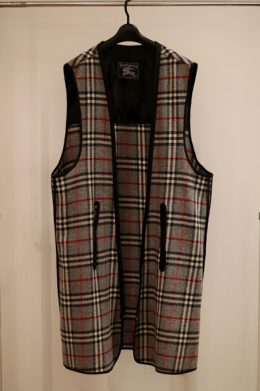
TanakaI'm from Kyoto, so I've always loved vintage clothing. Lately, not only American vintage but also European vintage is interesting, and I've been researching vintageBurberry※13Burberry. I don't know which items existed in which eras, or which people in which countries ordered them.
YumaEven Burberry's headquarters doesn't know that. That's part of what makes it interesting, isn't it?
TanakaRecently, I bought a Burberry from around 1918 from a vintage shop owner.
YumaA trench coat?
TanakaYes, an early military trench coat. The silhouette was already perfected, and the fine details are unchanged from today's.
YumaHow many Burberry trench coats do you own?
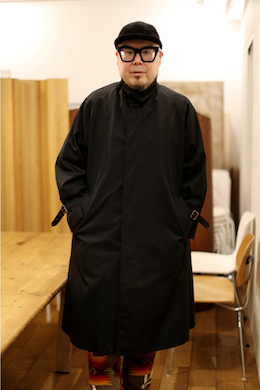
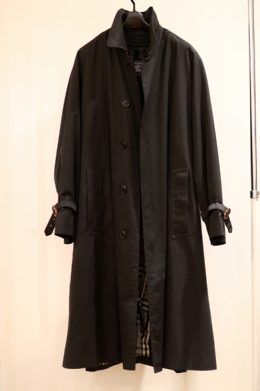
TanakaI have quite a few. The black coat I'm wearing today is a prized piece. It's a single-raglan sleeve type, called a rider or belted, and it has a removable lining for winter. I've never seen another one like it.
YumaWhere did you get it?
TanakaMy wife had it. I didn't know it had been sitting in the closet by her bedside for three years. I was surprised and asked, 'You had this?'
YumaIt's in good condition too. When did you start getting into vintage Burberry?
TanakaI've always liked it, and I've been buying pieces bit by bit for about 20 years. It's interesting because there's so much to research. Finding them is also enjoyable. Regarding vintage military and workwear from Europe, the differences in details from each era are fascinating.
YumaWhat is it about these old items that fuels such a passionate hobby?
TanakaI wonder myself (laughs). I like instruments, books, records, and cars, but when it comes to vintage clothing, I love items from the 1910s and 20s so much that I consider things from the 50s to be new.
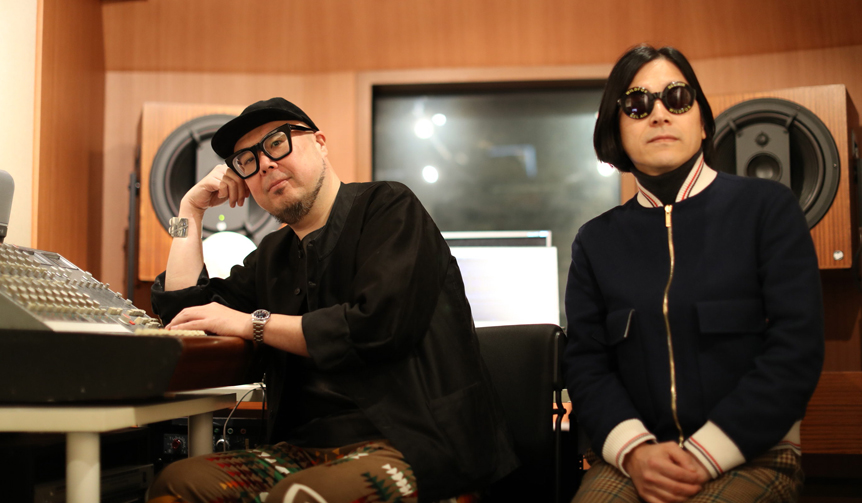
YumaThe 1910s were over 100 years ago. That's antique. It's amazing that they can still be worn. Where are the glasses you're wearing today from?
Tanaka Native Sons※14They're from a brand called Native Sons. This model is apparently inspired by the glasses worn by butchers.
YumaAnd the watch you're wearing today?
Tanaka Rolex Explorer※15It was stolen once. The police contacted me when the piece was luckily found at a pawn shop, and I was able to buy it back for the amount the pawn shop had paid the thief, unaware it was stolen.
YumaThat's a watch with a good story.
TanakaIt left and came back, so I treasure it.
YumaSpeaking of which, you're also involved in brand direction, aren't you, Tanaka-san?
Tanaka Demura from the vintage shop in Toyama※16andTsujita from Fullcount※17and I launched the brand 'List' in 2012. Currently, I continue it on a small scale by myself (laughs). Based on the designs of vintage leather jackets that are traded at exorbitant prices among vintage enthusiasts, we updated them for modern times and collaborated with Backlash, led by my friend Yu Kataayama. We recently had a pre-order sale in 'LEON' magazine that was incredibly well-received. We used high-quality Italian calfskin, which would normally never be washed, and subjected it to garment washing to strike a balance between a modish feel and vintage authenticity.
YumaI can sense your dedication.
TanakaIt doesn't compare to your level, Yuma-san.
YumaWe're both enthusiasts, aren't we? (laughs)
TanakaWhether it's a shop or an event, I'd love to collaborate with you again someday, Yuma-san.
YumaShall we do it in Kyoto, a special place for us? Thank you for your time today.
TanakaThank you as well. It was enjoyable.
13 Burberry
Burberry is a leading British luxury fashion brand founded by Thomas Burberry in 1856.
14 Native Sons
Native Sons is an eyewear and accessories brand co-designed and directed by Tommy Ogara, who previously worked as a creative designer at DITA, and Shinsuke Takizawa of NEIGHBORHOOD.
15 Rolex Explorer
The Rolex Explorer is a sports watch model released by the Swiss watch manufacturer Rolex, founded in London in 1905 by German Hans Wilsdorf, for adventurers.
16 Demura from the vintage shop in Toyama
Junya Demura, owner of the vintage shop 'Hayabusa Kat Klother' in Toyama, is one of Japan's leading vintage dealers.
17 Tsujita from Fullcount
Mikiharu Tsujita, designer for the denim brand FULLCOUNT.