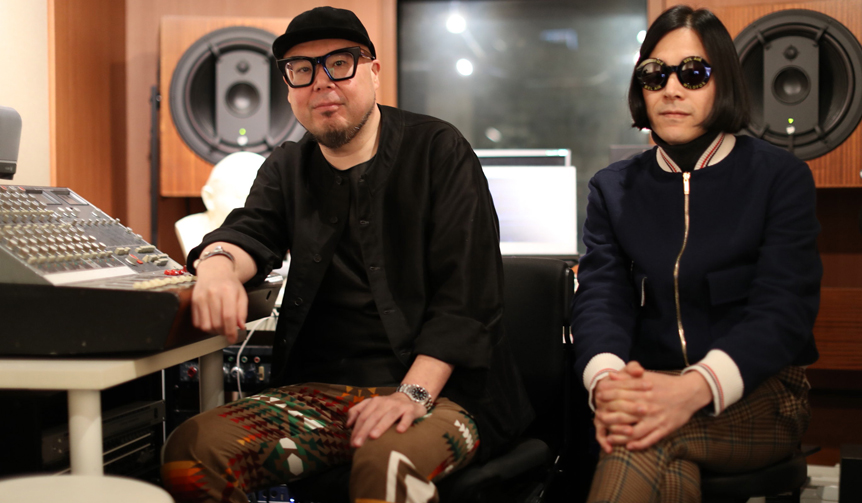
Tomoki Sukenaga & Editor Daimao Dialogue | Vol. 36 Tomoyuki Tanaka of FPM (Part 1)
Page. 1
Our guest today is Tomoyuki Tanaka, who is active both domestically and internationally as a DJ and producer, and performs music under the name of his solo project, "FPM = Fantastic Plastic Machine." The two, both originally from Kyoto, look back on Kyoto in the 80s and 90s, sharing personal anecdotes.
Interview by SUKEZANE TomokiPhotographs by MAEDA AkiraText by ANDO Sara (OPENERS)
A student life completely focused on becoming a professional, spent immersed in band activities and part-time jobs
YUMASANE Tomoki & Editor Daimao (hereinafter, Yumasane)How many years have you been active as a DJ, Tanaka-san?
TANAKA Tomoyuki (hereinafter, Tanaka)I’m not sure where to say it started, but I bought my first two turntables and mixer when I was living in Kyoto. I was 19 at the time, so that was 33 years ago.
YumasaneWere you yourself aspiring to be a DJ?
TanakaNo, not at all. You probably remember the atmosphere of Kyoto back then, Yumasane-san, but...New Wave※1There was that kind of vibe, wasn't there?
YumasaneThere was.
TanakaI was completely immersed in that scene, so naturally, I was in a New Wave band. At the same time, I thought it would be great to have a part-time job where I could listen to music. There were places like cafe bars, but I wondered what kind of job would let me enjoy music more extremely. That's when, in Kyoto, there was a disco calledMaharaja※2Maharaja.
YumasaneYes, yes! There was.
TanakaThere were smaller clubs too, but Maharaja was pretty much the only large venue that had actual job openings for part-time work.
YumasaneThe Maharaja on Shijo Street?
TanakaYes, the one on Shijo Street. It was the first one in Kyoto, before the Gion Maharaja, which became famous nationwide, opened. There was also a smaller club called Maharaja Club on Sanjo Street.
YumasaneYes, yes, there was.
TanakaI had been in a band since junior high school, but by the time I was in my third year of high school, I was already performing live with professional aspirations. I enrolled in university, but I barely attended, spending most of my time on music. Around the time I was about to graduate high school, I started working part-time at those two Maharaja locations. Of course, I wasn't a DJ spinning records; I was washing dishes (laughs). But it was good because I could listen to music.
YumasaneI see.
TanakaWhen I first started working there, I had never seen or heard of a DJ before, so I thought, "What is that person doing with headphones on?" just like people might wonder about us now (laughs).
Yumasane(Laughs)
TanakaAfter watching a few times, I realized they were cueing up the next song and mixing it. At the time, I was only involved in bands, so DJs were completely out of my sight. But I started to become vaguely interested. It was around the time Run DMC exploded onto the scene and hip-hop was becoming mainstream. I learned that turntables weren't just for playing music but could also be used as instruments, which further piqued my interest. Then, around the age of 19, I bought turntables and a mixer with the money I'd saved from my part-time job.
YumasaneDid you feel a difference between being a musician and a DJ back then?
TanakaOf course. I was in a New Wave band and completely musician-oriented, so I didn't see DJing as a substitute for making music or playing in a band. But it did seem like a fun job. At the time, Takarajima-sha had an indie record label calledCaptain Records※3Captain Records. We had made songs with bandmates and were ready to release them, but Captain Records went on hiatus.
YumasaneLike a movie (laughs).
Page02.The New Wave Scene in Kyoto in the 80s, Where We Spent Our Youth
Page. 2
The New Wave Scene in Kyoto in the 80s, Where We Spent Our Youth
TanakaAt that time, there was a band boom, but it also suddenly died down.
YumasaneIkaten※4Was it around the time of Ikaten's popularity?
TanakaYes, it was just before the 90s. I was completely absorbed in band activities, not even going to university, and only thinking about how to become a professional. Were you already in Tokyo around that time, Yumasane-san?
YumasaneI was already in Tokyo.
TanakaIn Shibaura, there was> INK STICK※5INK STICK, wasn't there?
YumasaneThat brings back memories.
TanakaI even drove from Kyoto to go see a live show there.
YumasaneWow (laughs).> Japan Music Selector Association※6There were events by them too, right?
Tanaka> Kakumei Butokai※7!
YumasaneYes! Those were events organized by Moichi Kuwabara. I used to go often.
TanakaDJs had gained acceptance by then, and I had started DJing myself after buying records, but I was still wondering if I could somehow make it work with my band.
YumasaneWhat instrument did you play in the band, Tanaka-san?
TanakaBass. At the time, there was a band based in Kyoto called> EP-4※8EP-4. They were a legendary New Wave funk band with a cult following. Do you know them? They recently reunited.
YumasaneIt sounds vaguely familiar...
TanakaI'm sure you do. They did all sorts of unusual things. When they debuted, I was in junior high school, and they were just so cool. Their promotional methods were so stylish. On May 21, 1983, they had a legendary live performance, and to announce it, they put stickers with the numbers "521" and the EP-4 logo on public phones all over Kyoto. Then, somehow they found my address and sent me an airmail package from overseas with just the EP-4 logo. Imagine how thrilling it would be for a kid who didn't know anything to suddenly receive an airmail letter from their favorite band!
YumasaneIndeed (laughs).
TanakaAt that time, Shinichi Osawa and I were like the youngest members of the Kyoto New Wave scene, with EP-4 at the pinnacle. We thought, "These guys are cool, even if we don't fully understand them," and "How much do we really understand?" But still, the impact they had on me in junior high school was significant. They were active while retaining that underground, Kyoto-esque feel.
YumasaneWhat kind of activities did they do?
TanakaThey did socially sensational things, like using a photograph of the house of a murderer who used a metal bat for their record jacket, taken by Shinya Fujiwara.
Yumasane> Nobuya Ichiyanagi※9It was his house, wasn't it?
TanakaExactly! You even know his name! They sold a record called "Lingua Franca 1 - Showa Taisha" with a jacket featuring a photo of Nobuya Ichiyanagi's house through bookstores. I don't remember if it was because it violated public decency or if record stores couldn't sell it, but EP-4 did all sorts of mind-blowing things.
YumasaneKyoto at that time was special, wasn't it? Performance art was also thriving.
TanakaThere was the New Wave world, and people who were still influenced by the student movements around Kyoto University, and then there were people from> Dumb Type※10And many others came and went. That was Kyoto for us in our teens. We were influenced by that intense atmosphere and then entered our twenties.
YumasaneI moved to Tokyo in '86, but Kyoto back then was really interesting.
TanakaFrom there, I lived in both Osaka and Kyoto until I was about 28 or 29, working for an apparel company and then a publishing company, spending my time in the Kansai region. Looking back, it was good to have seen Kyoto in those days, in both good and bad ways. Oh, and we played against each other in Little League baseball when we were kids (laughs).
YumasaneThe Nishijin Tigers and Guts Kamigamo (laughs). It's funny. I remembered that.
TanakaYou remembered me by my size, thinking "There was a big kid" (laughs).
YumasaneYou were interviewed for "> Brutus※11" and went to a house in Kyoto, right?
TanakaThey did come. It was around '94 or '95.
YumasaneAs we were talking about how Tanaka-san lived, you mentioned your parents' home was in Nishijin, and it triggered a flashback. "Wait a minute," I thought. "Weren't you in Little League baseball?" (laughs). I had also met Osawa-kun in Kyoto. Back then, Osawa-kun was working at a clothing store, and I used to go there often, so I knew him. Later, when he came to Tokyo and I saw him working with Shuuya Okino, I thought, "Ah!"
TanakaIt's amazing how everything is connected. Okino and I were in the same university class. I didn't know him until I graduated, but he apparently saw me walking around campus with my bass. He moved to Tokyo a little before me, and around the same time, Osawa-kun decided to debut with> Mondo Grosso※12Mondo Grosso, so he decided to move to Tokyo. Besides Mondo Grosso, Osawa-kun was in other bands in the Kansai region, and I received a call at the magazine company where I was working at the time, asking if I would play bass for one of those bands.
YumasaneThat's interesting. I first met Okino-kun around 1993 or '94 when I was doing a mod event at Laforet. Tadanobu Asano performed as an opening act, Yoshio Wakatsuki directed, I did the model casting and show styling, judged alongside HIROMIX, and Moichi Kuwabara produced it. It was an event with many mod fans, and it was fun. Okino-kun came backstage to greet me then, and that was our first meeting. I thought, "What an interesting person." Shortly after, I was styling a fashion show at Isetan, and Mondo Grosso performed live to accompany the show. Okino-kun was the manager and producer at the time, and Osawa-kun was playing. I still remember thinking, "This is getting interesting."
TanakaThose were nostalgic times.
YumasaneYou came to Tokyo shortly after that, didn't you, Tanaka-san?
TanakaYes. It was the year of the Great Hanshin Earthquake, so 1995.
Page03.After Graduating University: A Life as a Salaried Worker Immersed in Music
Page. 3
After Graduating University: A Life as a Salaried Worker Immersed in Music
YumasaneLet's go back a bit. After the record company disappeared and the debut plans fell through, what happened?
TanakaI had intended to become a musician, but my dream was dashed, and I realized I had to get a job. I asked myself, "What do I like besides music?" Since I liked clothes, I focused my job search on apparel companies. It was around the time just before the bubble burst, so it was an era where anyone could get a job if they wanted one. I started my job search in 1989, and the plan was to join a company in 1990. I applied to several companies and received offers from all of them. One of them was a company called> RAIKA※13RAIKA. I told them, "I'll join if you can put me in the planning department," and they said, "Alright, we'll put you in," so I received an offer for the planning department and decided to join.
YumasaneHow long were you there?
TanakaI worked as an MD for about 4 or 5 years. I was in charge of MD and production management for everything from children's to men's and women's clothing. I was a salaried worker, but I always loved eating out in various places. One day, I received a call at the company from Keihanshin L Magazine, a publisher that puts out a women's fashion magazine called "> SAVVY※14" They wanted to do a feature on where people working at RAIKA eat and hang out. The PR person asked me, "Tanaka, you like to eat, right?" and I said, "Yes."
Yumasane(Laughs)
TanakaSo, about three of my colleagues and I were interviewed. The person interviewing us invited me to join their company, saying, "You'd be good as a magazine editor." Since they said that, I went to my company and said, "I've been invited to work at the publishing company that interviewed me, is that okay?" They said, "We can't help it, but let's stay on good terms," and I left amicably and joined the SAVVY editorial department as a full-time employee. It was a difficult position to get at the only publishing company in Kansai.
YumasaneThat's an interesting career path. What about your DJ activities during that time?
TanakaI was doing them. I worked until the last train, and then DJed until morning – a crazy schedule. All the money I earned went towards buying records. Around the time I was deciding whether to quit RAIKA or not, I DJed for the first time at a club called Metro in Kyoto. I'll never forget it: in July 1992, I held an event where we only played movie soundtracks. I think it was the first in the world to have a club event solely featuring movie soundtracks.
YumasaneWere you the only one spinning records then?
TanakaI formed a DJ team with about three friends called "Sound Impossible," and we promoted the idea of playing only movie soundtracks.
YumasaneSound Impossible. The name is interesting too.
TanakaThe DJ event was quite popular, so we were put in charge of the Thursday night slot at Metro. At the time, I was DJing with Hiroshi Ito, who was an instructor at Kyoto Institute of Technology.
YumasaneI interviewed Ito-san for "Brutus" before too.
Tanaka> Groovisions※15Before Groovisions was formed, Ito-san was also a DJ, and later became a VJ. While it's common to do VJing now, it was difficult to create video content back then. It was impossible with a regular home computer like a Macintosh IIci due to its processing power. However, at Kyoto Institute of Technology, where Ito-san was, there was a computer called Indigo fromSilicon Graphics※16that cost about 20 million yen, which made it possible to create VJ-like materials.
YumasaneI saw it in Iwakura. They were creating visuals for Pizzicato Five, and it was so amazing I was shocked.
TanakaYes, that caught the eye of Yasuharu Konishi-san from Pizzicato Five, who came to our DJ party, and he asked us to create visuals. Even though no one was doing VJing in Tokyo yet, we were able to do it because we had Ito-san. Also, there's a film critic named Milkman Saito, who was my senior at the video rental store when I was in high school. We were in a band together. He was a trumpeter and a movie buff. We both loved music and movies, so we worked at a video rental store. I introduced Saito-san to Groovisions, and he combined his vast VHS movie archive with Ito-san's early computer graphics. We showed this at our movie music events, and Konishi-san saw it and thought, "This is it!" and brought them to Tokyo. Around the same time, he found our DJing interesting and told me, "Tanaka-kun, if you're going to be a DJ, you should make your own music." I got a bit carried away and said, "Really?" (laughs). Also, around the same time, we were organizing a big event in Kyoto, and when we discussed who to invite, I said, "I love the group Deee-Lite, so I want to invite Towa Tei, a member," and we invited Towa Tei, who was living in NY. That was in 1994. Towa Tei also gave me similar advice, and that's how I started making music, which eventually led to FPM.
Page04.Notes
Page. 4
Notes
※1 New Wave
A genre popular in the British and American music scenes from the late 1970s to the early 1980s.
※2 Maharaja
The collective name for the high-end disco chain stores developed nationwide in Japan by the NOVA21 Group in the 1980s and 90s. It is one of the representative discos of the bubble economy era.
※3 Captain Records
A music label founded in 1985 by the magazine "Takarajima," which was a subculture magazine at the time.
※4 Ikaten
A segment of the late-night TV show "Heisei Meibutsu TV" on TBS, "Yuji Miyake's Ikasuband Tengoku." It began on February 11, 1989, and ended on December 29, 1990, after producing many bands.
※5 INK STICK
A large live house in Shibaura, Tokyo, INK STICK. It opened on December 5, 1986, and closed with regret on December 31, 1989.
※6 Japan Music Selector Association
An association of music selectors voluntarily organized by music producer/selector Moichi Kuwabara, a key figure in Japanese club culture, since 1987.
※7 Kakumei Butokai
A DJ event regularly held by Moichi Kuwabara and the Japan Music Selector Association.
※8 EP-4
A Japanese New Wave band. Initially based in Kyoto Prefecture, they released many cassette tapes and records. With their eccentric and guerrilla-like strategies, they were always at the center of attention in the independent music scene.
※9 Nobuya Ichiyanagi
The perpetrator of the Kanagawa metal bat double murder of his parents on November 29, 1980.
※10 Dumb Type
An artist group formed in 1984, primarily by students of Kyoto City University of Arts. Members with diverse artistic backgrounds in architecture, fine arts, design, music, and dance participated, exploring the possibilities of artistic expression. Based in Kyoto, they focused on international performances.
※11 Brutus
A men's lifestyle magazine launched by Magazine House in May 1980, published on the 1st and 15th of each month.
※12 Mondo Grosso
Originally a band formed in Kyoto in 1991 with Shinichi Osawa as the leader, it is now Osawa's solo project. The band name means "big world" in Italian. The music genre is primarily club music.
※13 RAIKA
RAIKA CO.,LTD. was a Japanese apparel manufacturing and sales company founded in 1957, based in Osaka. It ceased operations and was dissolved on April 30, 2011.
※14 SAVVY
SAVVY is a monthly lifestyle magazine published by Keihanshin L Magazine. It was first published in November 1984.
※15 Groovisions
A design collective founded in Kyoto in 1993, centered around Hiroshi Ito. They engage in various design activities including graphics, movies, and products. They moved their base of operations to Tokyo in '97. They gained attention for their "Chappy" paper doll characters.
※16 Silicon Graphics
An American computer manufacturer founded in 1982, developing and selling hardware and software for 3D graphics.