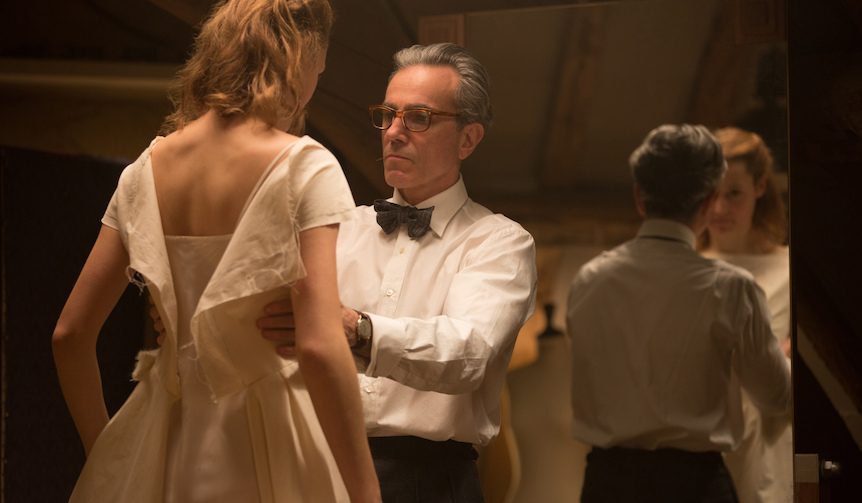
Serial | Jun Makiguchi's Cinema Full Life, Part 20: 'Phantom Thread'
Serial | Jun Makiguchi's Cinema Full Life
Part 20: The Love That Breeds Only One Choice, and Thus, Destiny
'Phantom Thread'
The phrase “Phantom Thread” originated in Victorian England. It stems from an anecdote about the seamstresses of East London, who, subjected to grueling, long hours to sew the clothes of royalty and nobility, continued to sew “invisible threads” even after work due to exhaustion. Phantom thread, or the power of the unseen, how much does it influence us, and how powerless are we? This mystery is crafted into an ultimate love drama by the rare storyteller, director Paul Thomas Anderson. Starring Daniel Day-Lewis for the second time since 'There Will Be Blood,' the film depicts the helplessness of humans tossed about by unseen forces, and the peculiar romanticism born from it, against the backdrop of the fashion world. Also noteworthy is the craftsman persona, meticulously researched by the acclaimed actor Daniel Day-Lewis, who has declared his retirement, and created together with the director, alongside famous designers like Christian Dior and Alexander McQueen.
Text by MAKIGUCHI June
Hurting Each Other to Carve Themselves into the Other's Heart
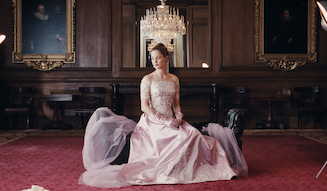
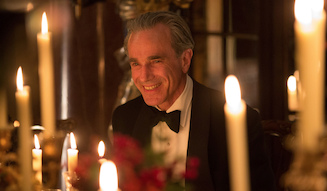
The setting is London in the 1950s. Reynolds, a dressmaker who leads the atelier “House of Woodcock,” is a titan of haute couture. He has no interest outside of dressmaking and maintains his emotional stability by focusing on his work, adhering to his daily routines. One day, while visiting the countryside for a break, he meets Alma, a waitress. She is tall, simple, and a little clumsy, but her warm smile is captivating.
Reynolds, regaining his smile through his interactions with her, invites Alma to dinner. As the two leave the restaurant and head to his villa, Reynolds removes her dress and begins a fitting. Facing a hesitant Alma, Reynolds asks, “May I take your measurements?” Alma eventually becomes Reynolds’ muse…
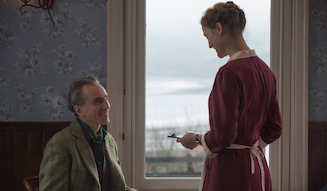
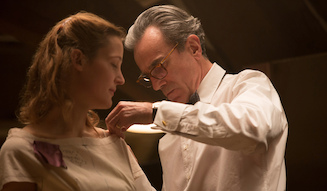
Encounters are mysterious. Life presents many crossroads, and some encounters create numerous paths, but watching this film, one feels that from a fated encounter, no choices arise. Meeting a certain thing, person, or event seems to converge the many possibilities of life into a single, inevitable conclusion. Perhaps that is why it is called 'destiny.'
Following their encounter, Reynolds and Alma embark on a life they could never have imagined. Initially, Reynolds's creative drive is stimulated by Alma, but as time passes and she begins to assert herself, he feels his sanctuary invaded and becomes unsettled.
Alma loves Reynolds and sometimes feels a connection, but each time she tries to get closer, she is brutally rejected and her presence is disregarded. While Reynolds always seems to hold the reins, Alma, having acquired the wisdom of a woman, subtly gains control without him realizing it. Their relationship, as symbolized by the frequent ascents and descents on the spiral staircase in the film, fluctuates wildly, appearing romantic yet also becoming a power game.
Ultimately, isn't romance a power game? They say love makes one weak, but it's not just affection; purpose, strategic maneuvering, and sometimes even hatred, all intertwine and dictate the flow of power.
To what end do they go, invading and eroding each other, to create space for themselves to be close? Is it only through collision and mutual hurt that one can carve oneself into the other's heart? Is it true love precisely because it's something that cannot be done with just anyone?
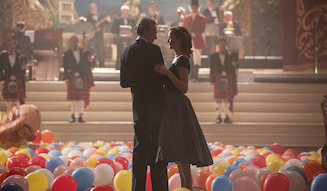
The film presents situations that raise the question of why they remain together even after enduring such treatment. But for those caught in the inescapable power game of love, even the thrilling and dangerous exchanges become an aphrodisiac. Trying to analyze it psychologically to understand their deep-seated desires, the human heart remains enigmatic. That is precisely what makes it so fascinating.
Though the film is rendered with elegantly romantic and exquisitely beautiful visuals, a subtle sense of unease, hinting at the peculiar relationship the two will eventually reach, exists from the very beginning. The details of the human portrayals are consistently odd. A man gleefully taking measurements on a first date, reducing the woman to her undergarments.
A woman showing open rivalry even towards customers. Like a dissonance, it subtly plants seeds of anxiety in the viewer's mind, one by one.
The music flowing in the background both soothes and stirs this sense of unease. At times, it emphasizes romance with beautiful melodies, only to leave the audience with a lingering sense of anxiety through unsettling themes. The use of classical music, in particular, is exquisite.
In 'There Will Be Blood,' Brahms' Violin Concerto No. 3 movement was used at the perfect moment to transition from the climax to the end credits. In this film, during a party scene, Berlioz's 'Symphonie fantastique' plays softly in the background. This piece, whose original title translates to 'An Artist's Life Events, Five Movements of a Fantastic Symphony,' expresses a 'fanatical love incomprehensible to others' lurking within its romantic melodies, which is precisely the underlying theme of this film.
What may seem strange and grotesque to outsiders is, for them, the ultimate, inseparable love. For them, the phantom thread is the red thread of fate. A meeting of such intense, fated significance. Whether you find it enviable or not, I encourage you to see it with your own eyes and decide.
****
Just as with 'Symphonie fantastique,' rare works of art invariably contain a cleverly woven element of the 'ugly,' which in turn creates a new concept of 'beauty.' This film is precisely that.
'Phantom Thread'
Directed and Written by: Paul Thomas Anderson
Starring: Daniel Day-Lewis, Vicky Krieps, Lesley Manville, and others
Music by: Jonny Greenwood
2017 | USA | 130 min | Color | Vista Universal Pictures
Distributed by: Bitters End / PARCO
http://www.phantomthread.jp/
© 2017 Phantom Thread, LLC All Rights Reserved
Now Showing!
Jun Makiguchi
After working for Kyodo News, a film festival secretariat, and magazine editing, she became an independent writer. She currently writes film columns and interviews for women's and men's magazines, focusing on lifestyle topics such as fashion, food, and music depicted on screen.