
Serial | Jun Makiguchi's Cinema Full Life: Part 15, Beyond the Horizon
Serial | Jun Makiguchi's Cinema Full Life
Part 15: Depicting the World Today with Minimalism
To the Other Side
Lately, I often hear laments that the world has become intolerant. Things that might have been laughed off in the past now cause conflict and confrontation. Of course, many things cannot be dismissed with a laugh, and clarifying black and white may not be a bad thing. However, in a complex society, people's circumstances are intricately intertwined, and one person's good can become another's evil.
Text by MAKIGUCHI June
Moving People: Differences and Similarities
Consider, for example, the refugee issue, which is frequently debated in Europe today. It is natural for people who can no longer live in their own countries for various reasons to want to flee to a safe place, but the perspectives and notions of justice and rightness differ between refugees and host communities. The same is likely true for proponents and opponents of acceptance.
Director Aki Kaurismäki has lightly simplified such complex issues. He is popular in Japan for films like "The Man Without a Past" and "Drifting Clouds." In his new film, "To the Other Side," the protagonists are Khaled, a young man fleeing from escalating civil war in Syria, and Wikström, a lonely restaurant owner.
Khaled, who lost everything in an airstrike, drifts to Helsinki, Finland, while searching for his sister, whom he lost contact with on the journey. The administration, struggling with many refugees, is far from tolerant, and he faces discrimination and violence from residents opposed to their acceptance. However, through the small acts of kindness from Wikström, whom he happens to meet, and those who work at his restaurant, Khaled begins to find hope. Wikström, who was also considering starting a new life, is reminded of what is truly important through his encounter with Khaled.
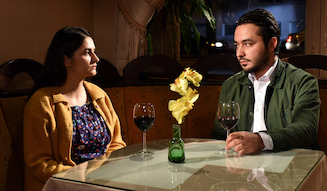

In Japan, where not many refugees are accepted, discussing this issue may only feel like an outsider's concern. However, it is not difficult to imagine the significant burden that would arise for host communities if a large number of refugees were to arrive. It is not a matter that can be resolved with platitudes alone. When it becomes a personal issue, even deciding whether to support or oppose acceptance may not be easy.
Yet, the restaurant owner and employees who appear here, without the slightest hint of conflict, take in Khaled, who is facing deportation, as a matter of course. If someone is in trouble, they help. For them, things are exceedingly simple.
The film depicts cruel realities, such as the heartless decisions of the administration and the violence from opposing factions, which are not often seen in Kaurismäki's previous works. However, this clearly shows that the director does not consider the refugee issue to be a simple one. It is precisely for this reason that the purity of Wikström and his employees shines through so vividly.
As in his previous films, the characters show no emotion, do not smile, and are gruff, yet this allows them to reflect the essence of matters without superficial filters. The essence is that officials and bigots are "people who are conscious of the differences between refugees and themselves," while Wikström and his companions are "people who are conscious of their commonalities with refugees."
Furthermore, the fact that everyone is gruff reveals Kaurismäki's consistent, ultimate minimalism. Watching this film, one might come to believe that for us living in an increasingly complex society, simplifying matters may be the shortcut to a happy life, as it helps to reveal the core of problems and find clues for solutions.
What matters is the heart, not pleasantries or pretense. Perhaps the principle of society and the path to coexistence lie in not denying the human capacity to care for one another.
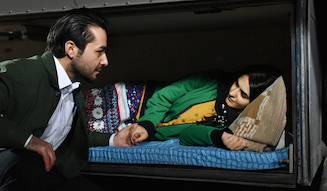
However, no matter how righteous the argument, if it is perceived as mere hypocrisy by someone, no amount of shouting will reach the intended recipient. This is where Kaurismäki's brand of humor comes into play. If one confronts the formidable issue of refugees head-on, people from various standpoints will clash their respective notions of justice, and a resolution will never be reached. Of course, this film does not offer a solution to the problem, but if it can redirect people's attention to the very simple "fundamentals" they have begun to forget, it may cast a stone into the stagnant waters of debate. For this, the power of humor, which everyone can easily lend an ear to, is necessary.
I would like to conclude by quoting the director's heartfelt message embedded in this film.


"My aim with this film was to shatter the European tendency to label refugees either as pathetic victims or as brazen economic migrants who invade our societies and steal our jobs, wives, homes, and cars. Historically, when stereotypical prejudices spread in Europe, they create a disturbing resonance. To put it bluntly, 'To the Other Side' is, in a sense, a propaganda film* that manipulates the audience's emotions and seeks to influence their opinions and views without question. Since such attempts usually end in failure, I hope that what remains is an honest, slightly melancholic story tinged with humor. On the other hand, this film depicts the reality of people living somewhere in this world today."
*Propaganda film refers to proletarian films with left-wing ideological content that exposed and criticized the contradictions of class society and capitalist society, which emerged in Germany and Japan in the 1920s.
****
An ambitious work by director Kaurismäki, who breaks new ground by tackling a highly contemporary theme.
To the Other Side
Director/Screenplay: Aki Kaurismäki
Starring: Sherwan Haji, Sakari Kuosmanen, and others
Distribution: Eurospace
Opening Saturday, December 2nd, at Eurospace Shibuya and other theaters nationwide.
© SPUTNIK OY, 2017
Jun Makiguchi
After working for Kyodo News, a film festival secretariat, and a magazine editorial department, she became an independent writer. She currently writes film columns and interviews for women's and men's magazines, focusing on lifestyle topics such as fashion, food, and music seen on screen.