INTERVIEW | Naoki Ishikawa x Yūsuke Kakuha: 'The Oldest Cave Paintings 3D: Memories of Forgotten Dreams'
INTERVIEW|Naoki Ishikawa x Yusuke Kakuha
Film 'Cave of Forgotten Dreams' Released
The Perspectives of Two Men Who Walked the World (Part 1)
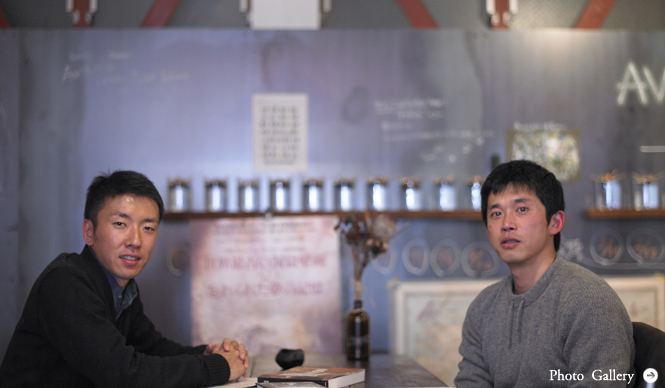
German auteur Werner Herzog's first 3D film, 'Cave of Forgotten Dreams.' Herzog is said to be the first non-researcher to enter the Chauvet Cave, where the world's oldest cave paintings were discovered in 1994. We spoke with two writers who saw the film. Naoki Ishikawa, a photographer and writer whose photo collection 'NEW DIMENSION' features cave paintings from around the world, and Yusuke Kakuha, a writer and explorer who won the Kōkai Ken Non-Fiction Prize and the Ōya Sōichi Non-Fiction Prize for 'The Five Mile Void,' documenting his expedition into the unexplored Tsangpo Gorge. The two, who share a common background in Waseda University's exploration club, discussed the film, weaving in their own experiences.
Photographs by JAMANDFIXText by SHU SUGIURA (OPENERS)
Herzog's 3D Camera Captures the World's Oldest Cave Paintings
Naoki Ishikawa (Ishikawa):The Chauvet paintings were discovered not by researchers, but by cavers, right? They descended vertically into the cave, not through a horizontal passage, and found them there. It's truly remarkable that a cave with 30,000-year-old paintings was found in France, a country known for adventure and exploration, and not in some remote corner of Asia or Africa, and as late as 1994, at the end of the 20th century.

Yusuke Kakuha (Kakuha):So, they weren't found by art experts or specialists in ancient paintings, but by cavers by chance? I think I'd be absolutely terrified if I found something like that.
But if they're in such pristine condition, the discoverers must not have realized they were that old, right? Or maybe they did?
Ishikawa:Quite a few paintings have been found in this area, so if they knew about that, they might have been struck by the magnitude of the discovery. And since it was deep inside the cave, they must have realized it was something extraordinary.
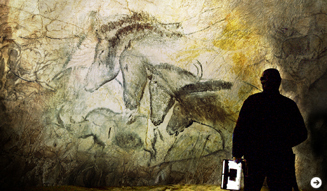
Kakuha:They look like something out of a manga or a graphic novel. Is this style of painting common? In your photo collection 'NEW DIMENSION,' the Aboriginal paintings are much more abstract, aren't they?
Ishikawa:The French cave paintings are notable because the artistic level is high and the motifs are focused. Some are drawn in a stop-motion style, like an early form of animation. The Lascaux paintings are incredibly famous, but paintings of comparable or even greater scale were found here. I tried every means to photograph Lascaux, but I was never allowed in; I only got to see the replica cave built nearby.
Ishikawa:The French cave paintings are notable because the artistic level is high and the motifs are focused. Some are drawn in a stop-motion style, like an early form of animation. The Lascaux paintings are incredibly famous, but paintings of comparable or even greater scale were found here. I tried every means to photograph Lascaux, but I was never allowed in; I only got to see the replica cave built nearby.

—Is Chauvet even more difficult to access than Lascaux?
Ishikawa:Even if ordinary people apply, they won't grant permission. At Lascaux, you can get in after waiting for years if you formally apply, but there's no sign of that happening for Chauvet. The reason the 30,000-year-old paintings remain so vivid is that they were almost completely sealed off from the outside air, and the French Ministry of Culture exercises extreme caution.
Kakuha:The vault-like door at the entrance to Chauvet is incredible, isn't it? The amount of money and effort put into its preservation is astonishing.

Ishikawa:At Lascaux, in the early days, the condition of the paintings deteriorated because they let too many people in. As a result of that lesson, Chauvet seems to be much more strictly guarded.
—What do you think about it being filmed in 3D?
Ishikawa:Cave paintings utilize the unevenness of the walls to depict animals. So, in 3D, you can better understand the context and environment in which they were painted, and you can really feel the depth. Some paintings are in narrow passages where you can't see the entire artwork from a distance.
—What do you think about it being filmed in 3D?
Ishikawa:Cave paintings utilize the unevenness of the walls to depict animals. So, in 3D, you can better understand the context and environment in which they were painted, and you can really feel the depth. Some paintings are in narrow passages where you can't see the entire artwork from a distance.
It's clear they weren't painted with the intention of being seen by others. I think 3D was a very effective way to express and fully experience these paintings, including their surroundings.
Kakuha:I find myself wondering why these people painted these images, or if they practiced somewhere. There was that story about the footprints, right? Children's footprints alongside wolf tracks. It makes you think about people being present in such a place in prehistoric times. I don't normally think about such things, and this film gave me a valuable opportunity to do so. Simply being moved by the fact that people were there.
Continued on page 2
Cave of Forgotten Dreams 3D
Opens Saturday, March 3, 2012
Limited 3-week Spring Break Special Roadshow
TOHO Cinemas Roppongi Hills and others
Directed by / Narrated by: Werner Herzog
Japanese Narration: Joe Odagiri
2010 / USA / 90 min / Digital 3D
http://www.hekiga3d.com/
Opens Saturday, March 3, 2012
Limited 3-week Spring Break Special Roadshow
TOHO Cinemas Roppongi Hills and others
Directed by / Narrated by: Werner Herzog
Japanese Narration: Joe Odagiri
2010 / USA / 90 min / Digital 3D
http://www.hekiga3d.com/
INTERVIEW|Naoki Ishikawa x Yusuke Kakuha
Film 'Cave of Forgotten Dreams' Released
The Perspectives of Two Men Who Walked the World (Part 2)
What Are the Fundamental Reasons Why Humans Create Art?
—Is your pursuit of cave paintings related to that kind of fascination?
Ishikawa:They are direct traces of human existence. For example, with ruins, you're told people lived there, but now it's overgrown with grass, and you can only imagine it with a limited imagination. But direct traces like cave paintings convey the raw gestures of people who, while not present, consciously moved their hands. I travel with the hope of touching the lives of ancient people by tracing these paintings, and that's what led to my photo collection 'NEW DIMENSION.'
Kakuha:I believe the way people perceived the world in those times was very different from ours. They must have lived in complete harmony with nature, so how did they perceive things, how did they relate to the world, and how did they position themselves within nature? Looking at these paintings makes you imagine all sorts of things. They are people beyond our imagination, and that's what's so compelling.
Ishikawa:Did you have themes like searching for cave paintings during your time in the exploration club? We even searched for man-eating pandas in remote parts of China (laughs).
Kakuha:I didn't have that kind of academic stance (laughs).
Ishikawa:There are various theories about why cave paintings were made. Some suggest they depicted hunting methods, while others believe they held shamanistic significance. However, at Chauvet, the main subjects are animals like bison and horses, and a bear skull placed intentionally was also found, suggesting it was related to both hunting and shamanism.
Kakuha:There were also paintings where newer art was drawn over older art from 5,000 years prior. So, their sense of time must have been different. For us, 5,000 years ago is the Jomon period, the Yin dynasty in China, the era of the Code of Hammurabi – a world beyond our comprehension. But for them, even 5,000 years ago, there was a sense of continuity, which might be why they could paint over existing art.
Ishikawa:Looking at cave paintings worldwide, you'll find many examples of superimposed drawings. The Bhimbetka rock shelters in India also have quite a few superimposed paintings. Normally, one would hesitate to paint over an existing artwork, but here they are painted freely. At Chauvet too, there are several instances where paintings were deliberately done over others. It might be to express movement.
Kakuha:It's amazing.
Ishikawa:In the past, they would have painted by the light of torches, which would make the animals in the paintings appear to flicker. There was also the risk of oxygen deprivation, and in such a hallucinatory state, they might have entered a trance while painting. The act of painting animals or female genitalia in such conditions seems beyond ordinary human capability. The 'negative hand' stencils, also featured in the film, are intriguing. These were made by placing a hand on the wall and spraying pigment held in the mouth to leave the outline. Holding one's face so close to the cave wall and continuously breathing out must have been a difficult and disorienting experience. Such actions in the dark might have been less about painting and more about communicating with something in the depths of the cave.
—Negative handprints seem to exist worldwide, but what do they signify?
Kakuha:Perhaps hands held a special significance. The hand is the foremost part of the human body that interacts with the external world.
Ishikawa:There are still people in areas like Borneo who do something similar, using them like family trees. It's fascinating that they create inverted images, like a photographic negative. I believe the prehistoric negative handprints are the first photographs, a manifestation of the fundamental human desire to capture and hold onto moving things. The subjects are usually prey animals. Perhaps they were imbued with the wish for successful hunting. The motifs in prehistoric cave paintings are almost exclusively animals; flowers or trees are never depicted. Only moving creatures. I believe the act of taking a photograph is an act of taking something, however small, from the subject, and it's related to desire and egoism. I think ancient people also had the desire to draw desired animals closer or to control them freely, which is why they depicted them.
—What first sparked your interest in cave paintings?
Ishikawa:While we can't time travel, we can touch the living traces of ancient people. I wanted to see something more direct than just visiting ruins, and cave paintings were the most direct. In Yoichi, Hokkaido, there's the Fugoppe Cave, which is perhaps the only prehistoric cave painting site in Japan. These are paintings etched by people from even earlier than the Ainu, including depictions of figures with wing-like appendages. Shamans along the Amur River in Northeast Eurasia wore clothes with decorative fringes under their arms and entered trance states during rituals. There might have been a connection between that culture and the coastal areas of Hokkaido. Perhaps people from the Amur region traveled there by canoe... Thinking this way reveals many things. This line of thought led me to want to see cave paintings from around the world.
Kakuha:By exploring how people perceived the world back then, you hope to internalize their way of thinking?
Ishikawa:I don't know if I can internalize it, but I wanted to think about it in my own way. You can't understand it just by reading books. With cave paintings, just looking at the images isn't enough. You have to stand there and see them in their surrounding environment to understand anything. That's why, regarding this film, I'm glad it uses 3D to show the texture of the walls and the depth of the cave. Although I don't think I'll be able to enter Chauvet anytime soon, being able to experience the cave paintings from various angles through 3D imagery, and moreover, through the lens of Herzog, was a fortunate experience for me.
—Why did ancient people paint?
Ishikawa:It's interesting that they painted in the dark depths of the cave, far from the light that reaches the entrance. If they could paint in the light, they would have. The fact that they painted in the dark depths must be because the location itself held significance. While it's best not to rashly link it to shamanism, the presence of the bear skull suggests traces of prayer.
Kakuha:The painting that looked like female genitalia from the front but transformed into a buffalo from a different angle was fascinating. A half-human, half-beast, perhaps.
Ishikawa:I like the motif of half-beast, half-human, and I always photograph them when I encounter them around the world. In Bali, I saw many stone statues with animal heads and human bodies, and there are various others in different regions. The combination of the female genitalia, or rather the lower body, and the forelegs of a buffalo at Chauvet is so subtle that you wouldn't recognize it unless told. It shows the incredible power of 'seeing' or interpretation that people had back then. The impression might change further depending on whether you view it by torchlight rather than just electric light.
Kakuha:Beyond that, in areas inaccessible to the film crew, there are paintings of lion prides, aren't there? I'd love to see them.
Ishikawa:Don't you do much cave exploration or caving yourself, Kakuha-san?
Kakuha:I don't like getting dirty with mud. I don't really want to do that. But people who go caving tend to be gloomy (laughs). The most cheerful people are those who are into water sports, like surfers. Next are rafters. Then mountain climbers, and then cavers. Their personalities get progressively darker (laughs).
Ishikawa:I just remembered, in a village called Shishmaref in Alaska, above the Arctic Circle, an old man was carving walrus bones and tried to sell one to me. It was a walrus jawbone, and because part of the tooth resembled a polar bear, he had drawn a polar bear's face on the bone. Where it looked like a fish, he drew a fish in the indentation. In other words, he was creating a work of art by seeing something else in the shape of the bone. It's similar to how children see animals in clouds or the moon. The Chauvet cave paintings also depict animals by seeing them in the unevenness of the rock. Art is usually considered a two-dimensional world, but there must have been people who painted while engaging with three dimensions or even hidden dimensions. The significance of filming this cave in 3D is immense.
Kakuha:I suspect men painted these. Men tend to have a strong interest in the external world. Women would never understand my adventures. Women give birth, and men who cannot give birth seek a sense of being alive by engaging with the outside world. I believe there's a gender difference in how we analyze and interact with the external world.
Ishikawa:At the Lascaux cave, there's a painting of an erect human figure lying down, with a spear that looks like a bird's head nearby. Next to it is an animal resembling a buffalo. My guess is that a man painted this. Perhaps a human in a state of ecstatic intoxication after killing an animal. Lascaux might have more of these sexual depictions.
Continued on page 3
INTERVIEW|Naoki Ishikawa x Yusuke Kakuha
Film 'Cave of Forgotten Dreams' Released
The Perspectives of Two Men Who Walked the World (Part 3)
Listening to the Traces of Human Existence and Imagining
Ishikawa:The entrance to Chauvet was blocked by rocks at some point, which is why it remained undiscovered for so long. It's understandable that only professional cavers could have found it. If the entrance had been a normal horizontal opening, the paintings wouldn't have survived in such good condition. However, I expected to see interviews with the explorers who first discovered it, but there was none. There was a somewhat amusing scene with a strange man throwing a stone spear, but I would have liked to hear the voices of the original discoverers.
Kakuha:There were interviews with various experts, not just art historians but also anthropologists, so they did try to approach it from multiple angles.
—Did this film make you want to visit cave paintings or caves?
Kakuha:The shock of encountering something so unexpected must have been immense. In the Tsangpo Gorge, there's the legend of Shangri-La in Tibetan Buddhism. When I went there, I found a huge cave by the river, and I thought, 'Could this be the origin of Shangri-La?' I can't forget that feeling of surprise and wonder when encountering the unexpected. Of course, Chauvet is clearly more significant, but the shock experienced by the first explorers must have been incredible.
Ishikawa:Herzog was good friends with the British travel writer Bruce Chatwin. There's an anecdote about Chatwin, who was ill in bed with HIV, giving Herzog his rucksack or something similar as a memento before he died. Chatwin himself wrote 'The Songlines,' exploring Aboriginal culture, and Herzog has also made works on the theme of Aboriginal people, so he must have had a long-standing interest in indigenous cultures. Therefore, being able to film at Chauvet, the world's oldest cave, was likely a happy experience for Herzog as well. I, too, would like to enter a cave someday, using any excuse I can find.
—Why are you, Kakuha-san, drawn to exploration?
Kakuha:It's about placing myself in harsh nature and feeling my own existence. I seek situations where that nature is unknown and I don't know what will happen even a moment ahead.
Ishikawa:But nowadays, there are hardly any geographically unknown places left, are there? Finding them itself is difficult.
Kakuha:I want to go to the Arctic during the polar night now. It's not about the unknown of not having a map, but rather, very few people have traveled there. Naomi Uemura went, but he didn't write much about it. He wrote things like, 'The sun finally rose!' but not about what kind of world it was, or if the sun truly didn't rise at all – maybe it gets brighter beyond the horizon. I want to go because I won't know unless I go.
Ishikawa:A few years ago, around Christmas, I went to Greenland, and the sun was up for only about three hours. This was in a village in the western-central part of Greenland.
Kakuha:It gets that bright even that far north? That's problematic (laughs). I want to go to Ellesmere Island in northern Canada. Nowadays, it's not about going to places no one has been, but about doing things no one has done and learning about that world. Ultimately, I want to write a book about it.
Ishikawa:That's the spirit of an explorer. I don't have that much of it. One reason I can't be an explorer is simply that I dislike hardship. The polar night in the Arctic or Antarctic is like hell – cold and dark. Walking for three months in such conditions is something I can't do.
Kakuha:I feel there's a connection between religion and adventure. In Joseph Campbell's 'The Power of Myth,' there's a story about an Inuit shaman at the beginning, who says, 'One can only understand the true nature of the world through poverty and suffering.' I found that deeply resonant. I think adventure is probably about that too. I like that quote. By chance, I was reading an English exploration account of the Arctic, and the same shaman appeared. Joseph Campbell seems to have quoted from that account. In Tibetan Buddhism too, they enhance their perception through extreme states like fasting. I believe the fundamental truths of life exist only in harsh nature. By venturing alone into such places, one can gain a semblance of understanding. I'm not knowledgeable about religious studies, but myths often feature mountains, suggesting that awakening might occur in harsh natural environments.
—What was the most interesting part of this film?
Kakuha:The highlights are, without a doubt, that they stimulate the imagination. I feel that each viewer can imagine the existence of ancient people. But the more you imagine, the more frustratingly incomprehensible it becomes. What kind of people lived there?
I am simply moved by the traces of human life. In my book 'The Yeti Came from Over There,' which covers my research on the Yeti, I recount an episode where I was moved to tears visiting the place where Norio Suzuki, who died in an avalanche while searching for the Yeti, perished. Before that, I had interviewed people involved with him, read his materials, and his writings, and empathized with him. So, when I went to the site, I imagined him and was moved, and I imagined what he saw in his final moments. In that sense, this film allows for a great deal of imagination. It confirms that humans truly lived.
Ishikawa:Like at Lascaux, many cave paintings worldwide were discovered by children playing. The relationship between children and caves is quite interesting; it seems connected to children's subconsciousness. There was talk of children's and wolves' footprints in Chauvet, and that alone sparks a lot of imagination. Although it was discovered in 1994, perhaps a child from around 5,000 years ago had already found it.
Kakuha:Still, if I had found them, I would have thought they were only about 200 years old, they're so vivid.
—They also have a contemporary art feel, don't they?
Ishikawa:Contemporary art has become a game of how to position one's work within art history and increase its value, which is somewhat different in nature from cave paintings. I believe that 'art,' which originally meant 'technique,' is closely linked to cave paintings.
—Indeed, they are the world's first art.
Ishikawa:Even when photographed, cave paintings are difficult to convey. In 'NEW DIMENSION,' I found that aspect frustrating, so I decided to show the process leading up to the cave paintings. The journey to the cave, the path from the entrance to the paintings, the process. This film, by combining 3D and cave paintings, has the potential to show humans a new dimension. I hope viewers will immerse themselves in the film, in the cave that is the theater.
Filming cooperation: VACANT (http://www.n0idea.com/)

YUSUKE KAKUHATA
Born in Hokkaido in 1976. In 2001, he sailed across the Pacific by yacht and made the first ascent of the north face of Mount Tricora in New Guinea. In 2002, he explored the Tsangpo Gorge in Tibet solo. In 2003, he joined the Asahi Shimbun newspaper, working as a journalist for five years before leaving to join an expedition searching for the Yeti in Nepal. His book 'The Five Mile Void: Challenging Tibet's Tsangpo Gorge,' published in 2010 (Shueisha), won the 8th Kōkai Ken Non-Fiction Prize, followed by the 42nd Ōya Sōichi Non-Fiction Prize in 2011. His latest work is 'The Yeti Came from Over There' (Shueisha).
Born in Hokkaido in 1976. In 2001, he sailed across the Pacific by yacht and made the first ascent of the north face of Mount Tricora in New Guinea. In 2002, he explored the Tsangpo Gorge in Tibet solo. In 2003, he joined the Asahi Shimbun newspaper, working as a journalist for five years before leaving to join an expedition searching for the Yeti in Nepal. His book 'The Five Mile Void: Challenging Tibet's Tsangpo Gorge,' published in 2010 (Shueisha), won the 8th Kōkai Ken Non-Fiction Prize, followed by the 42nd Ōya Sōichi Non-Fiction Prize in 2011. His latest work is 'The Yeti Came from Over There' (Shueisha).

NAOKI ISHIKAWA
Born in Tokyo in 1977. Completed his doctoral course at the Graduate School of Fine Arts, Tokyo University of the Arts. In 2000, he participated in the Pole to Pole project, traversing from the North Pole to the South Pole on foot. In 2001, he summited Mount Everest, becoming the youngest person at the time to conquer the Seven Summits. With interests in anthropology, folklore, and other fields, he continues to present works themed around 'travel as an experienced act' and journeys. His books include 'NEW DIMENSION' (Akashisha), 'CORONA' (Seidosha), and 'The Last Adventurer' (Shueisha).
Born in Tokyo in 1977. Completed his doctoral course at the Graduate School of Fine Arts, Tokyo University of the Arts. In 2000, he participated in the Pole to Pole project, traversing from the North Pole to the South Pole on foot. In 2001, he summited Mount Everest, becoming the youngest person at the time to conquer the Seven Summits. With interests in anthropology, folklore, and other fields, he continues to present works themed around 'travel as an experienced act' and journeys. His books include 'NEW DIMENSION' (Akashisha), 'CORONA' (Seidosha), and 'The Last Adventurer' (Shueisha).