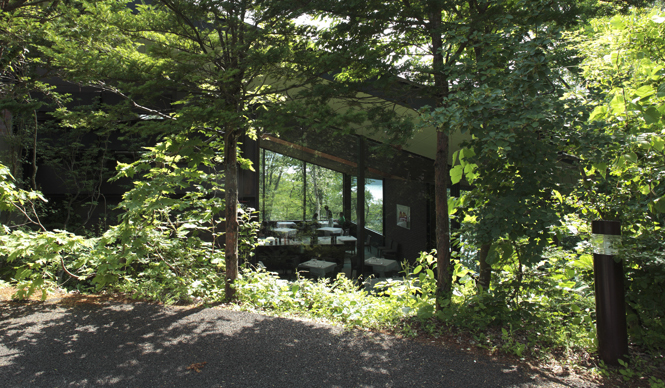
Feature: In Search of a True Summer Retreat – To Shinano Town, Nagano’s Hidden Gem – Part 1: A “Symbiotic” Hotel Living in Harmony with Nature
Feature: In Search of a True Summer Retreat
A "Town of Healing" Since the Taisho Era――Shinano Town, Nagano
Part 1: "Symbiotic Hotel" Living in Harmony with Nature
Early July, far too hot to be called early summer. We headed to Nagano Prefecture seeking cool air. Our destination: Shinano Town, Nagano, famous as the birthplace of Kobayashi Issa. There, tranquility, abundant nature, and the warm hospitality of the locals awaited.
Photographs by JAMANDFIXText by JUNKO TANAKA (OPENERS)
A "Town of Healing" Since the Taisho Era
About two hours from Tokyo by Shinkansen to Nagano, followed by another 30 minutes on a local line, lies Shinano Town, our destination. Located in northern Nagano Prefecture, it's the heart of the Joshin'etsu-kogen National Park, Japan's second-largest national park. Within the park, the majestic landscapes of Lake Nojiri and the Hokushin Five Peaks unfold. For travelers seeking to escape the city and simply drift, it's an ideal summer retreat.
This isn't a recent phenomenon. In the Taisho era, foreign missionaries, seeking to escape the increasingly popular and bustling Karuizawa, established a summer resort area along the shores of Lake Nojiri. This eventually led to what is now known as "Lake Nojiri International Village" (※).
These were people who moved here seeking a quiet environment. Since then, a lifestyle emphasizing simple living and spiritual richness has been maintained. For example, the approximately 250 wooden villas currently standing were built around the time the International Village was established. They have been maintained and preserved to this day with gradual repairs. This was done with consideration to minimize disruption to nature and to avoid becoming a "second Karuizawa."
A Hotel Inheriting the Spirit of the International Village
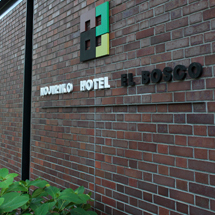
All bricks are Shigaraki ware
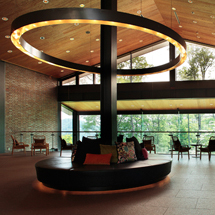
Check in while gazing at the forest and lake in the lobby
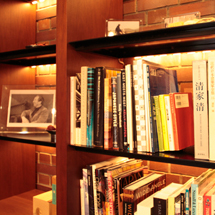
The concept is "A hotel for reading"
The spirit of the International Village still breathes throughout this town. One such place is "Lake Nojiri Hotel El Bosco" (hereinafter, El Bosco), which has been revived with a new concept from a hotel built 29 years ago. In 2008, the building, originally designed by architect Kiyoshi Seike, was reopened as "A hotel for reading," retaining its original structure.
"Why regeneration instead of renovation? Because we didn't think it was necessary to create something new. That's all. This is a building worth preserving for another 100 years. The method of regeneration was less about a drastic makeover and more about restoring it to its original intended state, akin to a restoration project. Our job was to remove elements that no longer met customer needs and help the work breathe again."

There are 50 rooms in total. Pictured is a Deluxe Twin.
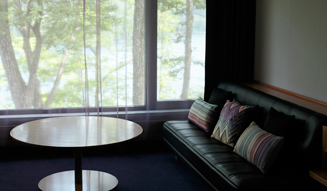
All rooms have a lake view
These words are from Aya Aso, who transformed the former "Lake Nojiri Prince Hotel" into El Bosco. She is currently the Representative Director of Agora Hospitalitys, which oversees eight alliance hotels in Japan, including El Bosco. A proponent of "preserving what is good," she is one who carries on the spirit of the International Village. Her background, born in Osaka Prefecture and raised in Brazil, might be another reason for her compatibility with this town, where "outsiders" have often served as a catalyst.

Aya Aso, Representative Director of Agora Hospitalitys
"When regenerating a hotel, people often start with the building's design. But we start from the opposite direction. We consider what kind of experience guests expect, and what kind of space would facilitate that. We then translate all of that into the concept."
At El Bosco, we want people to do things they can't do in their busy daily lives, like pausing time――I want them to come here to read. In the city, days just rush by, don't they? I hoped this would be a hotel chosen for the purpose of pausing that time and reading."
If a hotel is a space for experiencing the extraordinary, then "villa" is the most fitting description for El Bosco. It's a space that exists as an extension of daily life, where one can rest their mind, heal fatigue, or recharge their energy. In Ms. Aso's words, it feels like "what you experience here will enrich your everyday life."
Lake Nojiri Hotel El Bosco
4847 Furumi, Shinano-machi, Kami-takai-gun, Nagano Prefecture
Tel. 026-258-2111
Rooms: 50 (Twin, Maisonette, Maisonette Suite)
Check-in 15:00, Check-out 11:00
Meeting Rooms: 1
Restaurants: 3 (Dining "moment", Lounge, Bar "SOBA Bar")
www.nojirikohotel-elbosco.com