Georgian wine is about generosity. | EAT
EAT | Georgian wine is about generosity.
A fusion of ancient methods and modern technology
Today, it's unthinkable for anyone involved in the wine industry to be unaware of Georgian wine. It's full of discoveries, and the Georgian wines available in Japan have been carefully selected by Japanese wine professionals, ensuring their quality. Their compatibility with dishes that traditionally didn't pair well with wine is also a major appeal.
Text by SUZUKI Fumihiko (WINE-WHAT!?)
The oldest yet most modern wine captivating wine professionals
Georgian wine has been gaining attention in the Japanese wine industry for several years and is now increasingly seen in restaurants. In wine and food capitals like London and New York, it's already becoming a staple.
Georgian wine is contemporary. And it is also the oldest wine. Let's first summarize the key points of Georgian wine in three parts.
1) The history of winemaking in Georgia dates back archaeologically 8,000 years. As there is no evidence of older winemaking, Georgia is considered the "birthplace of wine."
2) The unique techniques believed to be from that era are still in use today, and wines made with these methods can still be enjoyed. In Georgia, individuals are not prohibited from making and drinking wine at home, so wine continues to be produced by thousands of grape growers and winemakers. There are so many "wineries" that it's impossible to keep an exact count.
3) Furthermore, Georgia boasts approximately 500 indigenous grape varieties, often referred to as local or heirloom varieties.
Georgia's traditional winemaking method was designated as an Intangible Cultural Heritage by UNESCO in 2013. This designation served as a clear catalyst for Georgia to begin exporting its wines in earnest. Of course, Georgia, located east of the Black Sea with Russia to the north and Turkey to the south, was a well-known wine-producing region during the Soviet era, and Russia remains an important market for its wine exports. However, Georgia has moved beyond the political framework of the Eastern Bloc to engage with the global market. And the world has discovered and embraced Georgian wine.
Wine production, inherited from ancient times and preserved dynamically without much influence from historical globalism, yields diverse wines from unheard-of grape varieties. This undoubtedly sparks the intellectual curiosity of wine experts. Moreover, Georgia is not merely a treasure trove of "local sake" that continues to preserve tradition, nor is it a region solely producing unstable quality wines. It is also a region that blends modern winemaking theories and technologies to produce high-quality wines.
Today, it is no exaggeration to say that it is unthinkable for anyone involved in the wine industry to be unaware of Georgian wine. Georgian wine is full of discoveries, and the Georgian wines available in Japan have been carefully selected by Japanese wine professionals, ensuring their quality.
However, explaining the spread of Georgian wine solely by its appeal to professionals feels incomplete. There are other reasons for us to try Georgian wine. For instance, its excellent compatibility with food.
Don't overthink it: a wine of generosity
What follows are more intuitive observations, but perhaps the global trend towards borderless food scenes is a background factor in the popularity of Georgian wine.
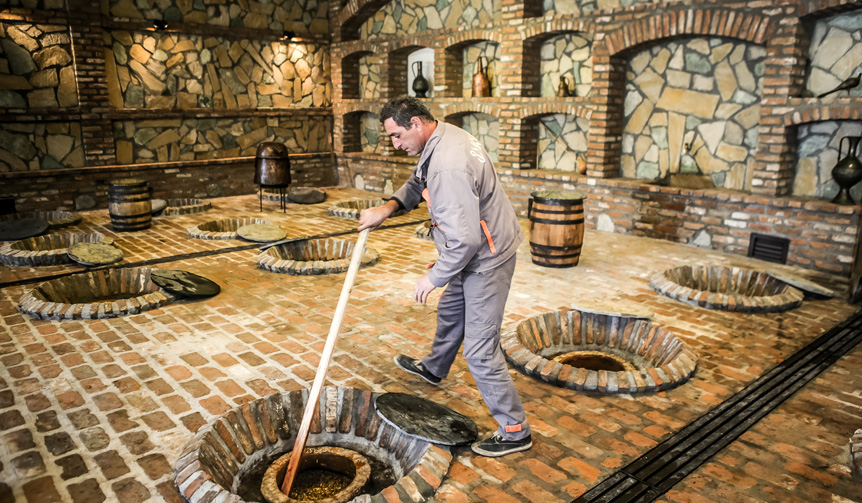
The traditional winemaking method in Georgia, recognized as an Intangible Cultural Heritage, uses large terracotta jars called Qvevri, large enough for a person to fit inside (typically 1000 to 2000 liters). The process involves shaping the clay on a turntable, drying it for 40 to 60 days, firing it for 10 to 12 days, and then coating the interior with hot beeswax and the exterior with a mixture of lime and river sand. Essentially, it's earthenware. It is said that only about 10 artisans can currently craft these Qvevri. Once completed, the Qvevri are buried in the ground at the winery, with only the opening exposed to the surface. Grape juice, skins, seeds, and sometimes stems are placed inside, and then the jar is sealed.
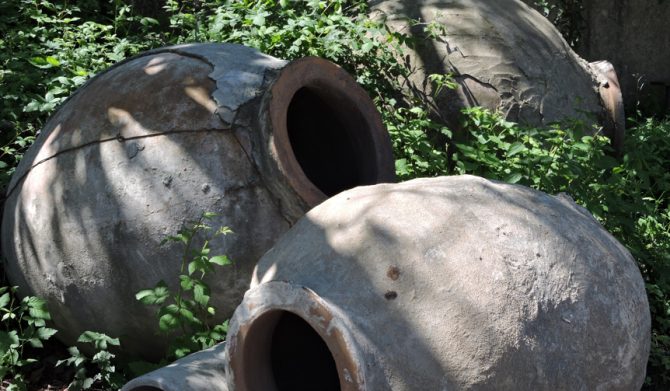
Then, fermentation begins with the power of natural yeasts present on the skins, and after a few months (about three to six months), when the jar is opened, there is wine inside.
Qvevri winemaking is an extremely natural yet highly rational method, as the underground temperature remains stable, and the skins and seeds contain antioxidants, eliminating the need for added preservatives.
Although Qvevri-made wines represent a small fraction of total Georgian wine production, they are the image leaders for Georgian wine. Currently, modern adaptations are being incorporated into this method to produce more stable, high-quality wines.
Now, the question is, what kind of wine is produced this way? The difference is particularly noticeable in white wines compared to conventional white wines. This is because conventional white wines are currently fermented using only the juice. Making wine with the addition of skins and seeds is typically done for red wines.

To put it very simply, this white wine is like a red wine. Due to the polyphenols (tannins) and color derived from the skins, the wine takes on an orangey hue, and is sometimes called orange wine to distinguish it from white wine. Orange wines possess a certain astringency and unique flavors and aromas that are difficult to achieve with conventional white wines.
This seems to significantly broaden the range of food pairings for wine.
For example, high-quality Georgian orange wines, while being very dry white wines, can have flavor profiles reminiscent of Chinese tea. Consequently, they pair harmoniously with dishes that traditionally didn't go well with wine, such as sweet Asian cuisine, dashi-based dishes, spicy foods, strong-flavored vegetables like cilantro, and even curries, sometimes even enhancing their deliciousness.
Of course, they also pair well with meat and fish dishes. Rich shellfish are also a good match. You could even try pairing an entire course meal with a single Georgian orange wine.
Chemically speaking, there are indeed food and wine pairings that do not work well together. However, choosing wine is not a journey to find the "correct" answer, nor is it like checking answers on a test. Food trends are also constantly evolving, with ingredients, seasonings, and cooking methods that were not traditionally used now being incorporated into dishes. Furthermore, delicate flavors that highlight the natural taste of ingredients are becoming mainstream. The compatibility with the deep, natural character of Georgian wine is increasing.

Photograph by YAMASHITA Ryoichi
While there are certainly fascinating details that captivate professionals, one can approach drinking it with a relaxed attitude.
Therefore, for those who have become interested in Georgian wine, I will conclude by introducing some representative Georgian grape varieties. Although I mentioned over 500 types, it's good to remember the three most widely produced varieties for now. If you have the opportunity to try them multiple times, it's interesting to notice the differences between producers.
First, Rkatsiteli. This is the quintessential Georgian grape. It has a crisp acidity, a slight bitterness, and perhaps a hint of smokiness. If you are wary of Georgian wine, thinking it might be something unusual, this is a good one to try first. Unless there's a significant issue, it will likely be surprisingly friendly. Rkatsiteli is also a versatile variety; while typically dry, it's also used for sparkling and sweet wines. Based on Rkatsiteli, Mtsvane is a variety with slightly less acidity, resulting in a richer, more sophisticated white wine. It tends to pair well with strongly flavored dishes. Finally, there's Saperavi, a black grape used for red wines. Its umami from tannins makes it a good match for protein, especially in meat dishes. Those who enjoy refreshing red wines with oak notes should definitely try it.
If these representative varieties aren't enough, here are two more that are relatively easy to find in Japan: Hikhvi, which can even exude an elegance comparable to high-quality European white wines, and Kisi, an interesting variety with a complex flavor profile and character, featuring notes of white peach, melon, almond, spices like clove and ginger, and a bitterness like walnuts.
If a sommelier or wine shop staff member is present, don't hesitate to ask them: "Which Georgian wine would be good with tonight's dinner?"