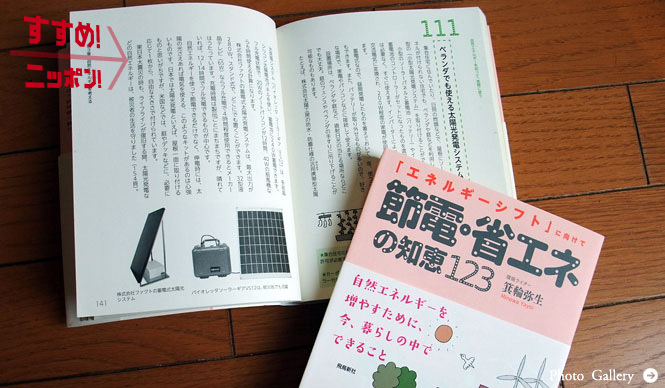
BOOK | '123 Tips for Saving Electricity and Energy' Towards the Energy Shift
Rethinking Life After 3/11
Towards an Energy Shift: '123 Tips for Saving Electricity and Energy' (1)
The Great East Japan Earthquakehas sparked increased interest in energy. Japan relies heavily on imports for oil and coal, and operates numerous nuclear power plants in earthquake-prone regions. Our affluence has, in fact, been built upon a precarious foundation. Knowing how to use energy efficiently and without waste is a mark of modern wisdom. This book offers a wealth of methods for living comfortably and abundantly while saving electricity and energy, along with ways to harness natural forces in our daily lives.
By Yayoi Minowa
Become a 'Power Saving Station'
The electricity and energy savings we can achieve in our daily lives have a significant impact, comparable to building large power plants. This July, when saving electricity was a major focus, the Tokyo Electric Power Company service area saw weekday savings of 20-30% compared to the previous year, and on the busiest days, over 40%. This is equivalent to the output of 15 to 25 nuclear reactors, each with a capacity of one million kilowatts.
The ongoing accident at the Fukushima Daiichi Nuclear Power Plant seems to have given us an opportunity to reconsider the energy we normally use. What is truly essential, and how can we live sustainably? We have been reminded that using energy does not automatically equate to prosperity.
In this context, the book presents numerous tips for saving electricity and energy without sacrificing comfort or abundance.
It concisely explains key points for more efficient power usage and waste reduction, accompanied by abundant photos and illustrations: adjusting LCD TV brightness can halve power consumption; putting computers in sleep mode; using blinds and sunshades to improve air conditioner efficiency; turning off water heaters, which consume the most standby power. These are simple yet effective strategies.
The editor of this book reports that after trying the methods introduced, their electricity bill was halved compared to the same period last year. By learning these tips, anyone can become a 'power saving station,' significantly reducing their electricity consumption.
Rethinking Life After 3/11
Towards an Energy Shift: '123 Tips for Saving Electricity and Energy' (2)
Towards a Life Utilizing Nature's Power
Another distinctive feature of this book is its extensive coverage of methods for effectively using natural materials and energy, not just saving electricity. Many of these are based on the author's own experiences.
For instance, solar heat can be used for hot water in summer and heating in winter. Walls can be coated with diatomaceous earth for humidity control, and an eco-plant in the living room can purify the air. Rainwater can be used for sprinkling to cool surfaces, the rooftop can be greened to combat heat, and a 'green curtain' of climbing plants can be grown on windows in summer.
Trying these methods reveals that harnessing nature's power is a remarkably sensible approach to saving electricity and energy. And unlike 'forced conservation,' these practices are enjoyable.
Experiencing this makes the reliance on importing vast amounts of fossil fuels from overseas and promoting nuclear power, which carries inherent risks, feel profoundly unnatural.
Shifting towards natural energy, starting from our immediate surroundings, seems crucial when rethinking life after 3/11.
Rethinking Life After 3/11
Towards an Energy Shift: '123 Tips for Saving Electricity and Energy' (3)
Let's Consider Energy
In addition to the 123 tips for saving electricity and energy, the book also delves into energy policy. The world watches with bated breath as Japan decides its energy path. The key to this lies, perhaps, in the examples of other nations.
Denmark, which had an even lower energy self-sufficiency rate than Japan during the 1970s oil crisis, not only improved building insulation and adopted energy-saving technologies but also shifted towards natural energies like wind power and biomass. Today, it supplies energy to other countries. Germany, too, is achieving both economic prosperity and a transition to natural energy.
The book also concisely and clearly explains Japan's electricity system, which lags behind Europe, and other crucial elements for future energy policy, such as smart grids and storage technologies.
One percent of the royalties from this book will be donated to the natural energy project on Iwaijima Island, Yamaguchi Prefecture.
We hope this book serves as a practical and effective 'handbook for saving electricity and energy' for its readers, and also contributes in some small way towards a better direction for Japan's energy situation.
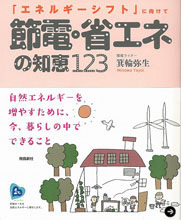
'123 Tips for Saving Electricity and Energy: Towards an Energy Shift'
Asahi Shimbun Publications
By Yayoi Minowa
¥1,365 (excluding tax)