April 16, 2015
TOKYO PREMIUM BAKERIES | Vol. 12 Boulangerie Nicolas
TOKYO PREMIUM BAKERIES | Vol. 12: Boulangerie Nicolas
Always Doing Something Different: Breadmaking as Self-Expression
In the 12th installment of our series introducing Tokyo's truly high-quality and delicious bakeries, we feature Boulangerie Nicolas Pain d’artisan, newly opened by Chef Haruharu Sugiyama, who honed his skills at the legendary Hanzomon bakery, Musee. Located in a residential area not far from Unoki Station on the Tokyu Tamagawa Line, the shop is marked by its red awning.
Text and Interview by Fuyuki TogawaPhotos by Mizuho Takada
Low-Temperature, Long-Fermentation Brings Out Yeast's Umami and Matures Flour for Its Own Flavor
Step off the Tokyu Tamagawa Line at Unoki Station, turn off the bustling Tamadutsumi Dori, and you'll find a quiet residential neighborhood. Walk about five minutes towards Denenchofu, and just when you think, "A bakery here?!" Boulangerie Nicolas appears. Its unassuming facade is so subtle, you might walk right past if you're not paying attention.
Opened last October, Boulangerie Nicolas is the much-anticipated shop from baker Haruharu Sugiyama, a name long revered among bread enthusiasts. His bread uses an extremely small amount of yeast, resulting in a profound depth of flavor that's unforgettable after just one bite. What's surprising is that he developed his signature "low-temperature, long-fermentation" method—now quite common—not by learning from others, but through trial and error.
Sugiyama didn't originally set out to become a baker. As an 18-year-old art student, he was assigned to the pastry kitchen at a local herb garden in his hometown of Ibaraki, where he first encountered making cakes and bread. At the time, he admits, "I didn't even know the difference between milk and cream (laughs)."
From age 21, he worked part-time in the cake and bread department at the "Tsukuba Daiichi Hotel" (now Okura Frontier Hotel Tsukuba), where he met his mentor, Masaichi Yamashita, whom he still deeply respects. Fascinated by the art of breadmaking under Yamashita, he trained diligently, eventually becoming the head baker at the aforementioned herb garden bakery, where he began creating his own original breads. Later, at just 23, he was appointed chef at Musee in Hanzomon, successfully running a highly experimental bakery before returning to his native Ibaraki to open Nicolas with his wife. Though they intended it to be a quiet establishment, it became surprisingly popular, drawing customers even from Tokyo.
A Single Mistake Led to "Low-Temperature, Long-Fermentation," a Method That Revolutionized Conventional Baking
Despite such a whirlwind career in his early thirties, Sugiyama took a break after closing Nicolas in Ibaraki before embarking on this new venture: the reborn Boulangerie Nicolas.
During his time at the herb garden bakery, Sugiyama encountered the poolish method—a technique where a portion of the dough is prepared and fermented before adding the main dough ingredients. While baking with this method, he accidentally used an extremely small amount of yeast. The dough, predictably, failed to rise, resulting in a failed bake. Yet, this bread possessed a sweet aroma unique to grains and an astonishingly delicious flavor unlike anything he had tasted before.
"This is it!" From there, his days of research began. With very little yeast, fermentation requires a long time, during which the yeast develops umami. Furthermore, because the yeast's activity is slow and time-consuming, the dough itself matures and develops its own umami. Thus, from a single accident, Sugiyama's "low-temperature, long-fermentation" bread was born—a method that overturns conventional baking wisdom, demanding time and effort but yielding a vastly superior taste.
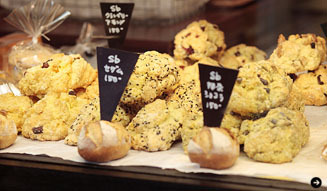
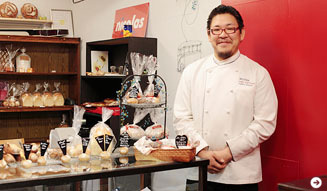
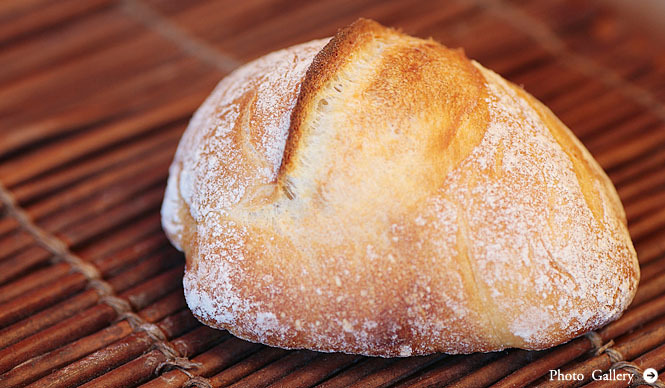
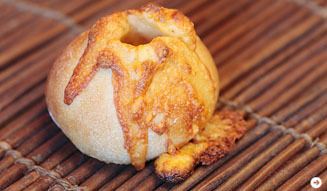
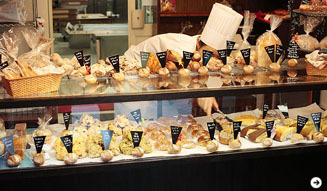
The shop currently offers about 30 types of bread daily, with many items changing. Baguettes, for instance, undergo a four-day resting period before baking using the low-temperature, long-fermentation method. Their signature "Rustic" bread, known for its satisfying chewiness, is a masterpiece that allows you to savor the natural sweetness of the flour. While baking times can't be fixed as they depend on the dough's condition, rustic and country breads are typically ready by midday.
Sugiyama is, at heart, an "artist." He himself jokes, "Breadmaking just happened to be my medium." He is driven by a passion to always think differently and create something new.
"The way I learned isn't the only way to make bread. I'm always thinking, 'Isn't there a better way to use the ingredients or prepare the dough?'" This is likely why Sugiyama's breads continue to evolve daily. "I want to do things that large manufacturers can't, and explore new forms of bakeries, right here in a small shop," he says. He's sure to embark on something truly exciting.
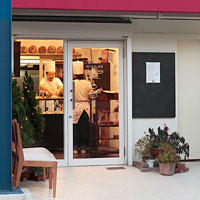
Boulangerie Nicolas - Pain d’artisan –
Boulangerie Nicolas Pain d’artisan
3-12-3 Unoki, Ota-ku, Tokyo
Tel. 03-5482-0808
11:00 AM - approx. 6:00 PM
Irregular Holidays
(5-minute walk from Unoki Station on the Tokyu Tamagawa Line)
http://www.nicolas-p.com/