March 6, 2015
TOKYO PREMIUM BAKERIES | Episode 10: Shoemaker
10th Installment: Schomaker | ショーマッカー
Authentic German Bread, Unadorned
This is the 10th installment of our series introducing Tokyo's truly high-quality and delicious bakeries. Our subject is Schomaker, a popular German bakery in Ookayama, where the Tokyu Meguro and Oimachi lines intersect. Having received the 'noren-wake' (a license to use the name and methods) from the highly skilled German bakery Schomaker in northwestern Germany, its authentic flavors are its main draw.
Reporting and text by Fuyuki TogawaPhotos by Mizuho Takada
Bread Made with Domestic Ingredients, Good for the Body
In the North Exit shopping street of Ookayama in Ota Ward, where a nostalgic atmosphere still lingers, a five-minute walk down a narrow lane off the main thoroughfare leads to Schomaker, marked by a sign featuring an illustration of a baker forming the letter 'S'. At first glance, it appears to be a modest, ordinary neighborhood bakery. However, stepping inside, the impressive lineup of German breads immediately heightens one's anticipation: 'This is a genuine German bread shop!'
Chef Nobutaka Shimizu developed an interest in food during his university studies in agriculture and veterinary medicine. His part-time work in baking sparked his fascination with the craft, leading him to join a major bakery manufacturer after graduation, where he focused primarily on French bread.
However, as he worked, he became increasingly concerned about the scarcity of healthy breads that those with allergies could safely eat in Japanese bakeries. Questions began to mount: Why is German bread sour? Why is it considered healthy? Why don't Germans buy the German bread from his own shop? His curiosity and questions about German bread grew, and at the age of 25, he finally moved to Germany alone to train in bread making.
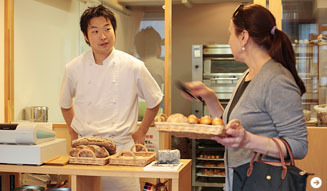
His training in Germany lasted two years. During the latter half, he apprenticed at a bakery named Schomaker in the small town of Leer, near the Dutch border in northwestern Germany. The shop, run by master baker Andreas Schomaker, is 'Die Bio Baeckerei Schomaker'—an organic bakery. While organic bakeries are not common even in Germany, at Schomaker, he mills his own pesticide-free rye, selected by himself, using a homemade mill within the bakery, and bakes flavorful rye breads the same day.
Chef Shimizu, having earned Schomaker's approval and the coveted opportunity to work at an organic bakery, apparently faced considerable challenges at first. The dough shaping technique was different. In Japan, he was accustomed to 'hiki-marume' (pulling and rounding), but in Germany, the predominant method was 'oshi-marume' (pushing and shaping), using the entire body.
Furthermore, while Japanese bakeries emphasize aesthetic appeal and delicate presentation, German bakeries prioritize strength, speed, and volume. In other words, bakers are expected to produce a large quantity of bread quickly.
Nevertheless, once he mastered the 'oshi-marume' technique, he found the training enjoyable, a testament to Chef Shimizu's strong resolve.
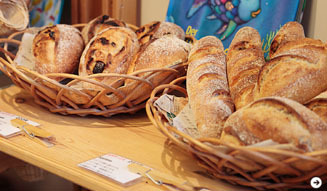
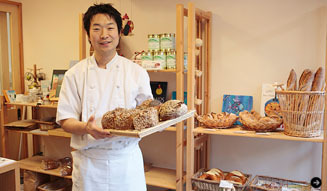
Chef Shimizu's breads are made using 100% German methods, with absolutely no alterations. The ingredients are fundamentally simple: rye, natural yeast, water, and salt. The ingredients are domestically sourced and chosen for their health benefits. The sourdough starter, brought back from Germany, is carefully nurtured three times a day, adjusting for water and room temperature. These are truly healthy breads, high in nutritional value yet low in calories, perfect for daily consumption.
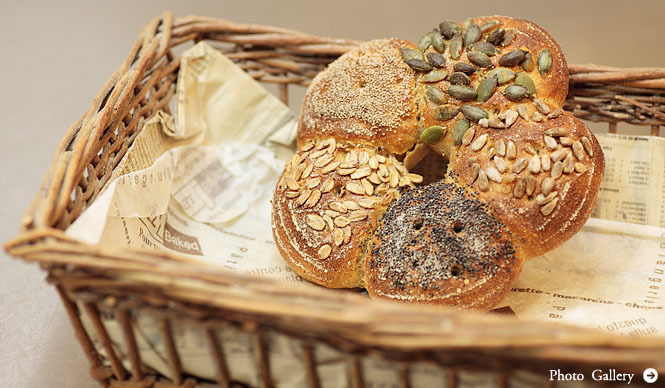
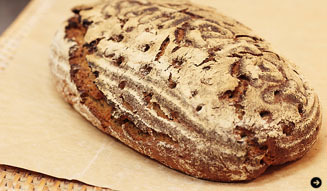
Recommended is the vibrant 'Party-Kranz,' generously topped with sunflower and pumpkin seeds. Made with 30% rye and 70% domestic wheat, its texture is approachable even for those new to German bread. 'Roggenbrot,' which means 'rye bread' in German, is the most standard bread in Germany. Made with 100% rye, its strong sourness delivers a hearty German bread flavor. The more you chew, the more the rye aroma fills your mouth, pairing exceptionally well with ham and cheese.
Ookayama is a town with a relatively high German population, partly due to a German school that was previously located nearby. During the interview, a German parent and child visited the shop, chatting happily with Chef Shimizu as they purchased a large quantity of bread.
Schomaker in Ookayama is the only establishment granted 'noren-wake' by the original Schomaker in Germany, and it proudly displays the same logo. The significant number of German customers living in the neighborhood is perhaps the best proof of its 'authentic taste.'
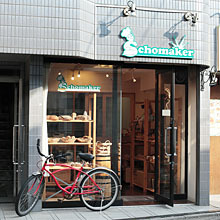
Schomaker
1-59-10 Kitakarasawa, Ota-ku, Tokyo
Tel. 03-3727-5201
Business Hours | 9:00–18:00
Closed Mondays
(5-minute walk from Ookayama Station on the Tokyu Meguro Line/Tokyu Oimachi Line)
http://www.schomaker.jp/