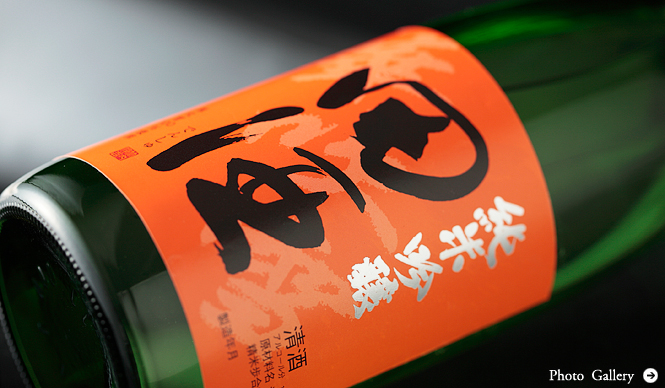
Wajō Waraku | Episode 1: Nishida Shuzo, the Brewery Behind "Denshu"
Exploring the Origins of Sake and Embracing New Challenges
Nishida Sake Brewery, Makers of Denshu
Established in 1878. Located in Aomori, the northernmost part of Honshu. Ohama, in Aomori City, Aomori Prefecture, once prospered as a port for the Tsugaru domain during the Edo period and is said to be the birthplace of Aomori. It is a land blessed with the bounty of mountains and sea, situated at the base of the Tsugaru Peninsula, facing Mutsu Bay.
In this Ohama lies Nishida Sake Brewery, the sole sake brewery in Aomori City, and the producer of "Denshu," "Kikuizumi," and "Utou."
Text by Wajo WarakuPhoto by Jamandfix (TOP)
Denshu: Junmai Sake, Kikuizumi & Utou: Ginjo Sake
"Denshu" is read as "Denshu." The character "田" (den) naturally refers to the rice paddy where sake's fundamental ingredient, rice, is grown.
As the name suggests, it is a rich and flavorful junmai sake that powerfully asserts its use of only rice, the sole product from the field, without any added brewing alcohol, allowing the true essence of the rice to shine through.
With the conviction to "return to the origins of sake and craft a dignified, authentic brew," the brewery began brewing traditional, entirely handmade junmai sake in 1970. It took three years to bring the product to market, and its release on October 1st, 1974, predated the Japan Sake and Shochu Makers Association's designation of October 1st as "National Sake Day" by six years.
In addition to "Denshu," our brewery has continued to produce "Kikuizumi" since its establishment. While Denshu is a junmai sake, Kikuizumi is a ginjo sake with the minimum necessary amount of brewing alcohol added. It is a clean, light, and refreshing taste that is not tiresome, achieved through traditional methods that bring out its deliciousness and umami.
This "Kikuizumi" has been submitted to the Tohoku Sake Appraisal and the National New Sake Appraisal, where it has won the highest honor in the industry, the gold medal, numerous times. "Utou" is also a ginjo sake with brewing alcohol added, similar to "Kikuizumi."
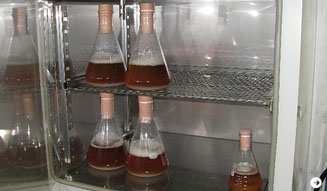
Nishida Sake Brewery Yeast
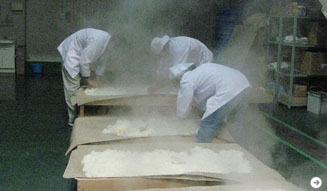
Nishida Sake Brewery Koji
Six Characteristics of Nishida Sake Brewery
A High Proportion of Women in Production and Product Management
During the sake brewing season, about half of the 30 employees are female staff. While on-site work is often approached from a male perspective, having many female staff members brings different viewpoints, expanding the scope of operations.
A Clean Brewery
Cleaning is performed continuously after each task is completed. The floors are cleaned multiple times a day, and the day concludes with a wet mopping of the floors.
Ginjo Sake and Above (Average Rice Polishing Ratio 53%)
All products from Nishida Sake Brewery are classified as tokutei meisho-shu (sake with a specific designation). Furthermore, all sake with added alcohol are ginjo types. All rice used is sake-grade rice, with an average polishing ratio of 53%.
No Activated Carbon Used
A significant characteristic of Nishida Sake Brewery's brewing process is the complete absence of activated carbon.
Activated carbon is typically used to remove undesirable flavors, off-notes, and the aged aroma that can develop during long-term storage. In essence, Nishida Sake Brewery views activated carbon as a "medicine to fix flaws." Medicine is for curing illness. Therefore, if the sake does not become ill, there is no need for medicine. Administering medicine to a healthy body can disrupt its balance and harm its condition. If the sake can be maintained in a healthy state, the use of medicine is unnecessary. Moreover, activated carbon does not solely remove these negative elements. While it treats damaged parts, as mentioned earlier, it can also adversely affect healthy components. In other words, it removes the sake's inherent umami and flavor.
Then, how can sake be made and kept healthy? This is achieved through constant taste checks of the finished sake and meticulous temperature control.
Nishida Sake Brewery has achieved "zero" activated carbon usage through fine-tuned tasting and rigorous temperature management.
All Ginjo Sake and Above Stored in Bottles
Ginjo sake and junmai ginjo sake with a polishing ratio of 50% or less are all stored in bottles. This means that bottled sake undergoes pasteurization once. Some tank-stored products use thermal tanks, while the rest are temperature-controlled using air conditioning.
Koji is Entirely Handmade
Despite the brewery producing only about 2,500 koku (approximately 450,000 liters), all the koji is handmade.
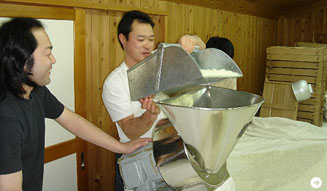
Nishida Sake Brewery Steamed Rice
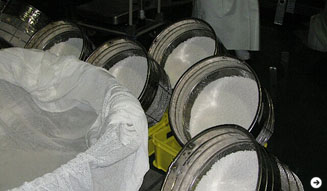
Nishida Sake Brewery Washed Rice
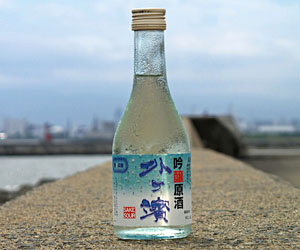
Introducing Hyosei: Enjoyable Sake in the Summer Heat
In the summer, we tend to lose customers to beer. And nowadays, customers are also drawn to shochu on the rocks. We thought, "How can we encourage people to drink sake even in the summer?"
Simply chilling it isn't enough; it quickly warms up. So, we wondered, "What about sake on the rocks?"
However, sake on the rocks had a drawback: as time passed, it became too diluted and watery.
Therefore, we decided to address this drawback in the following ways:
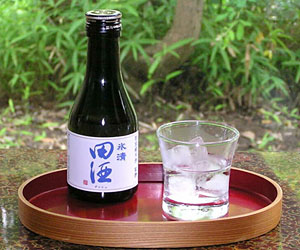
(1)Drink from a small glass. Use a small rock glass that can only hold one or two ice cubes (best with about 50-80cc capacity).
(2)Because it's a small glass, it's consumed in one or two sips, so the sake doesn't become too diluted.
(3)The sake must be "genshu" (undiluted sake). It should have an alcohol content of at least 17%.
(4)In other words, because it's genshu and won't become too diluted before finishing, the alcohol content will drop to only about 16% even after the ice melts.
(5)Keep the volume small. A maximum of 300ml, with 180ml or less being ideal. This size easily fits in a retail display cooler and also in a home refrigerator.
For commercial establishments, these are single-serving sizes, ensuring customers always receive a freshly opened bottle.
We began selling "Hyosei" in August 2004.
Introducing SAKE Highball: SAKE Sour
Following Hyosei, we took another step forward for summer products, aiming for a sake that could be enjoyed without resistance, even if it became watery.
To achieve an alcohol content close to that of beer (10% or less) without feeling watery, we mix it with carbonated water. It's like a sake highball. The ratio is 1 part sake to 1 part carbonated water.
This is a sake meant to be enjoyed for its refreshing throat-feel, rather than for savoring its complex flavors.
As this sake is also mixed with water, we used genshu (undiluted sake) as the base.
We started selling this last year, in 2008.
Challenging the National New Sake Appraisal with Local Rice and Yeast
The local rice is "Hanaomoi," the fourth generation of Aomori Prefecture's sake-grade rice.
"Hanaomoi" began development in 1988 at the Aomori Prefectural Agricultural Research Center, through artificial cross-pollination of "Yamada Nishiki" as the mother and "Hanafubuki" as the father, using techniques such as controlling daylight hours.
After many years, it was named "Ao-kei Shu 140" in 1998, and in 2002, it was designated as a recommended variety by Aomori Prefecture and named "Hanaomoi."
The local yeast is "Gō Kōbo," an Aomori Prefecture aromatic yeast developed in recent years.
This rice and yeast combination has excellent compatibility, resulting in a sake with a highly fragrant aroma and a light flavor.
With this combination, we won a gold medal at the "National New Sake Appraisal" in the spring of 2009.
Nishida Sake Brewery
http://www.densyu.co.jp/
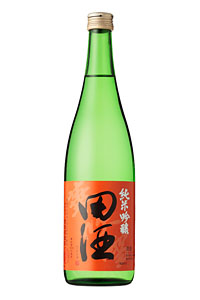
New Series Commemorative "Denshu" Giveaway
To celebrate the launch of the new series "Wajo Waraku SAKE Academy" in the web magazine OPENERS, we are giving away a 720ml bottle of the featured sake each month to three lucky winners.
If you wish to enter, please apply through the form below.
Winners will be contacted directly.
We also welcome your questions about sake. Those whose questions are selected will receive a popular sake from "Wajo Waraku." Please send us your questions about terms you'd like to know, or any simple queries you may have.
Application Period: Monday, August 3, 2009 - Monday, August 31, 2009 (until 12:00 PM)

Applications are now closed.
Thank you for your many applications.