April 2, 2015
New Series | Letters from Kesennuma | August: "Our Motto is 'Living with the Sea'"
New Series | Letters from Kesennuma
The Future, Handed Down Through People
August: "Living with the Sea" is Our Motto
In April 2014, travel journalist Naoko Terada headed to Kesennuma City in Miyagi Prefecture. Her goal was to participate in a "fishing boat experience tour" aboard a new fishing vessel, the first to be built in 20 years. Three years after the Great East Japan Earthquake devastated this region, Kesennuma is steadily, surely moving towards the future. Terada believes this boat represents a "beacon of hope" not only for Kesennuma but for the entire Tohoku region. Following the lead of the fishing boat, what did Terada discover about Kesennuma today and its future? Let's begin with the events that prompted her journey to Kesennuma.
Text & Photographs by TERADA Naoko
Encounters with People Rebuilding Kesennuma
The catalyst was a symposium on the Great East Japan Earthquake held in Tokyo in March.
Local representatives, government officials, volunteers, and travel agencies took the stage, discussing the current state of Tohoku in the aftermath of the earthquake from a tourism perspective, offering many insights into the role tourism could play in reconstruction support.
One of these speakers was Kazue Saito, from Saito Kichi Shoten, a seafood business that operates a shipping agency in Kesennuma. Born the daughter of the Saito Kichi family, she now serves as the company's managing director. Although Saito Kichi Shoten's head office, which combined their factory and home, was completely destroyed by the tsunami, they have rebuilt and now operate "Babba no Daidokoro" (Grandma's Kitchen) as a space for interaction with visitors to Kesennuma. Here, guests can enjoy meals made with fresh local ingredients, participate in workshops, and more, as they actively contribute to Kesennuma's recovery.
Kesennuma's motto for reconstruction is "Living with the Sea."
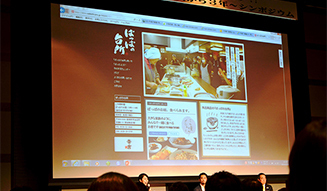
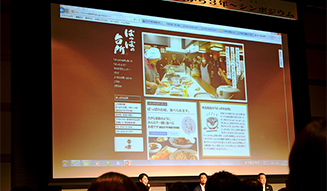
Symposium Panel Discussion
Throughout the symposium, Kazue maintained a bright, unwavering smile as she spoke about her business, her community, and Kesennuma, often eliciting laughter from the audience. Her innate sincerity, her deep affection for the people, things, and places of Kesennuma that have chosen to "live with the sea," and above all, her own sense of integrity as a part of it all, shone through.
During her talk, Kazue recounted how her family business was lost in the earthquake, the process of resuming operations, and the story behind establishing "Babba no Shokudo" after the disaster. She also spoke about the "Tsubaki-kai" group they operate.
The "Tsubaki-kai" is a group of volunteer women formed before the earthquake to revitalize Kesennuma. Comprised of women from various backgrounds—innkeepers, those in the seafood industry, business owners—they have been engaged in community revitalization activities. Kazue is one of them. One of the activities the "Tsubaki-kai" continues is the "Departure Ceremony."
Kesennuma is uniquely situated off its coast, where the Oyashio and Kuroshio currents meet, creating a rich fishing ground. This abundant environment boasts the highest catch yields in Japan for tuna, bonito, and saury. Many fishing boats travel to Kesennuma from all over Japan, unloading their catch at the nearby Kesennuma Port.
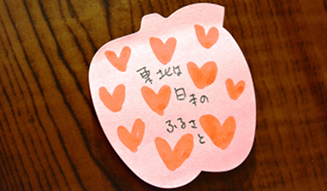
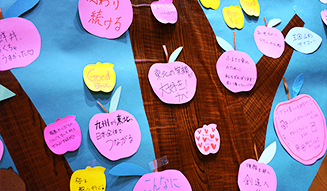
A message board from participants at the symposium venue
"Our port ranks first nationwide because we receive support from people outside the prefecture."
Kazue said this, explaining that the "Tsubaki-kai" wishes to express their gratitude to these ship owners and fishermen. The "Departure Ceremony" is their way of doing so.
The "Departure Ceremony" was a traditional event held since ancient times, but in recent years, due to changes in living environments and family structures, it had lost much of its former vibrancy. The "Tsubaki-kai" decided to revive the tradition of seeing off the boats together. It is a powerful and dramatic event where large fishing flags are waved, and the women of the port, their families, and sometimes even tourists, gather with taiko drums and paper streamers to celebrate safe voyages and bountiful catches as the boats and fishermen set sail. They believed it could attract attention not only locally but also as a tourist attraction, and more importantly, serve as a cheer for the rugged men of the sea. With this in mind, the "Tsubaki-kai" began participating in the "Departure Ceremony," which has gradually grown into a significant event in Kesennuma.
"Fishermen are truly magnificent!"
Kazue's words conveyed a sense of pride in the spirit of the men who live by the sea, gratitude towards many people, and an awareness of Kesennuma's new journey that has emerged since the earthquake.
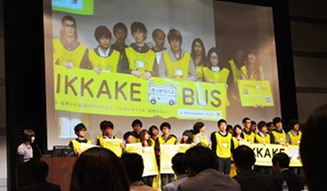
The "Kikkake Bus 47" project, where students organize buses from all 47 prefectures to Tohoku for reconstruction and disaster prevention.
She added that in April of this year, the "Tsubaki-kai," in collaboration with JTB's "Tohoku Furusato Ka (Department)" initiative for Tohoku reconstruction support, would jointly organize a "Deep-Sea Tuna Longline Fishing Boat Experience Tour." The boat tour itself was made possible by President Usui of Usufuku Honten, a local fishing company, who graciously allowed tour participants to join. Traditionally, women are not allowed to board fishing boats due to the presence of a "funadama," a female deity associated with the sea. However, this particular vessel, a new fishing boat built for the first time in 20 years in Kesennuma, permitted women to board.
I wanted to seize this rare opportunity. Of course, boarding a fishing boat was important, but more than anything, I wanted to visit Kesennuma. Learning about Kazue and the Kesennuma of today, with her at the center, felt profoundly significant.
And that intuition proved correct.
Naoko Terada
Travel journalist. Spends about 150 days a year living in hotels abroad. Has visited around 60 countries, including Australia, Asian resorts, and Europe. Primarily contributes to magazines, weekly publications, and newspapers. Her books include "Hotel Brand Monogatari" (Kadokawa Shoten), "London Bishi Guide" (Nikkei BP, co-authored), "A Journey Through English Gardens" (Nikkei BP Kikaku, co-authored), and she produced "Wagamama Aruki Bali" (Jitsugyo no Nihon Sha).