Designer Explains the JULIUS Spring/Summer 2016 Collection
JULIUS
A menswear brand presenting collections twice yearly in Paris
The Designer Discusses JULIUS's Spring/Summer 2016 Collection (1)
Launched in 2001 as an art project, JULIUS is a brand whose concept is "pursuing a worldview of decadent beauty and aggressive fetishism." Its unique universe, crafted through four forms of expression—clothing, film, graphics, and music—is enthusiastically embraced by men who live in the city yet aspire to an avant-garde lifestyle. We spoke with Tatsuro Horikawa, the designer who presents collections twice yearly in Paris, about the Spring/Summer 2016 collection.
Text by KAJII Makoto (OPENERS)
A Collection Evoking Wind and Celebration
Marking its 15th year, JULIUS unveiled its collection on June 27th in Paris, centered around the concept of [sefiroth].
—Please tell us about the origin of the concept [sefiroth] for this Spring/Summer collection.
Tatsuro Horikawa“Nature.” The law of Sefirot, an ancient Kabbalistic philosophy positing that all matter exists according to certain principles. From this, we derived essences such as yin and yang, and black and white (in a civilized sense).
I tend to build upon abstract images, so it's difficult to define a theme precisely, but I believe this show strongly emphasized the contrast and fusion of technology and tribal elements.
Also, my trip to Morocco had a significant influence, particularly encountering the "Tuareg," a desert-dwelling people. They were a proud tribe living in the desert.
The "Tree of Sefirot," which became the collection's theme, is also known as the "Tree of Life" and has various interpretations. For this collection, JULIUS expresses the cycle of life, encompassing all contrasting elements such as good and evil, and life and death.
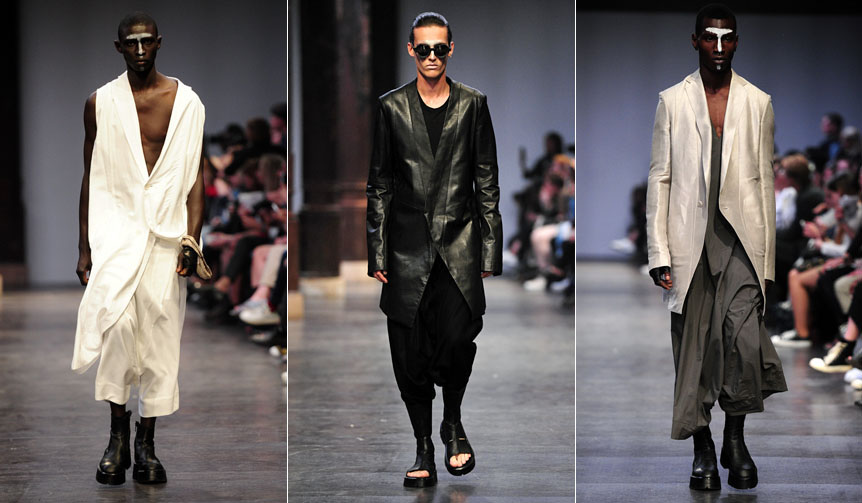
JULIUS has often been associated with the image of surviving in modern society—the city. However, this show focuses on "coexistence with nature." Omitting urban imagery, it approaches a more natural, primal African shamanism.
Presenting a New Organic Ethnicity
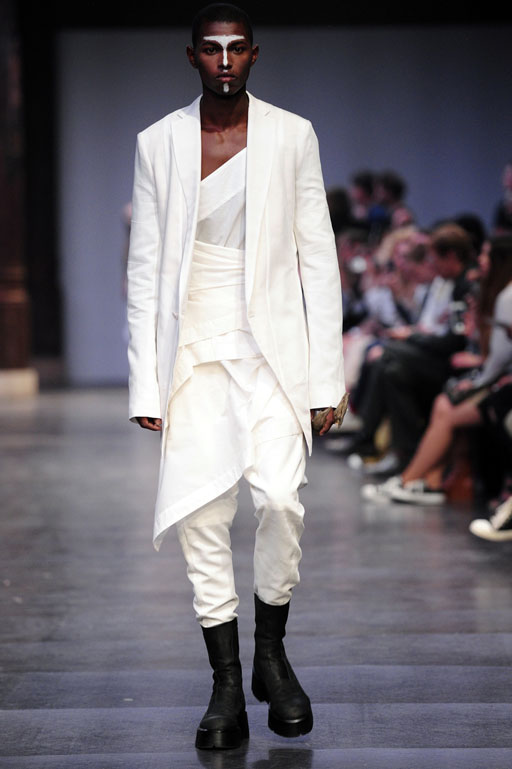
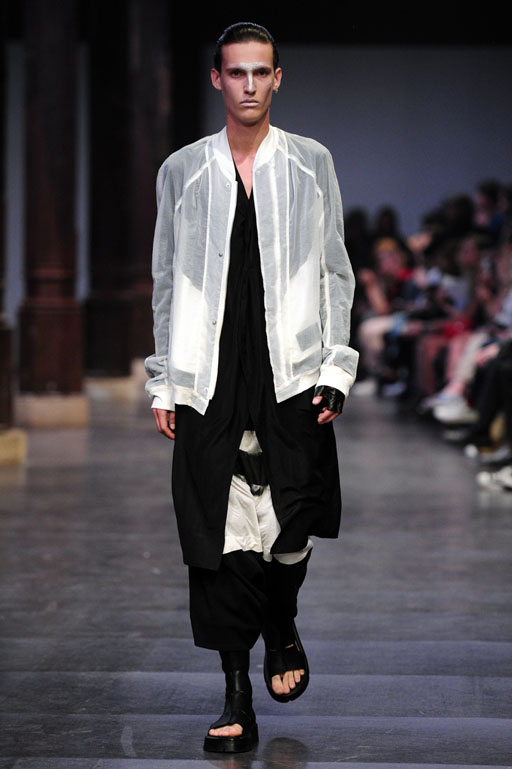
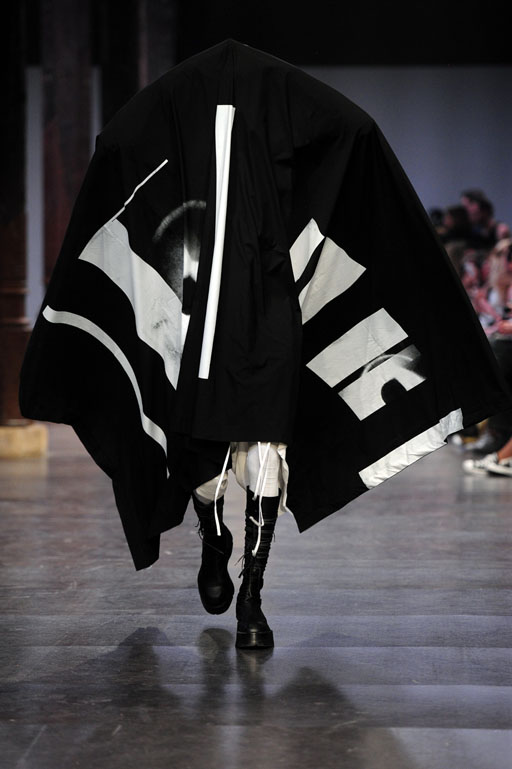
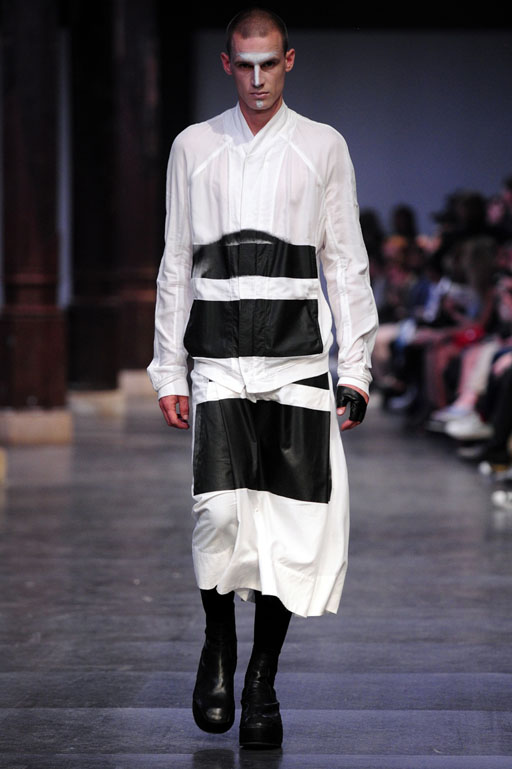
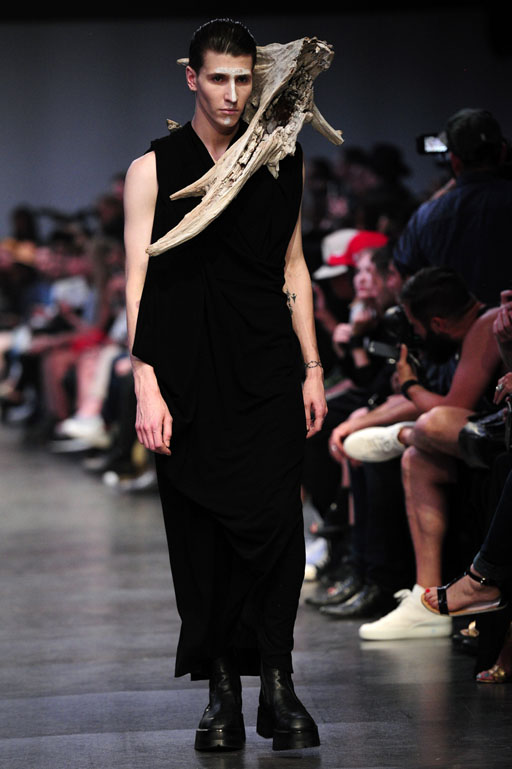
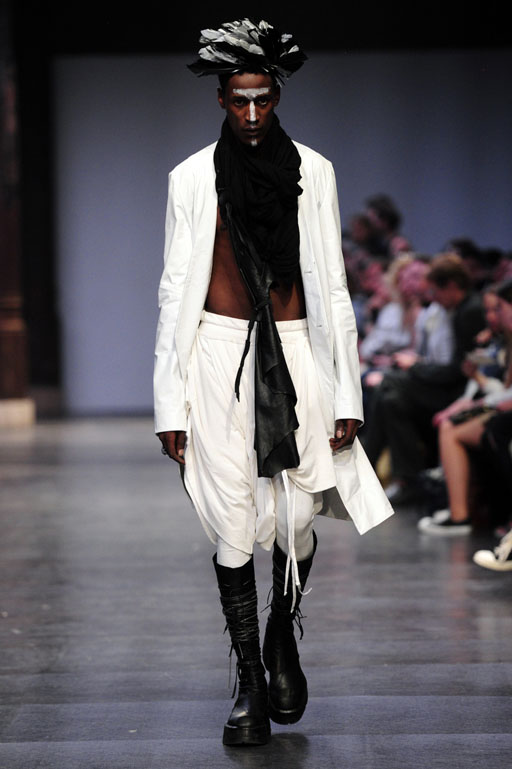
Models appeared on the runway with "paintings"—white lines drawn on their faces, reminiscent of African tribal ceremonies. Draping items that flowed like wind were central, layered with JULIUS's signature black alongside off-white and beige tones inspired by sun-baked stones.
—Please tell us why you chose this venue and how it contributed to the collection.
HorikawaThis time, we used "COUVENT DES CORDELIERS," located within the grounds of a medical university in Paris's 6th arrondissement. Built in the Middle Ages as a convent, it is now a designated cultural heritage site. We wanted a historical venue, and to contrast its decadent pillars and walls, we created a solid, contemporary feel with massive LED lighting.
—Please tell us why you started showing in Paris, why you continue to do so, and what it means to you.
HorikawaFor me, it felt natural. While overseas buyers did visit our exhibitions in Tokyo, a presentation in Paris was expected, and I wanted that too. Perhaps it was a convergence of their needs and our energy.
I also felt that achieving the desired quality for the show itself would be difficult in Tokyo. There weren't many alternatives to showing in Paris. I don't think there will be in the future either.
JULIUS
A menswear brand presenting collections twice yearly in Paris
Tatsuro Horikawa Discusses JULIUS's Spring/Summer 2016 Collection (2)
Why Harris Elliott Was Chosen
—Please highlight a few looks that symbolize this collection.
HorikawaThe show begins with a shaman performing a ritual on the models. The prints represent tribal tattoos, the embroidery signifies implants, and tent-like silhouettes symbolize initiation rites into adulthood. The body is adorned with symbols of tribal leaders, like a tree wrapped around it.
—What was the reason for choosing Harris Elliott as the stylist for this collection?
HorikawaI've always felt a spiritual dimension in his styling and direction, in a primal sense. I wanted this show to be more than just a fashion show; I envisioned it as a kind of tribal "ritual." The elements of black and white—in terms of race, culture, and color—were also important, so I approached him.
He was even involved in the casting. This is my favorite casting for a show of mine. Several models were street-cast. They shone exceptionally!
Aiming for Shows That Are More Focused on Expression
—Do you gain anything from showing in Paris?
HorikawaAbove all, the happiness of having customers all over the world is something not easily obtained!
—What do you believe can be conveyed through fashion (shows)?
HorikawaFundamentally, we hold shows to present my worldview as a body of work. While the mood of the times and global events are reflected, I intend to present more strongly personal themes going forward.
We have also launched a standard pre-collection and a separate brand with a stronger street influence. We plan to introduce a formal line starting with the next collection. As these grow, we aim to make the shows themselves more focused on expression.
—What are your thoughts upon concluding this collection? And please, a message for our readers.
HorikawaWe are already moving towards the next show, so I can't look back too much on Spring/Summer 2016, but please look forward to the next one.
Inquiries
JULIUS FLAG STORE
Tel. 03-5728-4900
www.julius-garden.jp
https://instagram.com/_julius7official/