March 6, 2015
Part 13: The Season of Changing Clothes for Summer, and Kimono Q&A
Part 13: The Season of Changing Clothes for Summer
Illustrator Kazuo Hozumi explains the "basics" of dressing for men's kimono. Part 13 discusses changing clothes for the season. This time, we also have him answer questions about kimono that have been submitted.
Text and Illustrations by Kazuo HozumiPhoto by Jamandfix
The Season of Unlined Kimono
June arrives, and with it, the summer season. June is the time for changing clothes, and kimonos are worn in summer attire until the end of September.
After spending the autumn, winter, and spring in awase (lined kimonos), the traditional Japanese custom is to switch to hitoe (unlined kimonos) from June 1st until the end of September.
However, with global warming, we often experience summer-like days in mid-May with temperatures around 30 degrees Celsius. Because of this, rigidly adhering to tradition isn't always practical. People have become more accepting of wearing summer clothing earlier.
During the rainy season, there can be days that are humid and slightly chilly. Once you've changed into your summer wardrobe, it's not feasible to bring out your lined kimonos again. In such cases, layering is the only solution.
In July and August, kimonos are for midsummer, with materials like linen (jofu, chijimi), lightweight pongee, and sha becoming common (men rarely seem to wear ro). Again, if it's hot, there's no problem wearing these from June. Cotton, the quintessential summer fabric, is perfect for festivals from spring to autumn, making this the busiest season for it.
When you change your clothes for the season, take this opportunity to inspect your lined kimonos from winter. Fold them neatly and store them away after cleaning or maintenance as needed.
Answering Your Questions
We've received several questions from readers of this series, so we'll answer them here, along with some points we've previously covered.
QuestionI've heard there are kimono dressing classes for men. Would it be a good idea to attend one as a beginner?
AnswerI started wearing kimono on my own without attending any classes, so I'm not sure exactly what they teach or how much. However, I imagine you would learn a lot of knowledge if you did attend.
For women, it seems difficult to dress beautifully on their own, so many beginners attend dressing classes. For men, it's not as challenging, so I think learning on your own is perfectly fine.
This series is intended to help those who have very little knowledge about kimono.
QuestionI have this kimono, which was expensive, but I hear there are many strict rules about when it's appropriate to wear it...
AnswerThis is about the "rank" or formality of kimono, isn't it?
Just as Western clothing has formal and casual wear, kimonos also seem to have a ranking system. I'm not an expert on all materials and fabrics, but generally speaking, kimono fabrics are either "dyed" or "woven." Dyed fabrics are typically considered more formal than woven ones.
Dyed fabrics are made by weaving the fabric first, then dyeing it, such as habutae or chirimen. Examples include formal black crested kimono (kuro-mon-tsuki) and Edo komon. Most men's kimono fabrics, other than these, are woven.
Among woven kimonos, 'Omeshi' is considered the highest in rank.
Generally, pongee (tsumugi), no matter how expensive, falls into the category of everyday wear in terms of kimono formality. Formal black habutae can be found in less expensive versions made of synthetic fibers. Oshima pongee, for example, is yarn-dyed, so even if it's expensive, it's not suitable for formal occasions. Think of it as loungewear for at home or for walks.
Lately, I even wear Oshima pongee when I go to formal gatherings. Experienced hostesses, with their impeccable grace, might say something like, 'We're happy if you feel as relaxed as if you were at home.' Can you grasp the nuance here?
QuestionI've heard there's a type of haori-himo called 'ichimonji' that doesn't have tassels at the end. However, the kimono shops I frequent don't seem to know about it or carry it. Where can I find one?
AnswerKimono shops carry various accessories, but for more specialized items, it's best to go to a specialty store. I recommend a shop that deals in Japanese accessories, particularly one specializing in braided or woven cords, such as kumihimo or amihimo. They handle items like women's obi cords and haori-himo.
Many stores only carry short haori-himo with S-hooks. For these cases too, it's best to look for a specialty store. They also sell cords for Japanese pocket watches and mobile phone straps.
QuestionWhat is 'nagagi'?
AnswerIt refers to a regular kimono. I believe it's used in contrast to 'haori' (a jacket worn over a kimono).
QuestionI bought an antique kimono, but it's too short and I'm having trouble with it.
AnswerAntique kimonos, or those received from acquaintances, often don't fit perfectly. People in the past were generally smaller than they are today. However, kimonos are well-made, and minor alterations are usually possible.
Women's kimonos are generally made with extra length, as they were historically worn with the hem trailing indoors (especially by the wives of samurai or wealthy merchants).
Currently, the length is adjusted by creating a 'ohashori' (a fold at the waist) secured with a shigoki cord before tying the obi. Men's kimonos are 'tsuitake,' meaning they are tailored to the wearer's height from the start.
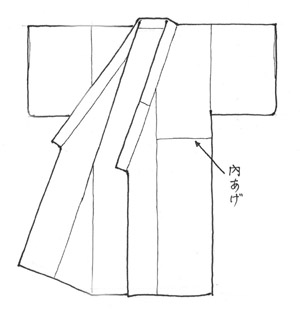
However, kimonos have an 'uchia-ge,' a section with extra fabric around the waist. By undoing this 'uchia-ge,' the kimono can be lengthened by that amount.
This 'uchia-ge' is a horizontal seam. This seam should be positioned where it will be hidden by the obi. It would look unsightly if the seam were visible above or below the obi.
If you have a neighbor who is skilled in sewing kimonos, it would be wonderful if they could make such alterations casually.
I once had a vintage women's kimono altered into a men's kimono. The 'uchia-ge' seam is visible above the obi, which I regret. However, I wear it without worrying too much.
There's a story about a young mother who bought a child's yukata that was too long. After much thought, she folded the hem inward and sewed it. Children's kimonos are typically made larger than their current size and adjusted for growth with 'koshi-age' (waist tucks) and 'kata-age' (shoulder tucks).
Kyoto maiko, despite their mature appearance, have 'kata-age' and sleeve tucks on their kimonos to create a childlike charm.
If the sleeve width (sode-yuki) is short, there's usually some allowance in the shoulder seams that can be let out to lengthen it. If it's still too short, fabric can be taken from the collar area and added to the sleeve attachment. This is not noticeable at first glance. For such extensive alterations, you must rely on a professional tailor.
Another method for lengthening sleeves is to use a separate piece of fabric. If the coordination is done well, it can even transform the kimono into a unique piece.
QuestionIs it acceptable to wear a dress shirt or similar under a kimono?
AnswerYes, it's perfectly fine. Ken-Suke Ishizu, a renowned figure, used to wear kimonos over a winged-collar shirt.
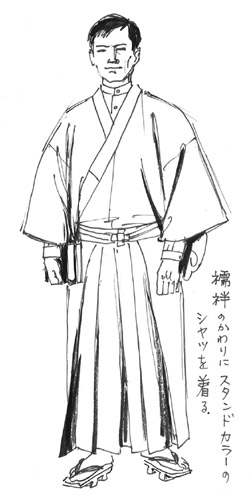
For younger people, I recommend a collarless, stand-collar shirt. This was the style for students in the Meiji era, as seen in Kurosawa's film 'Sugata Sanshiro.' You can even skip the nagajuban (under-kimono).
Pairing this shirt with a Satsuma kasuri or Kurume kasuri (which are quite expensive now) and hakama creates a perfect ensemble. It's guaranteed to be popular. I'll write more about hakama on this site later.
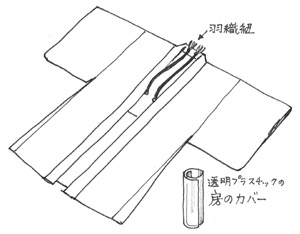
QuestionWhen folding and storing a haori, do you remove the haori-himo each time?
AnswerIf you have multiple haori-himo and like to mix and match them with your haori, then you'll need to attach and detach them each time you wear or remove the haori. Since it's easy to switch them, this method is fine if you use S-hooks.
I don't use S-hooks, and since it's bothersome to switch them, I usually leave them attached. This means you need as many haori-himo as you have haori. To prevent them from getting twisted when folded, arrange the haori-himo straight along the collar, towards the top.
To prevent the tassels from becoming creased and unsightly, steam them, straighten the threads with a toothbrush, and protect them with a plastic tassel cover.
QuestionEven on hot summer days, is it strictly necessary to wear a nagajuban?
AnswerYes, except for yukata. Even with yukata, depending on the color and pattern, you might wear one.
However, in summer, you wear a 'natsu-juban' (summer under-kimono). These are made of lightweight cotton or linen for a cool feel, but since you're still layering, it's unavoidable that it will be hot.
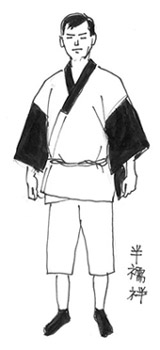
This is where a 'han-juban' (half under-kimono) is useful. It's shorter, like a half-coat. You only need to wear 'suteteko' (long johns) underneath. Originally, with a han-juban, men were also supposed to wear a 'susoyoke' (essentially a loincloth), but this seems to defeat the purpose of wearing a han-juban.
A 'han-eri' (half collar) is also necessary for a han-juban. When washing, it's attached and detached by hand-sewing.
For summer nagajuban, 'han-eri' made of cool-looking materials like 'ro' (a type of gauze weave) are preferred.
Kimono sleeves have wide openings, allowing air to flow in, making them comfortable in summer. However, when you wear a nagajuban and even a summer haori (with haori-himo often featuring openwork designs for summer), it looks cool but can actually be quite hot. Embracing that heat is what 'date' (style) is all about.