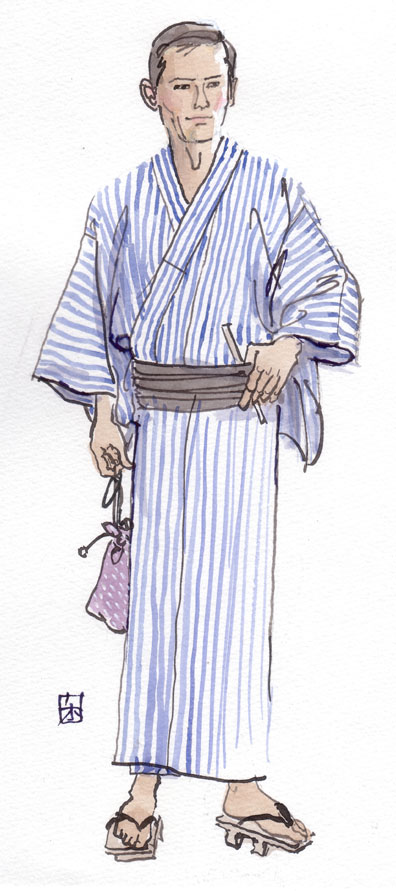
Part 2: Let's Try Wearing a Yukata (1)
In this ongoing series, illustrator Kazuo Hozumi offers his take on stylish kimono dressing. For our second installment, we finally dive into the practicalities with the yukata.
Where can you find one, how do you wear it, and what are the key points for a chic look?
Text and illustrations by Kazuo Hozumi
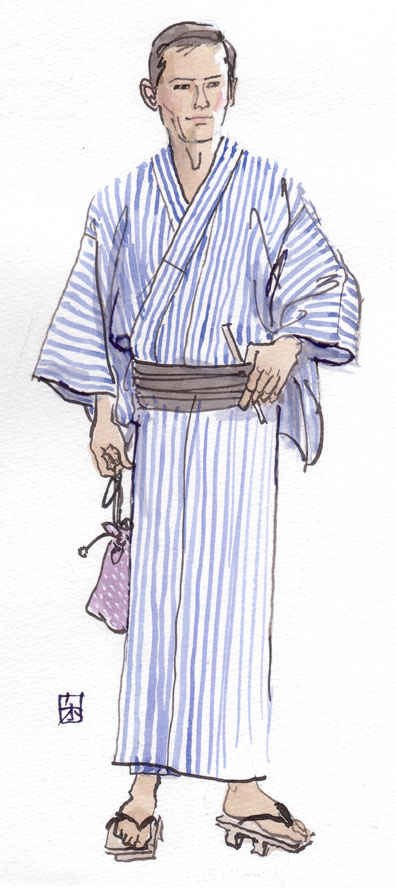
Subtle All-Over Patterns Are Easiest to Style
This time, let's jump right into wearing a kimono. We'll start with the easiest and most fundamental for the coming season: the 'yukata'.
Head to any kimono shop. Ask to see yukata fabric rolls, get measured, and place an order for tailoring. Expect to pay around 10,000 yen each for the fabric and tailoring. A department store will also do.
Yukata are typically made of cotton and unlined. As they are washed and worn, they gradually soften. In the past, after extensive wear, they would be unstitched and used as diapers for infants.
Department stores also sell ready-made yukata, which are perfectly fine for those with standard body types. Since they are already tailored, you can wear them right after purchasing.
Subtle, smaller all-over patterns are generally easier to manage. Trying to look stylish with large, connected patterns from the start will be futile if your way of wearing it is off.
Ready-made garments sometimes have questionable stitching, possibly due to their origin in China, but they usually come in sizes like L, M, and S, so choose one that fits your height.
The price is around 10,000 yen. I recently saw a three-piece set of yukata, obi, and geta for 10,000 yen.
There are also shops calling themselves antique or recycle stores, but they are essentially secondhand clothing shops. I saw a yukata for 500 yen at one of these places recently. I considered buying it, but decided against it as the length and sleeve dimensions weren't quite right.
You don't need a nagajuban when wearing a yukata. For undergarments, a T-shirt or tank top with susuteko is fine. Avoid crew-neck T-shirts; V-necks are the way to go.