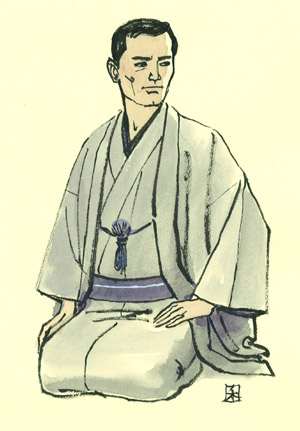
Part 7: The Awase Season Arrives
Illustrator Kazuo Hozumi explains the "basics" of men's kimono styling.
This is the seventh installment, focusing on lined kimonos. As summer gives way to autumn, it's time for a wardrobe change to more traditional Japanese attire.
Text and illustrations by Kazuo Hozumi
Your First Kimono
In October, the transition from the unlined summer kimono (hitoe) to the lined awase begins. Awase kimonos, which have a lining, are worn throughout the autumn, winter, and spring seasons.
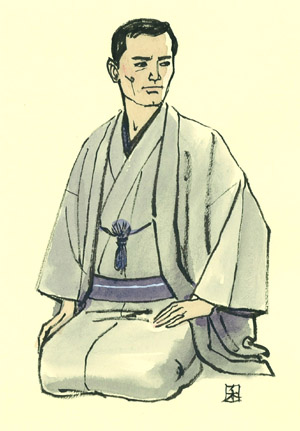
Summer began with the simple yukata, but the awase is a truly formal kimono. The process starts with selecting the fabric and then commissioning the tailoring.
Ideally, ordering a bit earlier, perhaps after mid-August or in early September, would allow the tailor to work more leisurely and meticulously.
The primary fabric is silk. While there are many types, the choice often depends on where you plan to wear the kimono.
In Western terms, you need to decide whether it's for relatively formal occasions or more casual wear.
For formal wear, there's the black habutae silk with crests, but let's consider that a separate category, akin to morning coats or tailcoats.
Let's narrow it down to options like Omeshi silk, Tsumugi silk, or perhaps more casual cotton or wool.
First, let's consider kimonos for going out. "Going out" can encompass various scenes, such as visits, parties, dinners, theater, dance, or concerts.
In my case, I started by visiting a long-established kimono specialty store and, as a complete novice, asked, "I'm wearing a kimono for the first time, what do you recommend?"
Among the fabrics shown, I was drawn to a Tsumugi silk in a light gray solid color.
Tsumugi is slightly more casual than Omeshi, but the one I chose had a slightly Omeshi-like feel, with a soft texture and a dressy aura. The lining was silk, and I left the color choice to the expert's recommendation without much fuss.
Once the kimono was ready, I decided to order a haori (jacket) to match. This one was a plain Omeshi silk.
I initially considered a navy blue, thinking of a blazer style, but following the kimono shop's advice, I opted for a darker brown than the kimono.
Incidentally, I made one special request: I wanted a single crest on the back of the haori, preferably a "seimon" (embroidered crest). The shop agreed, and it was done.
With the first kimono and haori tailored, my ensemble was complete. The satisfaction was high, and with the addition of hakama, it remains the most dressy outfit in my collection.
Matching Kimono Sets
In my case, the kimono and haori were made from different fabrics and colors, but when made from the same fabric, it's called an "otsui" set.
In other words, it's an ensemble, similar to a Western suit.
While this is common and widely worn, I wanted the freedom of separates from the start. It's akin to the concept of a blazer versus a suit.
With a good sense of coordination, you can enjoy more variety than with an otsui set. However, this is a matter of personal preference; some prefer the matched set, while others find it more interesting to mix and match haori and kimono.
I choose to wear both, depending on my mood at the time. Sometimes I even swap haori and kimono from two different otsui sets. This allows for four different color combinations.
Kirinashi (Unlined Kimono)
Wearing a kimono without a haori is called "kirinashi." This is also a matter of preference; some find kirinashi more stylish, while others feel a haori completes the overall look.
My colleague, illustrator Nobuhiko Yabuki, dislikes wearing haori. Conversely, I prefer to wear a haori for outings.
By trying various combinations, you'll naturally develop your own unique style.
Lined Kimonos Require Juban
For kimonos other than yukata, you wear a nagajuban underneath.
A "haneri" (half-collar) is sewn onto the collar of the nagajuban, and it's standard practice to replace it when it gets dirty. For men, haneri are usually plain, but consider the color coordination with your kimono and haori. This is a crucial point for coordination.
However, there are cases of "suawase," where the juban is omitted, but this should be considered a very informal style.
Nagajuban are made of materials like silk orモスリン (mosurin), and colors and patterns can be relatively free. The length and sleeve width should be shorter so they don't peek out from the kimono's hem or cuffs.
Since it's now the season for awase kimonos, it won't be relevant until next summer, but if you intend to wear summer kimonos properly (other than yukata), you'll need summer juban. These are often made of thin cotton or linen, and some are short-length, called "hanjuban."