
Part 12: Elevate Your Look with Footwear
Kazuo Hozumi, an illustrator, explains the "basics" of dressing in men's kimono.
In this 12th installment, we focus on footwear such as geta and setta. While it's fine to play the part of Ryoma Sakamoto, wouldn't traditional Japanese footwear suit a kimono better?
Text and photos by Kazuo Hozumi
Ryoma's Leather Shoes, Schoolgirls' Lace-ups
When wearing a kimono, it's only natural to wear traditional Japanese footwear. That said, there's no rule against wearing Western shoes.
Ryoma Sakamoto, for instance, is depicted in statues wearing formal kimono, hakama, and Western shoes, complete with swords. It was, in a way, the cutting-edge, fashionable style of the time.
For female university students' graduation ceremonies, the traditional kimono and hakama style is still common, and many wear shoes with it. This style dates back to the Meiji era, when ankle-high lace-up boots were the norm.
Geta: The 'Karokoro' Sound
The most common type of footwear is geta.
When I was a child, I exclusively wore geta. Even in elementary school, I commuted to school in geta during the summer. By high school, I was wearing 'hooba' geta – tall wooden clogs with a paulownia base and a 'ho' wood tooth.
Geta with separate teeth, such as 'ashida', 'hiyori-geta', and 'azuma-geta', were widely used from the Edo period. There were even itinerant vendors who sharpened geta teeth. Today, apart from 'Rikyu' geta worn by sushi chefs, they are rarely seen.
Geta where the base and the teeth (the part that touches the ground) are carved from a single piece of wood, in the Satsuma-geta style, seem to have become popular from the Meiji era.
Kankichi Dan, strolling on Atami's coast in "The Golden Demon," and the protagonist of "The Izu Dancer," both wore 'hooba' geta, which were typical of high school students back then.
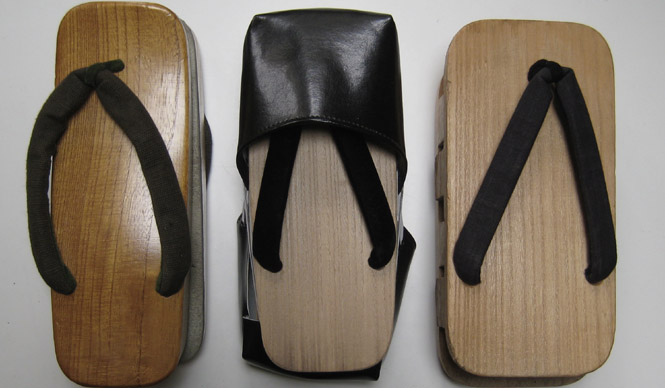
Ordinary adult geta are usually made of paulownia wood. High-quality ones are made from a single piece of straight-grained wood, and Aizu paulownia is still highly prized. Paulownia geta are characterized by their lightness. In Tokyo, they cost around 5,000 yen. At this price, they are often 'harimasa,' where a thin veneer of straight-grained wood is glued only to the surface of the base. Nowadays, many have the teeth glued to the base, but Aizu specialty shops reportedly do not sell such inexpensive items.
The teeth of paulownia geta wear down easily, so those with more grain lines are considered higher quality. In Aizu, geta with 30 grain lines cost around 15,000 yen, which seems surprisingly inexpensive. If you're going to wear them, you should wear good ones, or people will judge your feet.
Geta were an indispensable part of Japanese life, but over time, they gradually became less common. I stopped wearing geta after graduating from school and becoming a salaried worker. Around this time, the number of people wearing kimonos and the popularity of geta also began to wane.
When you walk in geta, they make a 'karokoro' sound. That's the appeal. An elderly gentleman once stopped me and said, "The sound of your geta is nostalgic." On the other hand, you might get disapproving looks in places like hotels. Geta were prohibited at universities, but I recall wearing them anyway. Nowadays, some geta have rubber soles, which eliminate the sound, thus diminishing the experience of wearing geta.
When I put on geta after a long time, I felt they were a bit difficult to walk in, but after a few days, I got used to them and the discomfort disappeared. To address this difficulty, there are geta shaped like zori, called 'nomeri' or 'Ukyo,' which have a heel that slopes higher like a shoe sole. However, they can make you feel like you're about to tip over, and the comfort isn't great. Still, they might be easier to wear for modern people accustomed to shoes.
Men's geta come in various widths, from about 12 centimeters for wide ones to about 9 centimeters for narrow ones. In the past, people wore 'ashida' on rainy days, but nowadays, ordinary geta are fine. When wearing them, you attach 'tsumakawa,' a toe cover to prevent tabi from getting wet. It's inserted in front of the geta, and the rubber strap is hooked onto the back tooth. This won't fit wide geta, so it must be set on narrow ones. 'Nomeri' geta cannot accommodate them.
Geta are prone to chipping if the corners are bumped, so they are usually rounded. However, there are also 'makkaku' geta, a sophisticated style from the downtown area, where the corners are intentionally left square. For both geta and setta, the 'hanao' (strap) is important. Coordinating the color to match the kimono and tabi is a key aspect of dressing. The quality of the 'hanao' varies greatly, affecting the price. Some are made of silk, velvet, or deerskin, and choosing these can be part of the enjoyment of wearing a kimono.
Setta: The 'Charachara' Sound
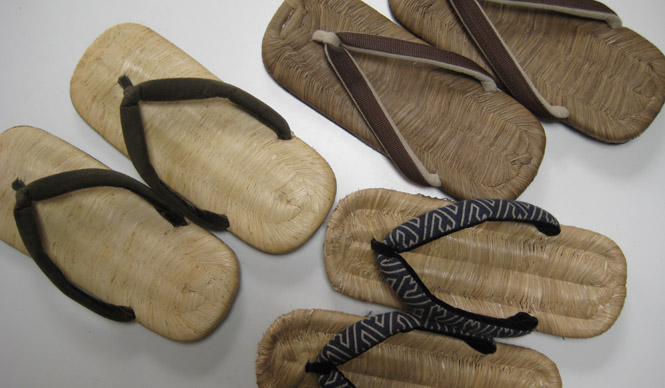
Setta can be considered a type of zori. They offer a slightly more mature aesthetic. They have a tatami-straw surface, leather soles, and studs on the bottom, producing a 'charachara' sound when you walk. Setta are worn for formal occasions.
Cheap setta are not advisable. Expect to pay over 20,000 yen. High-quality setta have a finely woven tatami-straw surface that looks elegant, and some can cost 40,000 to 50,000 yen. The most common inexpensive setta use vinyl for the surface, which might be acceptable for an annual festival. Shinto priests and Buddhist monks wear setta with white leather 'hanao,' but a monk wearing vinyl ones doesn't seem very auspicious.
A more refined option is the 'karasu,' where the surface is dyed a dark black. The 'hanao' can be made of fine silk, velvet, or deerskin, and choosing these adds to the pleasure of wearing a kimono. If the 'hanao' of setta is too loose, your toes will protrude forward, looking unstylish. They should be worn shallowly, with your toes just catching the 'hanao.' Consequently, your heels will extend beyond the back. This doesn't mean the size is wrong; it's the stylish way to wear setta. Setta are unsuitable for rainy days.
Zori
While a step down from setta, they are comfortable to walk in. Straw zori and hemp-lined zori are also available, but they wear out quickly. Nowadays, zori with rubber or cork soles offer the comfort of sneakers and are reasonably priced, making them easy to wear.