March 11, 2015
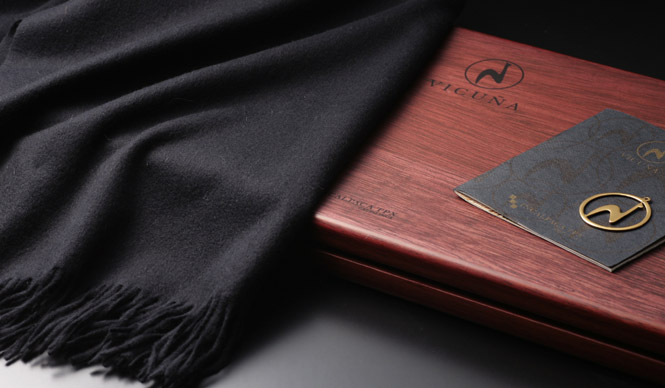
For a "Lifelong Companion" – The Vicuña Stole from "Actualité"
A “Lifelong Companion”—The Vicuña Stole from Accéntual
Scarves and the like are not trend items, so you only need a minimal number of pieces with assured quality. If it's vicuña, you won't be lacking.
Photo by Jamandfix
A Little of the Best, Cherished for Years
It’s called a “find” precisely because you stumble upon it unexpectedly.
Just as winter has passed on the calendar and we’re entering a season where the first signs of spring can be felt, a superb “find” has appeared.
In the corner of an importer’s stockroom, a large stole lay in wait. The material: vicuña.
For those who need a brief explanation,
It belongs to the genus Vicugna of the camelid family. Approximately one meter long, weighing 40–50 kilograms.
This animal lives in the high altitudes of the Andes, inaccessible to humans, and is protected by the Convention on International Trade in Endangered Species of Wild Fauna and Flora (CITES). Its wool is shorn only every two years, yielding about 250 grams, which after further selection, results in a mere 120 grams.
It takes 35–40 adult animals to make one coat, but only 2,000 kilograms are produced annually. This is enough for only 400 coats. That’s one-thirtieth of cashmere.
Incidentally, the fiber diameter is even finer than cashmere’s 15 microns, averaging 12 microns.
Annual export volumes are also regulated, and all products come with a serial number.
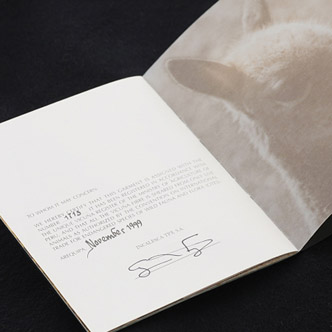
The certificate always bears a number.
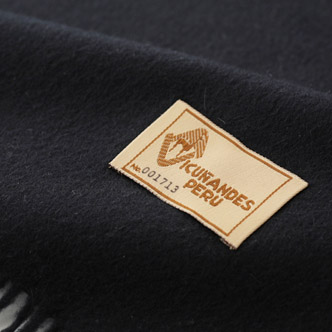
The number on the stole itself, paired with the certificate.
Its moist texture feels as if it’s “clinging to the skin.”
Yet, it’s frustrating that no matter how many adjectives are used, the true sensation cannot be conveyed without direct touch.
The original brand, quietly maintained by the Peruvian factory that is the “source” for a certain Italian brand touting exclusive handling of this material, doesn’t come with various markups, making it a welcome addition to one’s collection without breaking the bank.
This is a stole to be cherished for a long time, not “consumed” each season.
Acquiring a “once-in-a-lifetime” piece is, in fact, an act that is kind to the planet.
