Part 10: Coats for Japanese Attire
Illustrator Kazuo Hozumi explains the "essentials" of men's kimono dressing.
This 10th installment discusses kimono coats. Mr. Hozumi will talk about their types and how to stay warm this season.
Text and illustrations by Kazuo Hozumi
Two Types of Kimono Coats
In the harsh winter cold, a kimono alone isn't enough. A coat becomes essential. This time, let's consider the most common type of kimono coat, albeit a bit late in the season.
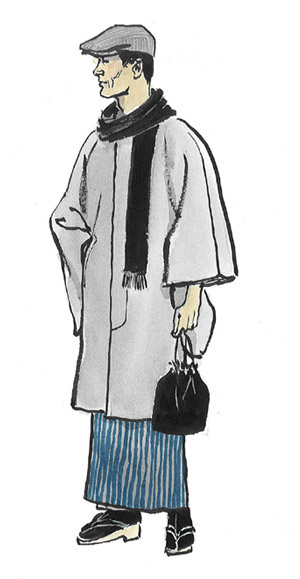
The most common coat is likely the "Kakusode," a coat specifically designed for kimono.
The Kakusode's collar and front closure resemble a Western raincoat, but its sleeves and armholes are constructed in the kimono style.
While some have wide sleeves that open fully to the sleeve length, many, like kimonos, have a smaller sleeve opening.
The fabrics vary widely, from thick to thin wool, in various colors and patterns. Some designs are reversible, in gray and black.
To see what's available and find what suits your taste, it's best to visit a department store's kimono coat section and see for yourself. Prices start around 100,000 yen.
There is another type of coat called the "Nijū-mawashi."
This item has been a favorite kimono coat for Japanese people since the Meiji era, but it originated in Britain as the "Inverness coat." Many of you may know it from Sherlock Holmes wearing a tweed Inverness, as it's quite famous.
The ingenuity of the Japanese lies in adapting this directly as a kimono coat, typically in a plain black fabric. In Japan, it's also known as "Tonbi."
The Nijū-mawashi has a cape-like form over a sleeveless outer garment, allowing it to be worn comfortably over the loose sleeves of a kimono. As the name suggests, it's double-layered, making it warm.
You'll likely recognize it if you recall Koji Ishizaka playing Kosuke Kindaichi, the protagonist in the films based on Seishi Yokomizo's novels.
Actually, I own one myself; it's a memento from my father, made about 60 to 70 years ago.
While it's wonderfully warm, the overall garment is a bit heavy. It has a detachable sea otter fur collar, but I've rarely used it as it feels rather ostentatious.
Even today, you often see them at events like Hatsumode (first shrine visit of the year) or New Year's visits. Modern versions seem to be made with lighter fabrics for a more streamlined look. Prices start around 150,000 yen.
While the Kakusode has a somewhat downtown atmosphere, the Nijū-mawashi could be described as having an uptown feel.
I tend to wear a hunting cap with a Kakusode and a fedora (soft hat) with a Nijū-mawashi. There's no strict rule, but it just seems to match the mood better.
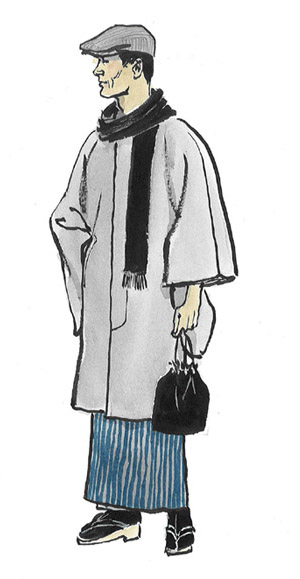
Kakusode
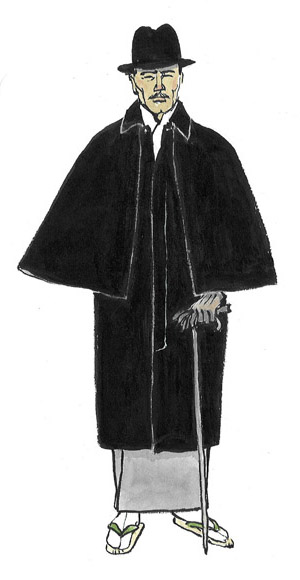
Nijū-mawashi
A kimono coat should ideally be easy to put on without passing your arms through sleeves, making cloaks and capes useful. Both are bell-shaped; longer ones are called cloaks, and shorter ones are capes.
Nowadays, they are seen more often on women, while men are more likely to wear the aforementioned Kakusode or Nijū-mawashi.
Other Winter Preparations
Since kimonos have a V-shaped neckline, a muffler is indispensable. You can wrap it directly around your neck, or cross it in front and let it hang below the haori cord. In this case, be careful when using an S-hook to attach the haori cord, as it can snag on knitted wool and cause unraveling.
As I feel the cold easily, I try to dress as warmly as possible when going out in winter. Sometimes, instead of a coat, I wear a fur-lined garment over the kimono (like a chanchanko). It's not heavy, and the fur isn't visible once the haori is on, which I like. It means I don't need a coat, so I recommend it for those who don't feel the cold as much.
When at home, a "Dotera" is the best choice. Alternatively, there's the cotton-padded "Hanten" instead of a haori. I usually wear sweaters and jeans, so I rarely wear kimonos or dotera at home.
However, I don't wear them every single day of the year. When I'm home, it's jeans and a sweater. So, when do I wear a kimono? In other words, if you want to wear a kimono, you need a place to wear it to.
In my case, it's for "special occasions" like parties and class reunions. For practicing kobuta (a type of traditional song), attending the theater, or dining at traditional Japanese restaurants, I exclusively wear kimono. If I don't wear them on these occasions, I'd never have a chance to wear them. Kimonos suit events like tea ceremonies and traditional music performances, and they enhance the mood.
If you intend to wear a kimono, you must also consider where you will wear it.