April 8, 2015
Chapter 8: Around the Haori
The Eighth: Around the Haori
Illustrator Kazuo Hozumi explains the "basics" of men's kimono styling.
The eighth installment is about the haori. We'll hear about various aspects related to the haori, such as how to choose haori himo and haori lining.
Text and Illustration by Kazuo Hozumi
Haori Himo
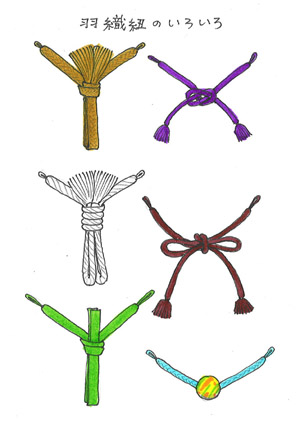
When wearing a haori, a "haori himo" is necessary.
These are silk braided cords, available in various types from round to flat, thick to thin, and the key is how they coordinate with the haori and kimono (also called nagagi in contrast to haori).
Especially since the color of the haori himo must be matched well, a sense of coordination is required.
This is very similar to neckties.
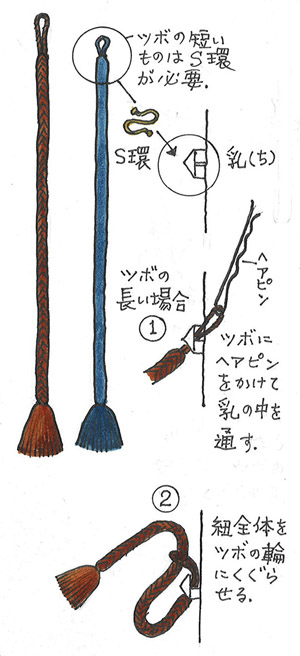
The left and right lapels of the haori have small loops called "ch" (乳), through which the haori himo is passed and secured, then tied in the front. Since the loops are very small, the loop on one end of the cord (tsubo) must be long enough to secure it.
If the haori himo is already tied and not meant to be untied, a small S-hook is used to connect the loop and the cord.
This seems to be the most common and convenient method.
The position of the loop is said to be neither too high nor too low, but I'll leave that to the kimono shop.
From experience, I dislike these S-hooks and rarely use them.
In winter, when wearing a woolen scarf, they tend to snag and unravel. Also, when taking off the haori in front of others, having to remove the S-hook each time is not very elegant.
The most stylish way to remove a haori is to casually untie the knot of the haori himo and let the haori slip off the shoulders.
Recall the gesture of a rakugo storyteller removing their haori on stage.
Therefore, all my haori himo have long tsubo loops for passing through the ch. While S-hooks are common and many have short tsubo, I make sure to check carefully when purchasing.
A haori himo only serves its purpose when it's an integral part of the haori, so I generally decide on a specific himo for each haori and keep it attached at all times.
This means I don't worry too much about "handling" them; essentially, my style is to have as many haori himo as I have haori.
It's the same principle as the fashion rule for Western clothing: "You should have as many belts as you have trousers."
For formal wear, such as haori himo with large tassels, which are elegantly tied from the start and not meant to be untied, the use of S-hooks might be unavoidable. However, for everyday use, the act of tying and untying seems to fit the mood of wearing a kimono.
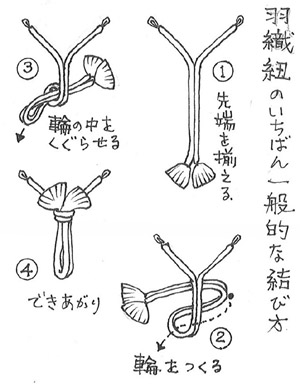
There seem to be various ways to tie a haori himo, and one might be able to tie it stylishly or not depending on the occasion. However, I believe that learning one simple knot that suits you is sufficient, and there's no need for excessive variation.
This is also similar to neckties, but the knot is simpler than a tie.
Haori himo can be quite expensive when you buy them.
Even the cheaper ones start around 10,000 yen.
Sometimes, you can find them surprisingly cheaply by searching through boxes of odds and ends at antique shops.
They might even be included as a bonus when you buy a haori. If a used one is stained, wash it with soap and a brush. For the tassels, carefully align the threads with a brush.
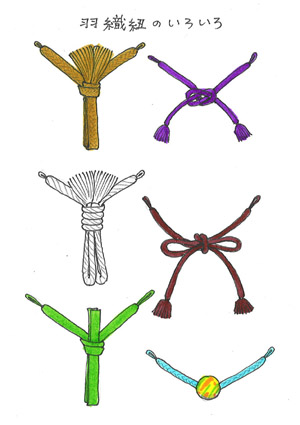
When it comes to variation, overly flashy or elaborate ones can be too conspicuous.
Some people reportedly trim the tassels shorter with scissors if they are too large for everyday wear.
Those with decorative glass beads instead of knots are favored by sumo wrestlers.
In summer, there are cool, openwork weaves. Simple styles without tassels at the ends, like the "ichimonji," also have a chic feel.
Sometimes, a subdued women's haori himo can also work. A simple, loose koma knot can surprisingly create a different look.
Haori Lining
Lined haori require a lining.
It's often said that "focusing on the haori lining" is the ultimate ideal of chic kimono wear, but I don't pay much attention to it. I've heard that sometimes the lining can be more expensive than the haori fabric itself. When the lining is elaborate, one naturally wants to show it off by taking off the haori in front of others.
Some people apparently have erotic art (shunga) made for their haori linings, but that's just a bit of playful fun. I once had a spare ukiyo-e patterned nagajuban, which I took apart and used as the lining for a newly made haori.
Despite the ostentatious "Shunsen" written on it, the painting was so crude that it was hard to tell if it was really Shunsen. However, the colors were subdued, and I thought it was acceptable as a haori lining.
Haori Length
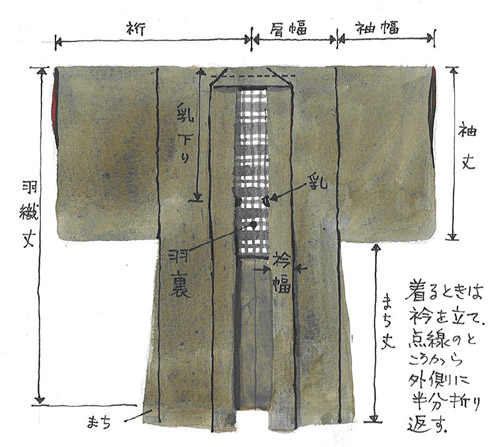
Depending on the wearer's height, the general length for a haori seems to be around knee-length.
Shorter than the knee gives a lighter feel, while longer gives a more substantial look. When buying a new one, it's probably best to leave it to the discretion of the kimono shop at first.
Some antique haori are unusually long. This is because they were longer about 70 or 80 years ago. Don't be put off by them seeming "old-fashioned." These long haori are now considered retro and stylish. Your grandfather's long haori should be highly treasured.
More importantly, you need to be careful that the sleeve width (sode yuki) is not shorter than the kimono worn underneath, as that would look unsightly. This can also be adjusted by lengthening the sleeve attachment. Even antiques can end up being costly.
For a matching set (o-tsuke), the choice is limited to the ensemble, so coordination is simple and straightforward. When changing the haori, you can vary not only the color but also the fabric.
For example, a tsumugi kimono with an omeshi haori, or vice versa. Or, for a slightly more casual look, a tōzan kimono with a tsumugi haori – enjoying the variations in combinations.
Kimono Measurements
When I declared I wanted to wear a kimono, relatives and friends, saying it was a shame to let them gather dust in the closet, sent me various items.
There were matching sets, as well as individual kimonos and haori. Combining these meticulously, thinking "this haori goes well with this kimono," or "I'll wear this as a matching set as is," is also part of the enjoyment.
Additionally, ready-made garments or kimonos found at antique shops are inexpensive and can be worn immediately after purchase.
The issue here is the measurements. It seems that in the past, people were generally smaller, so it's often difficult to find items that fit my measurements.
One might think kimonos, being cut in straight lines, are more forgiving than Western clothing, but that's not the case at all.
To get straight to the point, I've come to realize that kimonos, even more so than Western clothes, look and feel bad, and can easily become disheveled if they don't fit your body's measurements properly.
For instance, if the length is too short, it needs to be lengthened, or if the sleeve width is insufficient, it needs to be extended. Often, alterations are unavoidable. If it doesn't fit your body at all, it has to be completely taken apart and "re-tailored," which is costly and quite troublesome.
Kimono shops must be thinking, "For a kimono of this quality, it would be better to buy a new one."
Unless it's a kimono you're extremely fond of, or a high-quality piece that's hard to find nowadays, it's a difficult situation.