April 9, 2015
The fourth installment: Summer begins with unlined kimonos.
Part 4: Summer Begins with Unlined Kimono
Illustrator Kazuo Hozumi explains the basics of men's kimono styling.
This fourth installment covers summer kimono, specifically unlined ones.
Text and illustrations by Kazuo Hozumi
From Lined to Unlined: Changing Your Kimono
Having learned how to wear a yukata last time, we'd like to move on to the next step. But before that, you must know about the custom of "koromogae" (changing seasonal attire) in Japanese clothing.
Kimono, by nature, are sensitive to the seasons.
From winter to spring, what were lined kimono ("awase") are all changed to "summer wear" on June 1st.
From this day, kimono are supposed to be changed to unlined ones ("hitoe"). Before the war, on this day, schoolchildren, junior high students, female students (now junior and senior high school girls), police officers, and others would all switch to lighter-colored summer clothing, even if wearing Western attire. This allowed one to visually confirm and feel the arrival of summer.
Now, with global warming progressing, that's no longer feasible. If it's hot, there's no problem wearing summer unlined kimono earlier. And no one finds it strange to wear yukata early on.
In the height of summer, July and August, people wear linen unlined kimono, or kimono and haori made of ro or sha silk. As the sense of seasons has become ambiguous, some people are already wearing these from May or June.
Men's summer kimono are primarily represented by yukata. However, for other lightweight tsumugi silk, stylish tozan, or linen such as jofu or chijimi, one would still wear a summer juban (under-kimono). Few people wear a summer haori, but those who do possess a certain gravitas.
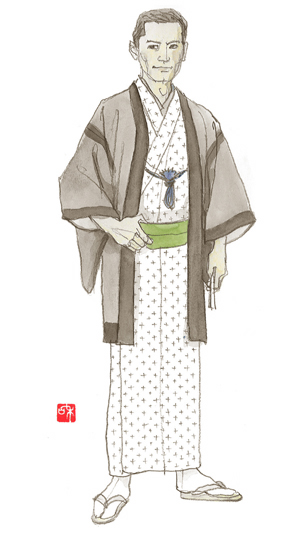
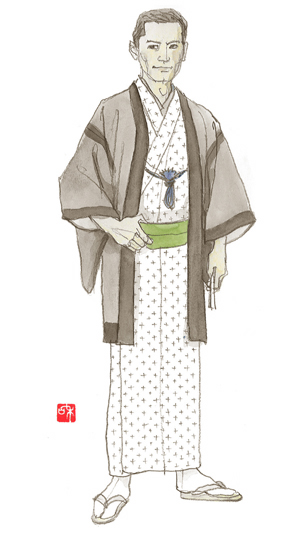
The illustration shows typical formal wear for the height of summer (July and August).
A fine white linen kasuri pattern with a black sha silk summer haori. It has a sophisticated, gentlemanly air, and the transparency is stylish, though it's not as cool for the wearer as it looks.
White tabi socks and setta sandals.
Practicing to Appreciate Quality
Now, since the change back to lined kimono from summer wear is on October 1st, it seems wise to consider your next kimono purchase accordingly.
It's said that indulging in kimono is expensive, but if you intend to enjoy fashion, some level of expense is unavoidable.
In my case, I generally set a budget of around 200,000 yen as the upper limit for both lined kimono and haori, whether they are omeshi or tsumugi silk. If I can manage both for 200,000 to 300,000 yen, it's comparable to the cost of a well-tailored suit from a tailor.
Some shops display the price for the finished garment alongside the price of the fabric roll. Cotton, wool, or polyester kimono are even less expensive.
A great thing about kimono is the absence of brands. Or rather, it's not that they don't exist; the weaving regions themselves serve as brands. Handwoven pieces by artisans designated as Living National Treasures naturally command a certain price, but if you don't understand the quality of the item, they will certainly seem expensive.