Living Small to Gain Abundance: The US-Born 'Tiny House Movement' (1) | SPECIAL REPORT
SPECIAL REPORT
Living Small for Greater Richness: An Interview with Dee Williams, Proponent of the Tiny House Movement (1)
The Tiny House Movement from the US (1)
In the United States, where large homes are the norm, a growing number of people are moving into "tiny houses"—compact, mobile dwellings under 40 square meters—creating a movement. What are the possibilities and lifestyles associated with them? Environmental journalist Yayoi Minowa explores this through her conversation with Dee Williams, who visited Japan for a workshop.
Text by MINOWA Yayoi (Environmental Journalist)Photographs by BEN MATSUNAGA
Is Being Tied to a Mortgage for Decades the Right Way to Live?
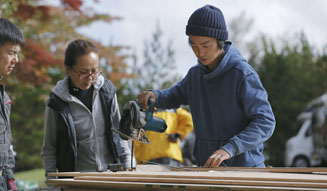
At a campsite by Lake Yamanaka, a group is building a small house on wheels. Participants range in age, and include women. Everyone works with a serious gaze, but their breaks are filled with smiles.
These are participants and support staff for Japan's first "tiny house" building workshop.
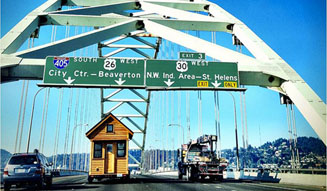
Tiny houses are ultra-compact spaces of 10 to 40 square meters, equipped with kitchens, toilets, and bedrooms. Most are built on trailer chassis, making them mobile. While their construction is simple, it is robust. Some are equipped with solar panels, allowing for off-grid living. They can be entirely self-built, or purchased as finished products in the US. Over the past decade, more than 2,000 residents have emerged in North America.


Letting Go of Possessions, Connecting with Nature, and Living Richly
At the heart of this movement is Yuichi Takeuchi, who organized this workshop. Takeuchi, also a treehouse builder, was working on treehouse projects nationwide when he realized he wanted a small, mobile home that could serve as a base. It was then that he saw Dee Williams' TED Talk on tiny houses and felt, "This is it!" What captivated Takeuchi wasn't just the compactness, but also Williams' message of "letting go of possessions, connecting with nature, and living richly."
In the US, following the 2009 Lehman Shock and the subprime mortgage crisis, many people lost their homes. Amidst this, a realization emerged: instead of buying a large house and being tied to a mortgage for decades, it was more important to minimize one's home and dedicate time to what truly matters, or to live freely by moving. The "tiny house" then spread as one means to achieve this new way of life.
Takeuchi soon after participated in a workshop led by Williams in Oregon, USA, where he experienced the potential of tiny houses firsthand. This year, he organized Japan's first tiny house workshop.
In Japan, a country prone to natural disasters, tiny houses offer high mobility as potential bases during emergencies. Furthermore, particularly from an economic standpoint, tiny houses, which are within reach for younger generations, expand lifestyle choices. Takeuchi is exploring these unique possibilities for Japan.
Takeuchi interviewed Williams, whom he invited for this workshop, about tiny houses.

Downsizing to Transform Your Way of Life
Yuichi Takeuchi (hereafter, Takeuchi)Why did you decide to build a tiny house?
Dee Williams (hereafter, Dee)Before I built and moved into my tiny house, I lived in a large, three-bedroom house in Portland. Like everyone else, I took out a mortgage for tens of millions of yen to build it, and it was a truly beautiful home. I loved that house and even did a lot of renovations myself. I never felt unhappy about my house. However, the fact that I couldn't quit my job because I had to pay off the loan terrified me. Around that time, I collapsed with heart failure. When I woke up in the hospital bed, I realized, 'I only have one life.' I understood that living as 'Dee Williams'—being true to myself—was more important than paying off debts or mowing the lawn. I wanted to express my world more joyfully and creatively as an individual.
TakeuchiHow did your lifestyle change?
DeeWell, many things changed. For example, I downsized from a large house, reducing my living space by 75 percent. This automatically forced me to get rid of a lot of things. It was a wonderful experience to think carefully about what I needed, what I wanted, and what I didn't need, and to recognize the difference. I realized that the only things I wanted to hold onto at the end of my life were my dear friends.
TakeuchiWhat are the benefits of self-building rather than buying a house?
DeeI believe that fundamentally, all humans are builders. Until recently, people lived in harmony with nature and knew how to create shelters and make them comfortable. This should be embedded in our DNA. Of course, you will face various challenges while building a house. But after completing that challenge, you will undoubtedly become a bigger, stronger, and more capable person. You discover your true self. I am happy to meet people who are having that experience through building their own homes.
TakeuchiHas living in a tiny house changed your connection with the community?
DeeBecause my kitchen shelves are small, I find myself going to the grocery store more often, and it becomes a part of my daily life. In a way, this is built on mutual trust, and I feel a deeper sense of giving and receiving than before. By letting go of a huge refrigerator and kitchen, I chose to live as a member of the community. This might be one of the wonderful aspects of living in a tiny house. You become part of a larger family.
TakeuchiWhat are some essential items for sustainable living?
DeeIf you're seeking an independent, off-grid lifestyle, self-sufficiency in electricity is important. Of course, you start by minimizing usage, but I'd want solar panels. A rainwater tank and filtration system, and a composting toilet would also be good. In the US, many people use propane for cooking and heating, but a small wood-burning stove would be ideal. If you can get firewood, there's no better option.
TakeuchiDo you have a message for people in Japan interested in tiny houses?
DeeI want them to not give up on living (creating) their own lives. Don't make excuses for not living the life you envision. Taking action is the most important thing. Move forward; instead of overthinking and staying still, try it, even if it might not work out.
I myself had many anxieties, wondering if this house would ever be completed, but I moved forward anyway. I never dreamed that living in a tiny house would lead to such a joyful life. If you want to change your way of life, I believe that inner voice is always right. Cherish your one and only life and decide how you want to live it.
Next, we explore the potential for tiny houses in Japan through the voices of workshop participants.
An open house for tiny houses is scheduled for Sunday, December 21, 2014.
Location: Lake Yamanaka PICCA
For details, visit "Tree Heads & Co."
http://simplife.jp/
Yuichi Takeuchi
Representative of Tree Heads & Co. Tiny House Builder. In his 20s, he worked as a handyman for creators in the UK and the Netherlands. After returning to Japan, he focused on creating experiential programs that connect people with nature. He began building huts around 2008. He travels throughout Japan building treehouses and tiny houses.
Yayoi Minowa
Environmental writer and board member of the NPO "Sorabea Fund." She writes and plans articles on environmental topics, and runs "Furomae Café & Gallery" (http://furomae.jimdo.com/), a green café near Yanaka, Tokyo, promoting and practicing organic food, natural materials, and natural energy. Her books include "123 Tips for Saving Electricity and Energy" and "Recommendations for Environmental Living" (Asuka Publishing).
http://gogreen.petit.cc/