Will It Spread in Japan Too? The US-Born 'Tiny House Movement' (2) | SPECIAL REPORT
SPECIAL REPORT
Will It Spread in Japan? Reasons Workshop Participants Became Interested in Tiny Houses
Focus on the "Tiny House Movement" Originating in the U.S. (Part 2)
A special report by environmental journalist Yayoi Minowa.Continuing from the previous article,we explore the tiny house movement, which is gaining traction in the United States. Is there potential for this way of life to spread in Japan? Insights into its direction emerge from the motivations and perspectives of those who participated in the first-ever workshop in Japan, hosted by treehouse builder Yuichi Takeuchi.
Text & Photographs by MINOWA Yayoi (Environmental Journalist)
A Desire Strengthened After the Great East Japan Earthquake
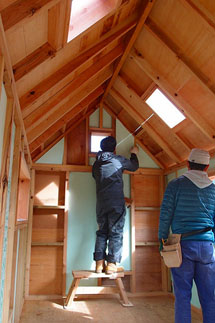
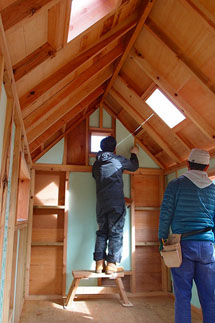
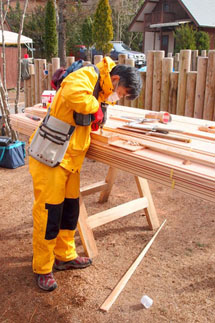
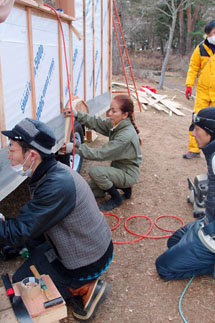
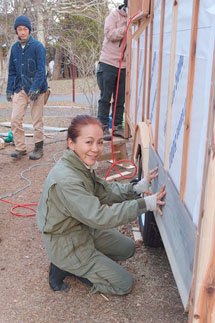
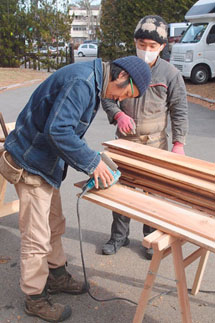
Over a total of six program sessions from October 2014, twelve participants with diverse backgrounds gathered for a workshop where they would actually build a tiny house in three months. Some dedicated participants even traveled from Hokkaido and Shikoku to attend the twice-monthly sessions.
Takeyuki Tanaka, who participated from Nagano Prefecture, had been seeking a lifestyle where he could be self-sufficient in energy and food. This desire intensified significantly after the Great East Japan Earthquake. "This workshop reinforced my belief that a circular lifestyle is important, and that self-sufficiency in energy and food, among other things, were the right path," he shared. "For starters, I want to build a tiny house in my garden or create a mobile home on a truck."
The workshop invited guest lecturers each session. One of them,Shinji Yotsui, a permaculture designer,provided insights into a circular way of living.
Building a Home for Several Million Yen Is Realistic
Akito Shimano, a tram driver in Sapporo, Hokkaido, hopes to build a tiny house to live in with his wife. "Taking out a mortgage for decades locks you into a certain way of life. With a tiny house, you might be able to take on the challenge multiple times, not just once," he says. For younger generations, the economic feasibility of owning a home for a few million yen also expands their life choices.
Shimano, who had no prior experience in carpentry, expressed his satisfaction with learning how to use tools and making new friends during the process.
Some participants were drawn to tiny houses with disaster preparedness in mind.
Hiroyuki Naka, who runs a design firm in Kochi Prefecture, began seriously considering community tsunami countermeasures after the Great East Japan Earthquake. He realized that a tiny house could be mobile during a disaster, eliminating the need to stay in evacuation shelters. Equipping it with solar panels for off-grid living would also ensure functionality even if public utilities failed.
He envisions using it as a weekend second home during normal times, and sees building a home for several million yen as a realistic option for establishing multiple residences. To this end, he also wants to host self-build workshops to promote tiny houses within his community. "We could have professionals handle the pre-cutting, and then the assembly would be self-build. That's the kind of model I'm considering," he explained.
First, Build and Live in What You Believe In
Junko Tezuka, who has always dreamed of living in a "little house on the prairie," is another individual aiming for a self-sufficient lifestyle. Prior to building a tiny house, she plans to create a mobile home using a truck, with support from Takeuchi and others, and embark on a journey. Having previously run a business, she is now transitioning to a freer lifestyle focused on enjoying life. While appreciating the workshop's rich content and wonderful community, she is particularly captivated by "the kindness of Takeuchi-san, which changes people's lives."
Kenta Murakami, who aims to make tiny houses his future profession, aspires to be a young builder. In Japan, housing options are typically renting or purchasing with a long-term loan, neither of which appeals to him. He sees the ability to build a tiny house for several million yen, tow it with a car, and place it on farmland as significant advantages. Japan has abundant abandoned farmland, and this offers more housing choices for the younger generation. Murakami, who is interested in Japan's forest resources, is enthusiastic about building tiny houses using domestic Japanese timber and thinned wood.
"First, build and live in what you believe in. Then, let's start a movement," he declared.
The Community Itself Becomes Your Home
While each of these five individuals had their own reasons for becoming interested in tiny houses, they all seem to be looking in the same direction: the security of having a place to live and access to utilities in disaster-prone Japan; the freedom to live richly without being bound by long housing loans, similar to the U.S.; and the passion for building a home with their own hands. The voices of the participants highlight the direction tiny houses should take in contemporary Japan.
Moreover, what everyone emphatically stated was, "I made friends." Building a tiny house is more enjoyable when done together with others, where friends help each other out, rather than building alone. A tiny house built with the help of friends, not by a construction company or real estate agent, also fosters connections after its completion. In essence, this leads to community building. As D. Williams puts it, by letting go of material possessions, one can become part of a community; expanding outwards means the community itself becomes your home. That is precisely the tiny house way of life.
The tiny house built by Takeuchi and his colleagues has been designated for use as a shop and a disaster response base in Hiroshima. It is likely that some of the workshop participants will go on to build their own tiny houses. The small flame of the tiny house movement ignited by Takeuchi seems poised to spread widely. A second workshop is planned for 2015.
*An open house for tiny houses is scheduled for Sunday, December 21, 2014.
Location: Lake Yamanaka PICCA
For more details, visit "Tree Heads & Co."
http://simplife.jp/
TAKEUCHI Yuichi
Representative of Tree Heads & Co. Tiny House Builder. In his 20s, he worked as a handyman for creators in the UK and the Netherlands. After returning to Japan, he dedicated himself to creating experiential programs that connect people and nature. He began building huts around 2008. While building treehouses and tiny houses, he travels throughout Japan.
MINOWA Yayoi
Environmental writer and board member of the NPO "Sorabea Fund." She writes and plans articles on environmental topics, and runs "Furomae Café & Gallery" (http://furomae.jimdo.com/), a green café near Yanaka in Tokyo. She promotes and practices organic food, natural materials, and natural energy. Her books include "123 Tips for Saving Electricity and Energy" and "Recommendations for an Eco-Friendly Life" (Asuka Publishing).
http://gogreen.petit.cc/