Thoughts on Architecture from a Collection of Small Illustrations | Junya Ishigami Lecture - Part 2
Thoughts on Architecture from Small Clusters of Illustrations
Junya Ishigami Lecture: Part Two
Continuing from our previous report, this installment covers architect Junya Ishigami's lecture "About My Own Work," held at INAX:GIZA as part of the Forum of Architects. Today, we present his talk on two architectural projects and the Venice Architecture Biennale.
In cooperation with: Forum of Architects, INAX PublishingSummary and text by: Koji Kato
T Project
Next, we turn to a residential project. I often ponder the role of housing in contemporary urban environments.
The client for this house is a single individual. They don't spend much time at home during the day. On weekdays, they return late at night and leave early in the morning. There are days they don't return home at all. It feels less like returning to live and more like returning to rest, or to refresh. I believe this lifestyle is quite common for single individuals today, especially in Tokyo. However, I feel there are very few homes currently suited for such people. Therefore, I considered whether it might be possible to create an urban residence not as a dedicated dwelling, but from the perspective of a vacation home.
Specifically, I envisioned creating a small house enveloped by a forest, occupying most of the site. Within this, I hoped to foster new relationships and create a unique spatial experience.
On the first floor, the earth and vegetation extend into the rooms, blurring the boundary between garden and interior. The second floor is the bedroom, from which a large balcony juts out, seemingly floating among the trees.
As this was a low-rise area, the house, with its second-floor at about 6 meters, is slightly higher than the surrounding residences, placing the second-floor level around the height of the neighboring eaves. Consequently, ascending to the bedroom opens up the view, creating a sudden, expansive sense of openness, as if a vast meadow has appeared before you. The bathroom is planned as a separate structure within the grounds, and all movement between rooms requires passing through the small wooded area.
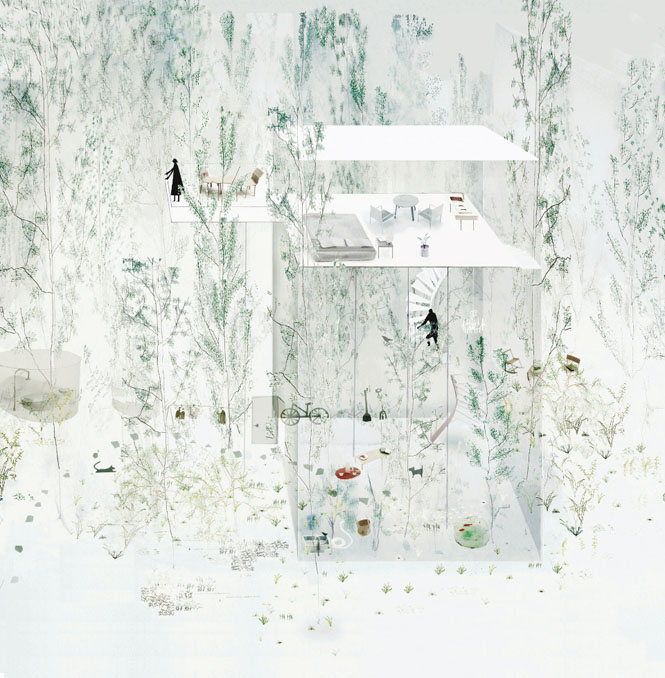
Typically, urban residences often feature an entrance directly accessible from the street, leading straight into the interior space from the urban environment. In this house, upon returning at night, one passes through a dimly lit, forest-like area before ascending to the bedroom on the second floor. During leisurely moments, one might enjoy a drink or read a book while admiring the illuminated trees and plants in the garden before sleeping, and in the morning, depart for work through the dappled sunlight filtering through the leaves. It feels less like returning home and more like heading to a vacation spot on the weekend, transforming the environment itself. This is integrated into daily life. The aim was to create a feeling that makes those short moments spent at home incredibly pleasant.
Here, I wanted to explore the possibility of creating a small architectural form, a house, by considering its relationship with the surrounding environment. While this is common practice for public buildings, houses are often private spaces, naturally tending to be inward-looking. Client demands and personal tastes frequently become the primary conditions. Thus, I began to consider how to create a small house and its surrounding environment simultaneously, with equal emphasis.
Rather than a large building suddenly appearing in front of one's home, the emergence of a forest seems like it would improve the living environment for surrounding residents, which I believe is a positive outcome. This approach to housing feels particularly well-suited to a city like Tokyo.
In many cities worldwide, particularly in Europe, public and private spaces are clearly delineated. For instance, the transition from a public street to the private interior of a building is like an on/off switch, with nothing in between. Tokyo, however, is formed by each building standing on its own plot, set back to some degree from the property line, creating intervals between adjacent buildings. This difference is significant. I believe it is highly meaningful to consider the small interstitial spaces between residences, or between buildings, when designing architecture in a city like Tokyo.
Lake Project
Next is a project involving the design of a lake. The site originally featured an artificial lake created by a dam. Its water is still used for industrial purposes, and its water level fluctuates by about five meters annually depending on operational rates. Due to the unstable water level, the surrounding environment is not particularly pristine.
When this project was commissioned to my office, the plan was to create a park near the lake and a walking path around it. However, as I mentioned earlier, the surrounding environment of the lake was not very appealing to begin with, and I felt that simply fulfilling the design brief would not lead to an effective outcome.
As I contemplated this, I began to think that perhaps by reimagining the lake itself, a new park could naturally emerge.
The idea was to create a space that would subtly integrate the constantly changing artificial water levels, driven by industrial use, with the seasonal shifts and changes found in mountains and nature.
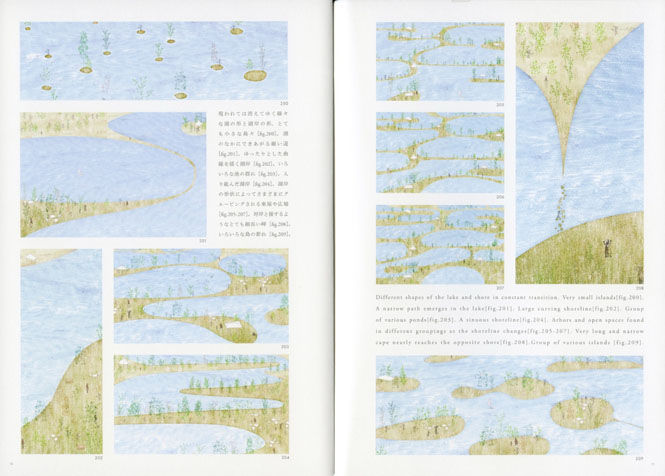
Specifically, I am considering whether it's possible to create a lake with a form that constantly transforms by subtly altering the topography of the lake's edge and bottom. I believe that by contemplating the scenery created by this evolving lake shape, a new kind of space can be formed.
At times, small islands might appear, at other times, areas connecting to the opposite shore might form, creating a complex shoreline that blurs the relationship between lake and land, or perhaps a gently curving shoreline emerges. Occasionally, it might resemble a series of puddles, allowing passage to the other side.
Within this landscape, I plan to incorporate vegetation and small structures. Areas with trees and pavilions would be positioned above the water level. The arrangement of these plants and structures would vary with the changing lake shape, creating small settlements in diverse configurations. Gentle relationships would subtly alter the scenery, and this fluid movement would quietly dissolve into the passage of seasons, which shifts without sound.
Regarding the Venice Architecture Biennale
The Venice Biennale is an international exhibition that alternates annually between art and architecture. This year is the Architecture Biennale, and my office will be responsible for the exhibition in the Japanese Pavilion.
Generally, architectural exhibitions tend to represent architecture indirectly through models, drawings, or installations. While I acknowledge that such displays convey valuable information, I wanted to explore new ways of communicating architecture this time.
The intention was to explore new spatial possibilities by directly utilizing the physicality and reality of the venue. I considered exhibiting actual architectural works alongside related drawings. The idea was to think about new architecture concretely by planning actual buildings, rather than through installations.
The Japanese Pavilion, designed by Takamasa Yoshizaka (1956), is the only pavilion in the Giardini Park, the Biennale venue, that features an outdoor space. This includes areas like the pilotis, the approach to the entrance, the front garden, and the rear garden – comfortable outdoor environments. I spent considerable time contemplating how to best utilize this distinctive outdoor space. Specifically, I planned four greenhouses of varying sizes. These four greenhouses are simultaneously architecture and a newly designed garden within the Japanese Pavilion's grounds. I wanted to consider the creation of architecture and the creation of landscape on an equal footing. I aimed to design landscapes as if planning architecture, and simultaneously, to design architecture as if creating landscapes. This was my thought process.
Each greenhouse is constructed with slender columns and thin glass, with variations in spatial proportion and the number of columns depending on the planned environment. These proportions and surroundings dictate the arrangement of tropical plants within the greenhouse, much like ikebana. The density of the plants is meticulously balanced to ensure that the space created by the architecture, the space created by the plants, and the surrounding landscape are all of equal value. Furthermore, the relationships between the greenhouses create new spaces within the existing landscape. By blurring the lines between creating space and creating scenery, I am attempting to conceive of unprecedented architectural possibilities.
While these are greenhouses, they are not intended to drastically alter the environment using extensive equipment. Instead, by being enclosed in thin glass, akin to a soap bubble film, they introduce a subtle fluctuation, a slight shift in the local environment. This dramatically expands the diversity of plant life.
Through slender columns resembling plant stems or tree trunks, and glass as thin as soap bubbles, I aim to endlessly blur the boundary between the environment created by the existing park and the space generated by the architecture.

Contemporary Architects' Concept Series 2: Junya Ishigami
Thoughts on Architecture from Small Clusters of Illustrations
Author: Junya Ishigami, Taro Igarashi, et al.
Published by: INAX Publishing http://www.inax.co.jp/publish/
Format: 210mm x 150mm
Pages: 160 pages (all color)
Price: 1,890 yen
Published: September 5, 2008
For more detailed information on Junya Ishigami, please visit:
http://openers.jp/interior_exterior/index/junya_ishigami.html