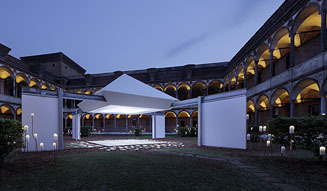
Panasonic | The Future of Sliding Doors Presented to the World at Milan Salone
Panasonic|The Future of Sliding Doors Presented at Milan Salone
Panasonic x Torafu Architects: "SLIDING NATURE" Exhibition
An Installation Responding to the Courtyard of Milan University
Panasonic exhibited for the seventh consecutive year at "Milan Salone 2014," one of the world's largest design fairs, held from April 7th to 13th. Since 2008, the company has presented spatial concepts using housing-related products. This year, under the theme "SLIDING NATURE," they showcased an exhibition featuring large sliding doors and LED lighting, with Torafu Architects responsible for the spatial design. We spoke with Koichi Suzuno and Shinya Kamuro of Torafu Architects, who have returned to Japan after the successful event.
Text by KAJII Makoto (OPENERS)Photographs by SUZUKI Shimpei (Interview)
The Impact Felt from the Installation
Koichi SuzunoThis year's Milan Salone was blessed with wonderful weather throughout, and I feel many people were able to enjoy the outdoor installation. They visited both during the day and at night, and some came after dinner, around 8 PM when dusk settles. I believe they were able to interact with it in their own way.
Shinya KamuroI really enjoyed it this time, as I was involved in the actual setup of the landscape.
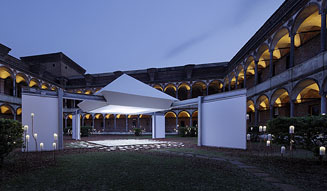
SuzunoFor this year's Milan Salone exhibition, I was involved from the site selection process. We specifically requested Milan University and visited only that location for scouting. Panasonic hasthe past two years, held installations atMilan University, and although the designers and products have changed this year, I wanted to clearly show the continuity at the same location. I found it interesting to explore how to express Japanese sliding doors.
Also, when I visited Milan Salone two years ago, I found Milan University to be a very beautiful place, and I felt a strong desire to exhibit there when I visited in the evening.


Dynamic Changes Through Sliding Doors, Lighting, and Sound
KamuroThis time, we expressed a space where the living environment and nature respond to each other using large sliding doors and LED lighting. We believe we were able to express dynamic changes that directly connect with the environment through the opening and closing of the sliding doors. By synchronizing the lighting, visuals, and sound, including a dimming system, with the movement of the doors, the installation became a large-scale response within the entire courtyard, truly expressing a "breathing house."
SuzunoWithin the environment of Milan University, enclosed by thick walls, we aimed to create a contrast with the surrounding solid architecture by having thin, light sliding doors, like "moving walls," open and close. While the actual installation wasn't consciously designed with Japan in mind, many visitors perceived it as Japanese, which made me realize again that the sensibilities of Japanese people might be reflected in it.
KamuroWhat particularly surprised me was that the entire program cycle is about 10 minutes, yet many people stayed to watch for several cycles, which is an exceptionally long time for an installation. Everyone watched very calmly.
Panasonic|Panasonic
Panasonic x Torafu Architects: "SLIDING NATURE" Exhibition
The Future of Sliding Doors Presented at Milan Salone
Panasonic's exhibition concept, "SLIDING NATURE," utilizes sliding doors such as "fusuma" and "shoji," characteristic of Japanese homes. A major theme is skillfully incorporating the benefits of nature, like allowing a comfortable breeze through living spaces, guiding soft sunlight, and enjoying views by opening up spaces widely. Koichi Suzuno of Torafu Architects states, "When you think of sliding doors as 'moving walls,' you can take bold challenges."
How to Present "Moving Walls" in the Courtyard of Milan University
SuzunoWhen Panasonic told me the product for the Milan Salone installation would be sliding doors, I was honestly surprised at first.
Traditionally, in Japanese homes, when many guests arrive, fusuma are removed to create a large space, or shoji are opened and closed to regulate wind and light. In our actual work, we've used fully opening sliding doors, for example, at the " Freitag Store Shibuya", so it's a familiar concept, but presenting it in the courtyard of Milan University during Milan Salone, where connoisseurs of furniture and interiors gather from around the world, was challenging.
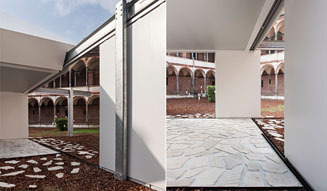
KamuroAs Suzuno mentioned, we often use sliding doors in our architectural designs. Sliding doors are not just doors; they are also boundaries, and when open, they are less obstructive than regular doors. Sliding doors are also very effective for reconfiguring the layout of a studio apartment. As we discussed these ideas, a form began to emerge.
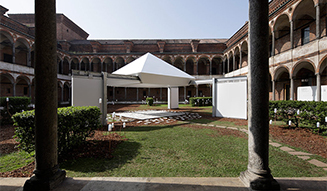

The Reason for the House-like Shape, Like an Icon
SuzunoThis time, with sliding doors and LED lighting as the main products, we wanted to create something that would extend beyond just an installation. We explored various design approaches, but by re-examining fusuma and shoji and considering them as "moving walls – devices that dynamically alter space," we saw an opportunity for a bold and new challenge. To encourage viewers to perceive the sliding doors as walls, we designed them in a clear house shape, so they would recognize that walls were moving, not just panels. We also made the shape iconic, like a house, to make the changes caused by the opening and closing of the sliding doors easily understandable.
KamuroWe started with the concept of "SLIDING NATURE" from the beginning, and the phrase "a breathing house where the living environment and nature merge," incorporating lighting, was born from this, which I think is a very good expression.
Panasonic|Panasonic
Panasonic x Torafu Architects: "SLIDING NATURE" Exhibition
The "Evolution of Sliding Doors" Revealed Through a Real-Space Exhibition
As a development of the installation exhibition at Milan Salone, Panasonic, together with Torafu Architects, has created a next-generation spatial concept model. It will be unveiled for the first time at an exhibition for housing industry professionals in May. In Panasonic's proposed new smart house, sliding doors are also key, proposing a new way of living in a real-space context.
A New House Form Inspired by Sliding Doors
SuzunoWhile setting up and exhibiting the installation at Milan Salone, we had many realizations, such as people saying, "It would be great if this could be a Panasonic cafe in a park," or "We want to build a showroom that fully utilizes the advantages of sliding doors."
The key sliding doors, beyond just changing shape, can function as walls, canvases for drawing or writing, or projection screens. They not only offer flexibility in floor plans required for modern living but also hold the potential to transform lifestyles.
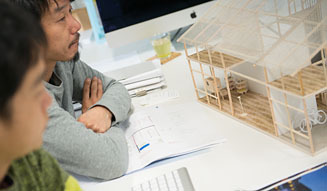
KamuroTo integrate the installation exhibition into actual homes, "translation" is necessary. However, in the concept model we will be exhibiting, the movement of sliding doors—acting as walls and partitions—will present the possibilities of a home more realistically.
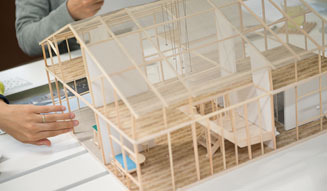
SuzunoThe model we will exhibit is designed for a house of approximately 80 square meters, with a structure where walls move in a swastika-like pattern. Inside, four private rooms can be closed off or connected using sliding doors.
It will be a package of variable spaces tailored to different lifestyles, including "Family Mode" for balancing living and chores, "SOHO Mode" for comfortable remote work, and "Party Mode" for accommodating large families during holidays like Obon and New Year.


Advanced Technology Supporting Our Lives
KamuroAt Milan Salone, we presented the LED lighting, which was arranged like plants in the courtyard, as hidden technology, not overtly displayed. This concept model effectively combines the idea that advanced technology supports our modern and futuristic lives.
SuzunoFrom an architect's perspective, Panasonic's housing materials and the Archi-Spec series of lighting are very user-friendly, as they align with what architects aim to achieve. This time, we used actual products to express Panasonic's worldview through an installation on the grand stage of Milan Salone. By leveraging our strong teamwork, I believe it will be a valuable experience for both of us if it leads to future collaborations.
Inquiries
Panasonic Eco Solutions Company, PR & Communications Group, General Planning Team
Tel. 06-6908-1131 (General Inquiries) Reception: 8:45 AM - 5:30 PM
http://panasonic.net/milanosalone
Torafu Architects
http://torafu.com/
