Secrets Behind the Success | Series Vol. 6: Alexander Schaerer, CEO of USM
Behind the Scenes with Business Leaders
Part 6 | Alexander Schärer (CEO, USM)
Timeless Craftsmanship (1)
What are the daily lives and thoughts of successful business professionals like? In our "Secrets behind the Success" series, we delve into the private lives of these accomplished individuals through interviews, revealing a side of them rarely seen.
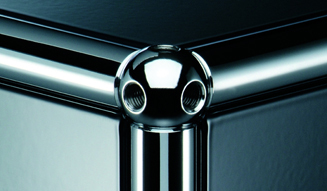
USM Haller, the modular furniture system, is comprised of just three basic components: balls, tubes, and panels. It originated in Switzerland in 1965, nearly half a century ago. The ingenious concept involves connecting lines (tubes) to connection points with six holes (= balls), and then fitting in surfaces (= panels) to create cubes. Combining these elements allows for an infinite variety of configurations. Today, Alexander Schärer leads the USM Group, which has a global following and operates direct subsidiaries in Japan, Germany, France, and the United States. We spoke with him during his visit to Japan about the allure of USM, his management philosophy, and his personal life.
Photographs by NAKAMURA Toshikazu (BOIL)
Text by TASHIRO Itaru
Innovative and Original: USM Haller
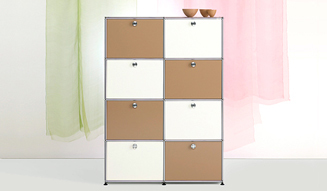
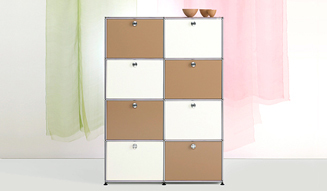
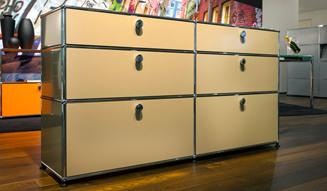
Expressing the gentle light of spring with a checkerboard pattern of beige and pure white panels—This USM Haller modular furniture, evoking a sense of gentle warmth, is currently on display at the company's direct showroom in Marunouchi. Beside it, Alexander Schärer smiles softly.
“This is a type of installation created by Maruwakaya, led by artist Hirotoshi Maruwaka, who embodies the concept of ‘craftsmanship that creates eras’ by reflecting Japanese aesthetics in contemporary products. This combination of beige and pure white has a very serene, Japanese feel. It brings a sense of calm to those who see it. USM products are not like statement design chairs that demand attention simply by existing. This installation beautifully brings out those characteristics through a Japanese sensibility. Yes, it’s like the Japanese themselves, who sometimes prefer tranquility.”
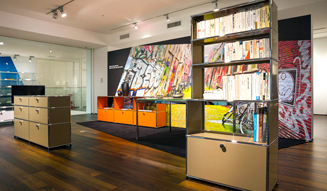
“On the second floor, we are exhibiting furniture in a gradient of orange, beige, red, and gray. Through these installations, visitors can experience our USM Haller modular furniture in a different context. It’s a fascinating discovery to see how the same products can evoke such different impressions. It also reaffirms that USM can seamlessly integrate into any environment and space.”
The simplicity of its structure allows for endless customization, making it adaptable to both homes and offices according to individual preferences. This versatility is the greatest appeal of USM, and it’s remarkable that this idea was conceived nearly half a century ago.
“USM and I are the same age,”
says Alexander Schärer with a laugh. He was also born in 1965.
“It’s made from a very simple basic structure. That’s our strength and a major factor in our success. I believe that’s why it has endured for nearly half a century without change since its inception. It not only boasts high quality but also possesses a design aesthetic that can withstand the test of time. Even after more than 50 years, it remains modern, and if you wish to expand your existing system, you can do so at any time. It’s a piece you can continue to use indefinitely. Some might feel that USM furniture is expensive, but in the long run, it’s a very eco-conscious purchase.”
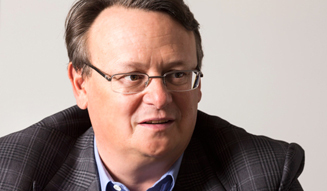
While the core design remains unchanged, we continuously make subtle improvements to the unseen technical aspects, such as the hinges used for doors. We maintain rigorous quality control alongside our commitment to sustainability. In addition to the three main components, various options have been added over time, and at our sole production facility in Switzerland, we consistently strive to enhance the product's appeal through efforts in efficiency and reduced environmental impact. I am confident that these fine-tuning adjustments are why the same products have enjoyed enduring popularity.
While overhauling all products at once would be challenging, the simple basic structure is a significant advantage in this regard. For us, improving a part of a component achieves this. Enhancements are crucial for maintaining product relevance, and improving production processes is a natural necessity for any company today.”
Behind the Scenes with Business Leaders
Part 6 | Alexander Schärer (CEO, USM)
Timeless Craftsmanship (2)
A Family Business with 150 Years of History
Alexander is the fourth generation of the Schärer family. USM has built its history as a family-owned enterprise, passed down through generations of the Schärer family.
“The company was founded in 1885, initially as a manufacturer of metal components such as window fittings and locks. Later, my father, Paul Schärer Jr., became president in the third generation. The company reached a major turning point when my father met the architect Fritz Haller. Haller designed our new factory using innovative techniques, and based on that, the USM Haller modular furniture was created as a new product. The story behind it is quite interesting.
Fritz Haller was an expert in architectural design. My father, like myself, is an engineer, responsible for the more technical aspects. The crucial point was that my father and Fritz came from completely different fields. For instance, an idea my father conceived might be technically excellent but questionable in terms of design. Fritz filled those gaps, resulting in USM Haller modular furniture that is both functionally superb and aesthetically outstanding.
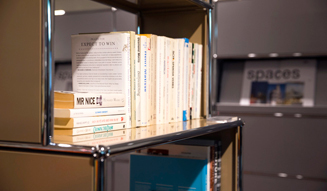
USM Haller Modular Furniture Showroom
Marunouchi MY PLAZA 1F/2F, 2-1-1 Marunouchi, Chiyoda-ku, Tokyo
Tel. 03-5220-2221
http://www.usm.com/ja-jp/
Afterward, we expanded our business beyond Switzerland to global sales, with international revenue now accounting for 80% of our total sales. This was a period of significant growth for USM. In my tenure, my focus has been on personally visiting these markets and establishing the brand's presence and reputation there. Previously, sales in countries outside Europe were largely left to local distributors. However, I realized this approach wasn't yielding the desired results. Instead of rapidly expanding into new markets, we adopt a strategy of achieving solid results in one market before moving on to the next.
We currently have new projects underway in the UK and Australia. While I cannot disclose details yet, we are thoroughly researching the market dynamics and distribution structures to formulate strategies and promotional plans. This meticulous approach to planning and execution is a significant change we've implemented. We are no longer in an era where simply selling is enough.”
Today, USM Haller modular furniture is sold in over 40 countries worldwide. Yet, the spirit cultivated through the Schärer family's generations of management continues to be passed down.
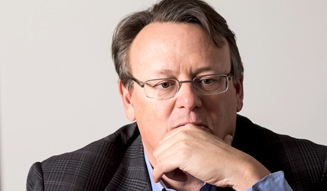
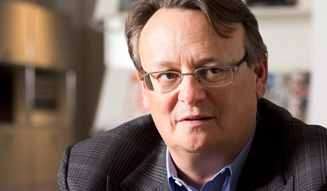
“That hasn’t changed even now, 150 years after our founding. When we hire new employees, we do so with the mindset of welcoming a new family member, not just an employee. As we work together, they truly become part of the ‘family.’ In a good way, of course. Not in a mafia sense (laughs). This benefits the company immensely. Because it’s for the family, everyone works with great dedication. Naturally, with the good comes the bad; sometimes, discussions can escalate into arguments, much like family disputes (laughs). But that simply reflects how much each person loves the company.”
Behind the Scenes with Business Leaders
Part 6 | Alexander Schärer (CEO, USM)
Timeless Craftsmanship (3)
The Personal Pleasures of a Global Business Leader
As the head of a company with a global reach, Alexander travels extensively. Consequently, his favorite restaurants span the globe.
“I’m fond of The Four Seasons Restaurant in New York. Not the hotel group, but the one located within the Seagram Building. The building was designed by architect Philip Johnson, and the interior was handled by Mies van der Rohe. It’s furnished with pieces from the late 1950s, making it comfortable and inviting. It seems to have a rich history and is designated as a historical landmark. In contrast, my preferred hotel boasts a modern design. It’s the ‘Omnia’ in Zermatt, at the foot of the Matterhorn in Switzerland.OmniaIt’s actually a hotel owned by USM. It has 30 rooms, and each one is uniquely designed with different room sizes and furniture arrangements, which I find quite interesting.”
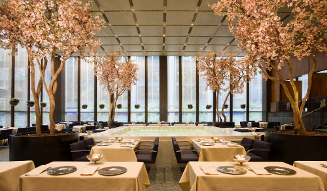
The Four Seasons Restaurant
99 East 52 Street New York, New York 10022
Tel. +1-212-754-9494
http://fourseasonsrestaurant.com
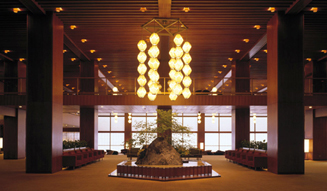
Hotel Okura Tokyo
2-10-4 Toranomon, Minato-ku, Tokyo
Tel. 03-3582-0111
http://www.hotelokura.co.jp/tokyo/
What I look forward to in Japan is, above all, Japanese cuisine. I love Japanese food, especially sushi. My regular hotel is the Hotel Okura, so I often dine at ‘Kyuubey’ within the hotel. I’ve already been this time as well. Tonight, I’m having shabu-shabu with all the Japanese staff (laughs). Speaking of Hotel Okura, I believe it was built around the same time as The Four Seasons Restaurant. Because of this, both leave a strong impression of modernist design. Of course, Okura incorporates a significant Japanese interpretation, but when I visit the bar, I feel a particular connection to The Four Seasons.
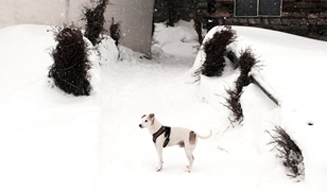
His dedication to his work and his passion are evident even in his attention to design during dinner. During moments of relaxation, away from work, his constant companion is his beloved dog, Jack.
“He’s a Jack Russell, so his name is Jack. Unique, isn’t it? (laughs) He’s more leggy than a typical Jack Russell and runs a lot. I myself enjoy walking, and when I feel stuck, I often go for a stroll to clear my head. Jack, who loves to accompany me everywhere, is always by my side. We often go for walks in the mountains. That’s my favorite way to spend a holiday.
I smoke cigars during these times. I throw a ball, and while he fetches it, I smoke and wait (laughs). For my daily cigar, I prefer a Partagás Serie D. I love Cohiba and believe they make excellent cigars, but their standard line is a bit too strong for me. So, my favorite is the smoother Behike, which I reserve for special occasions.”
Another hobby essential to his relaxation is sailing, something he has been familiar with since childhood on Swiss lakes.
“I participate in races now. While it’s a hobby for me, some of my sailing companions are professionals or semi-professionals in their respective fields. About 80% of my friends are pros or semi-pros. I don’t employ them, mind you. When I was in my early teens, around 12 to 14 years old, I found sailing a bit dull and took up windsurfing. Strong winds are also not very common on Swiss lakes (laughs).
Windsurfing led me to the sea, and I grew to love it. Then, I felt a desire to pursue sailing more deeply in the wonderful environment of the sea and wind. Now, I focus solely on sailing. The sea is wonderful. It’s open, and unlike being in the city, you can experience a sense of freedom.”
As Alexander shows images of his sailing on a tablet, his eyes light up. Prompted to look closer at the sail of the boat he points to, one can see the ball, the heart of USM, depicted as a symbol.
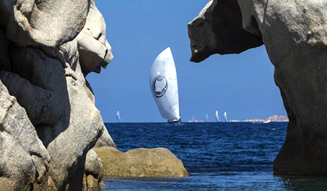
“It’s just a ball with a hole (laughs). I carry a real one with me, too. This is my lucky charm. Thanks to this ball, not only has my family become rich (laughs), but without it, I wouldn’t be able to come to Japan or travel to other countries. I consider it a symbol of good fortune that has made all this possible. As an engineer, I don’t believe in superstitions (laughs). Actually, this patent was acquired ten days before I was born. In that sense, it’s like an older brother, ten days my senior (laughs).”
Alexander states that USM's mission is to consistently produce high-quality products and to advance as a brand, step by step. Today, he continues his global journeys with his lucky charm, the ball.
Alexander Schärer
Born in Bern, Switzerland, in 1965. Graduated from EPFL (Swiss Federal Institute of Technology) with a bachelor's degree in engineering. After working at P&G, he joined USM U. Schärer Söhne AG in 1993. Appointed CEO in 2000. He is the fourth-generation leader of the founding family.