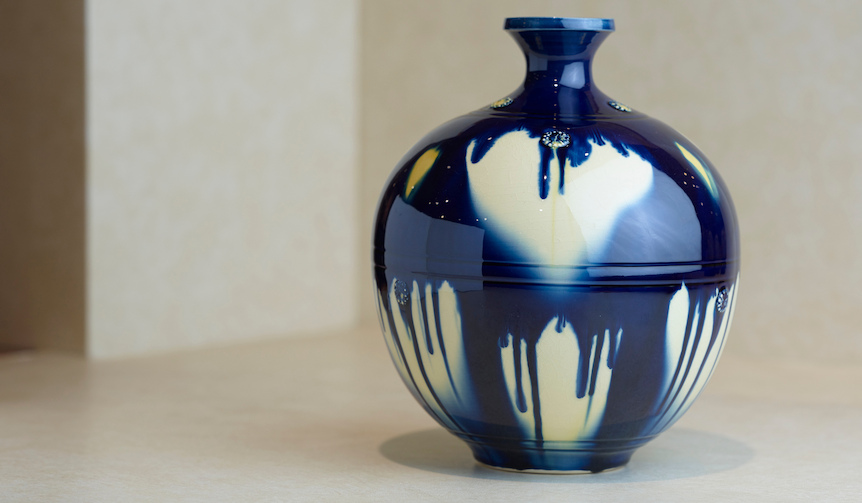
Yasuhiro Mihara on the allure of "KOGEI" | MITSUKOSHI
SponsoredNihonbashi Mitsukoshi Main Store, 6th Floor Art Section
Where Works of Soul Reside
Yasuhiro Mihara Visits the Sacred Ground of "KOGEI"
Yasuhiro Mihara visited the 6th-floor art section of the Nihonbashi Mitsukoshi Main Store, a space that offers a diverse range of world-class works, from traditional crafts to paintings. What did the globally renowned fashion designer feel and think upon encountering the "KOGEI" that this long-established department store proudly presents?
Text by OGAWA FumioPhotographs by Jamandfix
Artists Expressing Their "Now"
Japanese traditional crafts are highly regarded overseas. Among them, the "Art Crafts Salon" on the 6th floor of the Nihonbashi Mitsukoshi Main Store gathers works by top-tier artists, including Living National Treasures. As traditional crafts are now evolving into "KOGEI" that appeal to international tastes, it's essential to experience their charm. Mr. Yasuhiro Mihara of "Maison MIHARA YASUHIRO" is one designer who keenly appreciates the allure of traditional crafts.
Mr. Yasuhiro Mihara and traditional crafts. One might imagine a vast gulf, perhaps spanning galaxies, between Mihara's designs, exemplified by shoes underpinned by sharp concepts and bold forms, and the works of metalwork and ceramics that have been continuously produced in Japan for centuries. However, Mihara, an alumnus of an art university, actually spent time in workshops of traditional crafts in Kyoto and other historic regions during his studies. In his professional life, he also engages in conversations with artisans of textiles and other crafts, giving him a deep understanding of the background from which these works emerge.
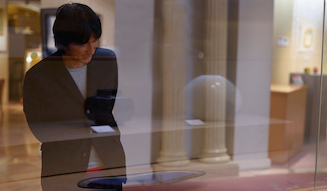
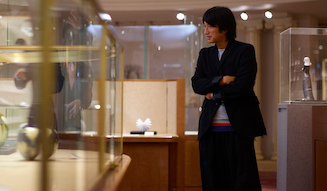
For Mr. Mihara, the "Art Crafts Salon" on the 6th floor of the Nihonbashi Mitsukoshi Main Store is therefore a place of profound interest. Upon entering, his first words were that this is a sacred place.
"Various artists are expressing their 'now.' And boldly. Their pursuit of self-expression, rather than aiming for applause, is clear. Yet, they are not confined to their own worlds, pursuing 'art' in isolation. They are genuinely open to the public. That's why the works feel alive, and I can sense the artist's warmth. This place, where such works are displayed, is, in a sense, a sacred ground. The artists here possess immense talent, and I am also impressed by the skill of the staff (at Nihonbashi Mitsukoshi's art department) who bring together these artists and facilitate their creations."
The art floor on the 6th floor of the Nihonbashi Mitsukoshi Main Store began its operations in 1907. Since then, it has featured works by talented artists based in Japan. Its scope is remarkably broad, encompassing paintings, sculptures, and objets d'art, as well as ceramics, lacquerware, metalwork, woodwork, bamboo crafts, dolls, and glass. Furthermore, the exhibition space on the sixth floor boasts a floor area that is "top-class in Japan," truly embodying the essence of a "sacred place," as Mr. Mihara described it.
Nihonbashi Mitsukoshi Main Store, 6th Floor Art Section
Where Works of Soul Reside
Yasuhiro Mihara Visits the Sacred Ground of "KOGEI" (2)
The Aura Emitted Only by Authentic Crafts
The Art Crafts Salon on the 6th floor of the Nihonbashi Mitsukoshi Main Store and designer Yasuhiro Mihara. At first glance, the pairing might seem disparate, but perhaps it is precisely such unexpected encounters that hold significance. As traditional crafts gain international recognition under the banner of KOGEI, the evaluation from an artist active globally in a different field is highly valuable.
Mihara's assessment is indeed very high.
"It is astonishing to see such a high level of work displayed in such quantity. Seeing these pieces in person, I realized how little I knew. The charm is not fully conveyed in catalogs or online. The form, including its size, the texture of the surface created by carving or glaze, and most importantly, the atmosphere. I truly understood anew that these can only be fully appreciated when viewed firsthand."
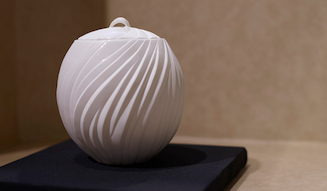
Nami Takahashi, "Mizusashi" (Water Jar)
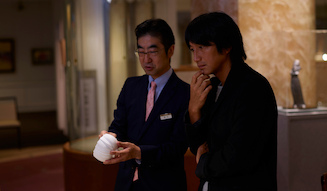
Mr. Yasuhiro Mihara and Mr. Osamu Shimada, Manager of the Nihonbashi Mitsukoshi Art Department
One piece that Mr. Mihara remarked, "This is truly remarkable," was a new work by Nami Takahashi, a recipient of the Newcomer Award at the 63rd Japan Traditional Crafts Exhibition. Takahashi, who resides in Tokyo, works with white porcelain using a casting technique. She has also spent time creating art in Italy, but her unique style, combining lines that appear gouged with a knife or chisel with bold contours, possesses an originality that powerfully captures the viewer's attention.
"In pieces like this vase, the incised lines, despite their hardness, possess a fullness of life, as if filled with water like a plant within. It must be a tactile sensation. It's something that absolutely cannot be made with a 3D printer. It's almost erotic, in a good way, evoking a sense of sensuality. The aura of authenticity is truly powerful."
There were further encounters with astonishing works.
Nihonbashi Mitsukoshi Main Store, 6th Floor Art Section
Where Works of Soul Reside
Yasuhiro Mihara Visits the Sacred Ground of "KOGEI" (3)
A Strong Obsession with Beauty
Designer Yasuhiro Mihara experienced surprising encounters at the Art Crafts Salon on the 6th floor of the Nihonbashi Mitsukoshi Main Store. Following Nami Takahashi's white porcelain, he turned his attention to the works of Kiyokazu Kato, a potter based in Kyoto. Kiyokazu Kato is the 13th generation of the Jihei lineage, descended from Oribe Furuta's Seto Jussaku, and his father is the first generation Seizan. He creates Sancai (three-color) pottery.
Mihara was captivated by the richness of the colors and the beautiful patterns. Sancai is a type of pottery with a long history, originating from China. It is characterized by the use of glazes with lead for white, copper for green, and iron for yellow. Cobalt glaze is also used for blue. Although introduced to Japan during the Nara period and established here, Mihara is particularly interested in how new expressions continue to emerge.
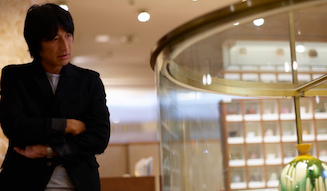
Yasuhiro Mihara admiring Kiyokazu Kato's "Sancai Mokkō Baibing" (Sancai floral-decorated plum vase)
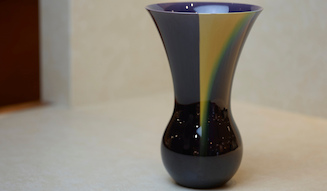
Masatoshi Tajima, "Sairyu Kaki 'Kōsai'" (Polychrome Glazed Flower Vase 'Brilliant Colors')
"I love Kato-san's work. I think he masterfully utilizes the unpredictable nature of glaze, which cannot be perfectly controlled. It feels as though he has calculated even the uncontrollable aspects, revealing a strong obsession with beauty. Some pieces suggest an intention towards symmetry, but they are, of course, not perfectly symmetrical. I find that aspiration deeply impressive. In nature, there are virtually no perfectly symmetrical things. Even a butterfly's wings are actually different on each side. Contemplating this draws me in."
Regarding Masatoshi Tajima's works, Mihara states, "I am moved by the colors that are perfectly controlled." Tajima is a highly acclaimed artist known for his unique style, which omits red from the five colors typically used in Kutani ware.
"The brushwork in his pieces is, in a sense, like the universe. It possesses an incredible depth. I also strongly feel the interplay of light and shadow. It's so profound that it numbs all concepts, like a black hole beyond our imagination. Although the forms are minimal, the expression, achieved through extremely skillful use of gradation, reminds me of conceptual art."
Mr. Yasuhiro Mihara then recalls something else.
Nihonbashi Mitsukoshi Main Store, 6th Floor Art Section
Where Works of Soul Reside
Yasuhiro Mihara Visits the Sacred Ground of "KOGEI" (4)
High or Low Artistic Value Is Not the Point
After touring the 6th-floor art section of the Nihonbashi Mitsukoshi Main Store, fashion designer Yasuhiro Mihara also visited "The 63rd Japan Traditional Crafts Exhibition" (held until October 3, 2016, followed by a national tour), which was taking place on a different floor.
"I felt that whether the artistic value is high or low is not particularly important to the artists exhibiting here."
In a floor populated by visitors in suits and ties, Mr. Mihara, dressed somewhat distinctively, moved fluidly through the crowd, observing the works. Afterward, he shared the above sentiment.
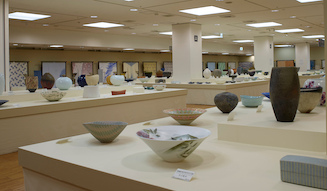
Venue of "The 63rd Japan Traditional Crafts Exhibition"
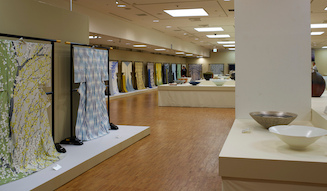
"Within traditional techniques, the pursuit of an almost stoic self-expression is likely what is important to these artists. Marcel Duchamp, the pioneer of conceptual art, once said in an interview, 'The artist creates because of a kind of addiction to the creative process.' I was reminded of that."
Judging solely by fame or obscurity might mean missing half the point of visiting the Art Crafts Salon or the "Japan Traditional Crafts Exhibition." As Mr. Mihara has discussed, one should immerse oneself in the works and have a moving experience. Of course, the high quality of the works is guaranteed by Nihonbashi Mitsukoshi's century-long relationship with artists based in Japan.
"Duchamp also stated that 'value is determined by a third party,' and I truly felt that to be the case. By approaching the works without preconceptions, young artists can also be greatly inspired."
"There are undoubtedly works imbued with soul here," concluded Mr. Yasuhiro Mihara.
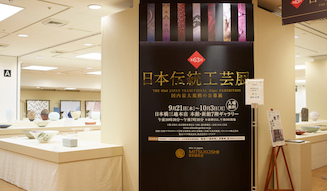
The 63rd Japan Traditional Crafts Exhibition
September 21 (Wed) - October 3 (Mon)
Nihonbashi Mitsukoshi Main Store, Main Building & New Building 7th Floor Galleries (Free Admission)
10:30 AM - 7:30 PM (Last day until 6:00 PM)
Japan Crafts Association
http://www.nihonkogeikai.or.jp/
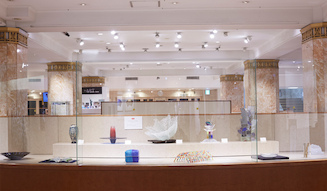
Nihonbashi Mitsukoshi Main Store, 6th Floor Art Section
1-4-1 Nihonbashi Muromachi, Chuo-ku, Tokyo
TEL: 03-3241-3311 (General Inquiries)
Business Hours: 10:30 AM - 7:30 PM
http://mitsukoshi.mistore.jp/store/nihombashi/floor/main_6f/art/