Panasonic | Milan Salone "Photosynthesis" On-Site Report
Panasonic|Milan Salone "Photosynthesis" On-Site Report
A Grand Pavilion That "Photosynthesizes" Like a Tree
"Photosynthesis" On-Site Report
This marks Panasonic's fifth consecutive year exhibiting at Milan Salone.Panasonicunveiled a striking installation, "Photosynthesis," at the University of Milan. Miho Kawamura of Daily Press, an attaché de presse, reports from the scene.
Text by KAWAMURA Miho (DAILY PRESS)
The Courtyard and Surrounding Cloisters Form the "Photosynthesis" Venue
Milan in April had been marked by frequent rain and chilly days, but the opening day of Milan Salone, which began on April 17th, was blessed with clear skies, making for a pleasant start.
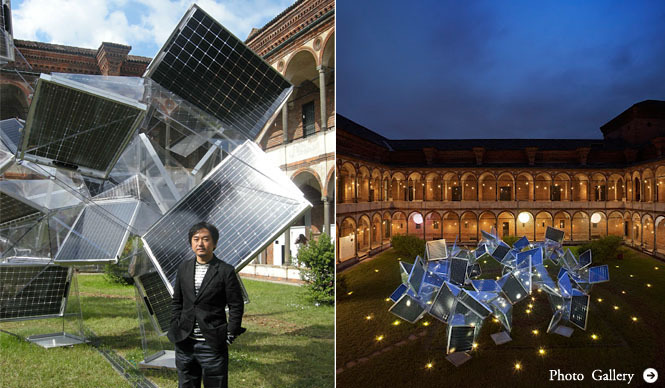
For its fifth exhibition at Milan Salone, Panasonic collaborated with architect Akihisa Hirata to present "Photosynthesis." The installation, embodying a concept for a sustainable new energy era, likened Panasonic's energy management philosophy to the "photosynthesis" of plants, the origin of biological circulation systems.
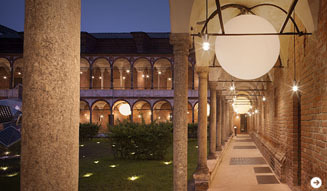
The venue was the University of Milan, one of Milan's significant architectural landmarks dating back to the 15th century. This site, annually hosting events organized by INTERNI, is a focal point of Fuorisalone. The university, once a monastery and hospital, features a courtyard called "Cortile Farmacia"—a former herb garden—and its surrounding cloisters, which served as the setting for "Photosynthesis."
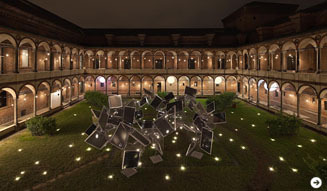
Entering through a narrow passage, visitors were greeted by a large pavilion crafted from solar panels and transparent polycarbonate, set within a courtyard enclosed by charming brick cloisters. This pavilion "photosynthesizes" like a solitary tree.
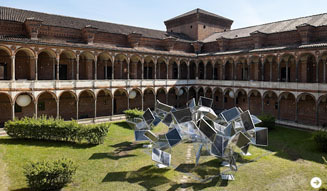
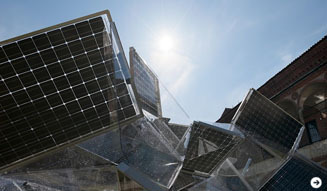
The panels, oriented in various directions like tree leaves, capture sunlight to generate energy. This energy is stored in batteries, akin to fruits accumulating nutrients, and then distributed to the cloisters. Within the cloisters, LED and organic EL lighting systems conserve energy while sparkling like flowers, illustrating a cycle throughout the entire venue.
During the day, the pavilion vibrantly generates electricity from sunlight, its transparent polycarbonate reflecting the sun's rays to create a rainbow-like iridescence, mirroring the courtyard's plants and historic architecture. As the sun sets, the pavilion gradually recedes, as if entering slumber, while LED lights embedded in the cloisters and ground begin to twinkle. Their glow reflects onto the pavilion, crafting a truly ethereal space. This dual-faced environment, shifting between day and night, offers a spectacle where nature and artifice, history and modernity, and cutting-edge technology converge.
When we think of solar panels, we typically imagine them laid out flat on rooftops or vast expanses of land. These might be likened to moss or grass covering the ground. However, nature also presents trees with leaves arranged three-dimensionally, like branches reaching outwards. This led to the creation of the pavilion, conceived as a new "species" of tree with a three-dimensional arrangement of "leaves."
Just as vegetation grows beneath trees, providing shade for people and animals to rest, this artificial structure casts light and shadow, allowing for coexistence with nature. At the venue, small birds were often seen playing near the pavilion and resting on its panel "leaves." This exhibition conveys a vision of a prosperous future where natural and artificial elements interact and coexist, moving beyond mere efficiency.
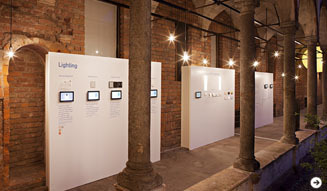
Following the opening, architect Akihisa Hirata, who designed the installation, expressed his hope that visitors would "reconsider their perception of sunlight and artificial light, experiencing the diverse forms of light. We want them to feel and experience the creation and use of energy not as a concept, but as light and scenery."
Despite frequent rain throughout the exhibition period, the venue attracted large crowds daily, with many repeat visitors. They seemed to be leisurely enjoying the space as it revealed different expressions under natural and artificial light, depending on the sun's position and the weather.
We hope that visitors, walking through these historic cloisters where past generations once contemplated the future, will immerse themselves in the "Photosynthesis" exhibition and reflect on new energy cycles for a sustainable and prosperous future. "Photosynthesis" runs until April 28th.
Winner of the "Elita Design Awards" Grand Prize!
Panasonic's "Photosynthesis" exhibition has won the Grand Prize at the Elita Design Awards, which selects the best installation from Fuorisalone (approximately 500 venues across Milan).
This award, established last year through a partnership between Elita Festival, IED (European Institute of Design), and Fuorisalone.it, is presented to the installation that most moved visitors, including those involved in Fuorisalone and design schools.
elita design awards
http://fuorisalone.it/2011/specials/design_award
Panasonic "Photosynthesis"
"INTERNI LEGACY" Venue
Dates: April 16 (Mon) - 22 (Sun), 2012, 9:00 - 24:00 (Exhibition explanation hours 11:00 - 21:00)
April 23 (Mon) - 28 (Sun), 2012, 9:00 - 21:00
INTERNI LEGACY
Università degli Studi di Milano: Cortile Farmacia
Interni at the University of Milan (Cortile Farmacia)
via Festa del Perdono, 7 - Milano
"INTERNI LEGACY" Venue
Dates: April 16 (Mon) - 22 (Sun), 2012, 9:00 - 24:00 (Exhibition explanation hours 11:00 - 21:00)
April 23 (Mon) - 28 (Sun), 2012, 9:00 - 21:00
INTERNI LEGACY
Università degli Studi di Milano: Cortile Farmacia
Interni at the University of Milan (Cortile Farmacia)
via Festa del Perdono, 7 - Milano
http://panasonic.net/milanosalone
Panasonic
Customer Consultation Center
0120-878-365 (Reception 9:00-20:00)