Part 3: Brand Evolution and the Arrival of the Boom
text by KANAZAWA Ariadnaphoto by Jamandfixedit by TAKEISHI Yasuhiro
From Mackey to Jeannette
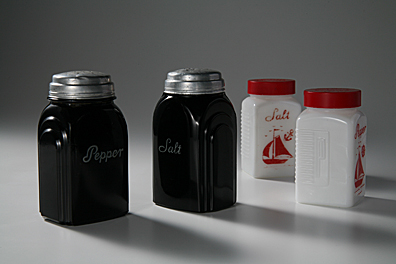
In the 1930s, Mackey began to establish mass production systems, releasing numerous series and items. While today their pieces might strike us as having a rather tricky design, they were apparently influenced by European traditional design at the time. These influences can be seen even in Mackey's pre-milk glass products. Unfortunately, Mackey's prosperity was not to last long.
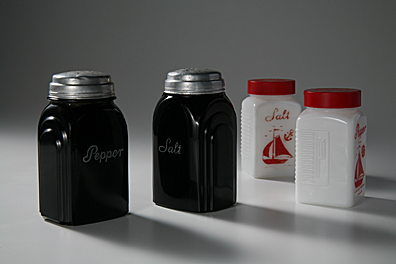
By the late 1930s, the clouds of world war loomed, and countries involved in the conflict faced metal shortages for arms manufacturing. In the U.S. too, various companies began to have their resources requisitioned. Many glass companies, including Mackey, had their molds taken by the government, entering an era where operation became practically impossible.
It is heartbreaking to consider how many wonderful design molds were reborn as weapons of harm. While the fate of the original molds is unknown, eighty years seem to have erased even such histories. Perhaps, somewhere in an American attic or basement, they still exist today as heirlooms of a grandfather.
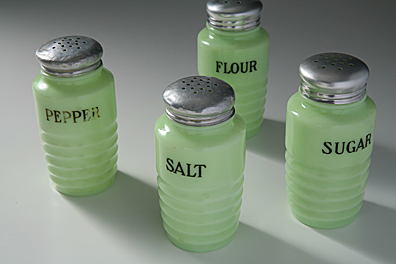
Mackey was later acquired by one company and then sold to Jeannette. Jeannette, a glass company founded in 1898, absorbed much of Mackey's technology and produced remarkably similar series and items, particularly evident in their shakers and canisters. The difference in jade color between Mackey and Jeannette is distinct, but this appears to have stemmed from fundamental technical capabilities rather than intentional differentiation. Mackey's pieces showed little variation in color, but the increased variation after the transition to Jeannette likely reflects the significant influence of the color director's skill and vision at the time.
Living in Japan, we tend to take standardized specifications and uniform colors for granted. However, in the U.S. today, there's still a casual approach to such matters, and the variations in jade color are, in their own way, a delightful characteristic. Jeannette continued to operate until the early 1980s. Notably, their "Glasbake" series, manufactured and released in the 1970s, has gained significant recognition in recent years.
The Arrival of Fire-King and the Milk Glass Boom
Then, in the 1940s, Anchor Hocking introduced "Fire-King," which would become the quintessential mass-produced milk glass. Fire-King products from the 1940s bear a resemblance to Mackey's items, clearly indicating a highly adept marketing strategy. The early "Philbe" mug, for instance, strongly reflects the shape of Mackey's mugs.
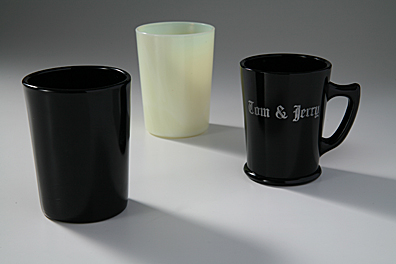
Regardless, Mackey played a crucial role in my understanding of milk glass. Until the late 1990s, items from Mackey and Jeannette were known only to a select group of collectors and vintage clothing merchandisers.
Around 1996, however, the already nationally popular "celebrity homemaker" Martha Stewart began to spotlight jade-colored milk glass on her magazine and TV shows. Her TV program featured shelves lined with jade items from Mackey and Fire-King, and they were also used for serving dishes. This brought jade into the focus of housewives and her fans across the country. Interestingly, at that time, it was still common for American households in rural areas to have one or two pieces of Fire-King.
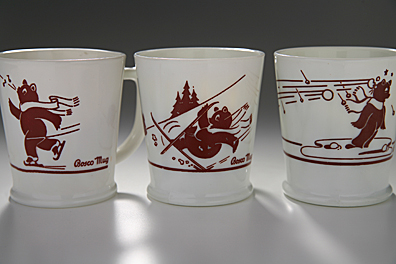
Driven by these trends in America, the milk glass boom also ignited in Japan in the late 1990s. The major Fire-King craze truly took off around the turn of the 21st century. Of course, in the late 1990s, they were still discreetly placed in the corners of furniture shops on Meguro Dori or on the counters of vintage clothing stores. Subsequently, collector's guides and related books were published en masse in the U.S., leading to nationwide recognition of vintage American glassware. At glass shows across the country, the main items traded shifted from cola bottles to pieces from Mackey, Jeannette, and especially Fire-King.
In the next installment, I will discuss the birth of Fire-King, the Fire-King boom that began in Japan in the 21st century, and my photo collection "BREATH TAKING."