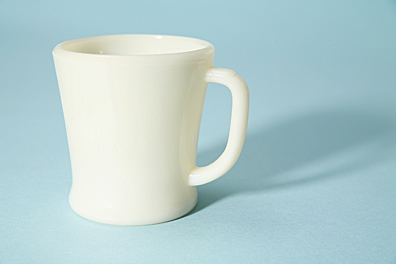
Part 1: Encountering Fire-King
This is the inaugural installment of our series.
Today, I'd like to share how I first encountered vintage tableware.
photo by Jamandfixtext by KANAZAWA Ariadnaedit by TAKEISHI Yasuhiro
Jewels of the Kitchen
As a child, I split my time between Russia and Tokyo. My grandmother lived in St. Petersburg, and her home, like the city itself, was filled with traditional, beautiful European tableware. I was captivated by its elegance.
If my life in Russia was steeped in tradition, my time in Tokyo felt decidedly modern and stylish. I adored libraries and bookstores, and while I often acted as my mother's translator, I also frequently took her to shops specializing in tableware, an area of great interest to me.
The first shop I visited, discovered through a magazine when I was in elementary school, was "Orange House" in Aoyama. The memory of dragging my mother there and convincing her to buy me the least expensive cocotte dish still brings a peculiar feeling. Little did I imagine then that these "jewels of the kitchen" would one day lead to my career.
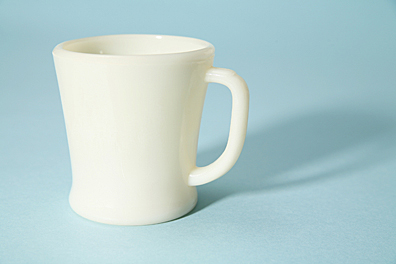
And there, nestled amongst the other items, was a Fire-King D-handle mug. Until then, I had only known the texture of ceramic. This was my first encounter with tableware made of "milk glass," a material with a unique translucence.
The color wasn't the famous Jadeite or white, but a subtle ivory. On impulse, I switched my choice from the silverware to the mug. The shop owner told me, "It's junk," but I felt an indescribable, gentle warmth from it. At the time, I knew nothing about it, not even the brand. All I could discern was the "FIRE KING" inscription on the bottom.
The Deep World of Milk Glass
Later, I met my husband, a collector of milk glass, who taught me about its nature and history. This ignited my curiosity further, and I found myself traveling between Tokyo and America—particularly the East Coast—countless times in search of milk glass.
Compared to European ceramics, the designs were somewhat rough-hewn, yet possessed a mysterious, standardized quality despite mass production. I became engrossed in the profound world of milk glass, delving into the history of Jadeite in particular. With my husband's help, I gradually pieced together its mysteries and history, making new discoveries and amassing a considerable collection.
Meanwhile, starting in the late 90s, I began contemplating publishing a photo book of my personal collection of American vintage glassware. This culminated in "BREATH TAKING" in 2003. The vintage glassware shop "kitsch-n," which opened the year before, wasn't part of the original plan; it was conceived as a gallery space to follow the book's publication.

In any case, vintage tableware has become an integral part of my work and life. In the following installments, I aim to share my discoveries and the moments that have moved me. We'll begin with Jadeite, the quintessential milk glass color.