Part 2: Tableware Adorned with Orientalism
text by KANAZAWA Ariadnaphoto by Jamandfixedit by TAKEISHI Yasuhiro
The Origin of Jade Color
Since my first encounter in New York in 1994, I have been captivated by milk glass. As I delved into its history, I felt the thrill of uncovering historical texts and a growing curiosity for its mysteries. Each time I acquired a new piece, I found myself grappling with various data to understand what it was and the historical context of its production. I began attending glass shows, held several times a year across America, where anything related to glass was on display, and deepened my friendships with dealers and collectors from various regions.
At first, I felt they regarded me, a Russian-born Japanese speaker, with curiosity. However, it seemed they were more intrigued by the "Russian-Japanese person from Tokyo who bombards them with questions about milk glass." Thanks to this, my knowledge expanded dramatically, and I absorbed a wealth of profound insights that even seasoned collectors were unaware of. The dealers and collectors I met then have become old friends, and we remain bound by a deep friendship to this day. Today, drawing on the knowledge gained from these companions, I would like to share the history of jade color as I have compiled it.
The origin of "Jadite," the captivating color that would later become synonymous with milk glass, dates back to around the 1893 Chicago World's Fair. At that time, Orientalism was on the rise in America, with a growing interest in Asian countries, particularly China. Many people were mesmerized by the beauty of jade, a traditional Chinese gemstone, and the jade carving artistry. In this climate, several glass companies began experimenting with tableware in colors that mimicked this oriental symbol of preciousness. While the manufacturing method for heat-resistant milk glass was already established, the full-scale production of jade-colored glass appears to have begun in the 20th century.
The Influence of Art Deco and the McKee Company
Furthermore, the European artistic transition from Art Nouveau to Art Deco significantly influenced this period. By the 1920s, the McKee Company ventured into manufacturing jade-colored glassware targeted at ordinary households. While many pieces were based on Art Deco styles, unlike their European counterparts, they were characterized by a rough, unrefined design, far from delicate. Although produced using mass-production methods like mold casting, these glassware items were very well-received by consumers. However, the price point was not easily affordable for typical households at the time, suggesting that jade-colored tableware was a luxury enjoyed by the upper class.
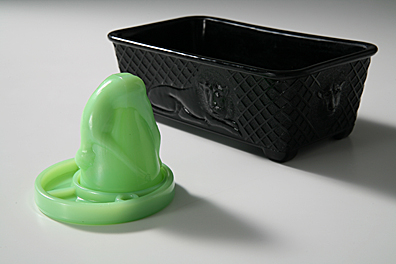
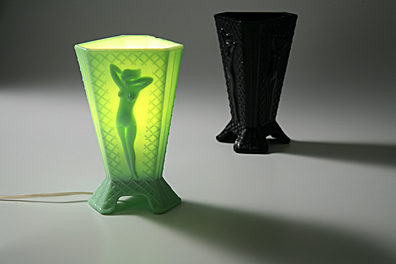
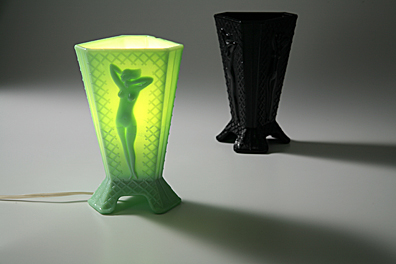
The McKee Company products pictured here strongly reflect the trends of that era. A flower vase was ingeniously converted into a lamp to illuminate a living room coffee table, and shot glasses that couldn't stand upright were displayed on a bar counter, unused. My first piece of milk glass was a Fire-King "Ivory D-Handle Mug," but my eventual discovery of jade color and tracing its history back to the McKee Company was a significant factor in broadening my interests.
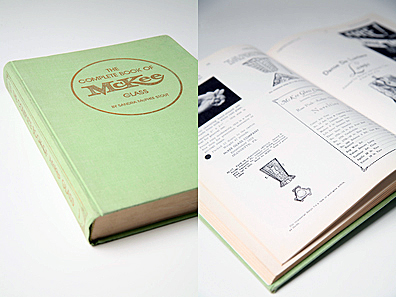
Collector's guides, akin to encyclopedias, for McKee glassware were already being published in the 1970s. Such guides attest to the depth of the collector base in America. This particular guide, with its jade-colored binding and cover, was passed down to me by my husband. It is now one of the rare resources that became almost impossible to obtain in America during the '90s.
Following McKee's lead, other manufacturers such as Jeannette and Anchor Hocking successively introduced their own jade-colored glassware, establishing jade as the quintessential color for milk glass. While jade-colored tableware, now a global collector's item, saw little significant market change until around 1996, it began to take an unexpected turn in its home country, America, thereafter.
In the next installment, I plan to discuss the McKee and Jeannette companies in more detail. We will also explore the significant reasons behind the surprising revitalization of jade-colored tableware in America.