Toyota Unveils MIRAI Fuel Cell Vehicle | Toyota
TOYOTA MIRAI
FUN TO DRIVE, Even as an FCV
Toyota Unveils the MIRAI Fuel Cell Vehicle
Toyota will launch its new sedan-type fuel cell vehicle (FCV), the MIRAI, on December 15th at Toyota and Toyopet dealerships. Priced at ¥7,236,000, the sales target is approximately 400 units by the end of 2015, with future sales to be determined based on market conditions.
Text & Event Photographs by Shunichi Uchida
The Next 100 Years of the Automobile
The development team's motto was "The Next 100 Years of the Automobile," revealed Yoshikazu Tanaka, Chief Engineer at Toyota Motor Corporation's Product Planning Division. Based on this motto, five key areas were prioritized: the "new compact, high-performance Toyota Fuel Cell (FC) system," "packaging unique to FCVs," "Fun to Drive through motor operation," "design that embodies ingenuity," and "functionality unique to FCVs."
"This vehicle is a pioneer in realizing a hydrogen energy society for the next 100 years of the automobile. To achieve this concept, we have poured all our technology into its development. As a result, we believe we have created a car that is not only environmentally friendly but also enjoyable to drive, with a quiet and comfortable ride that makes you want to keep driving it," said Mr. Tanaka.
He added, "We hope that by supporting this car, we can take a concrete step towards a hydrogen society."

The Culmination of Over 20 Years of Development
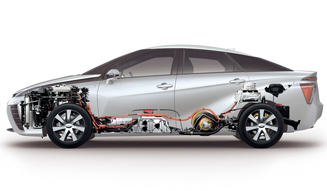
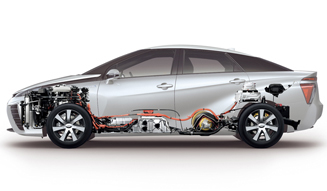
First, the new Toyota FC system is the culmination of over 20 years of development, a system that is both compact and highly performant. The FC stack (cells layered together) generates up to 114 kW of electricity instantaneously through a chemical reaction between oxygen drawn from the air and hydrogen supplied from a high-pressure tank, the reverse of water electrolysis. Its compact size allows it to be mounted under the floor, enabling the sedan packaging seen here.
Comparing its performance to home fuel cell systems like Ene-Farm, Mr. Tanaka explained, "It needs to produce over 116 times the power of a home fuel cell, despite its small size. This required an extremely high level of design, including manufacturing cells with a thickness of only about 1.3 mm."
Furthermore, the two hydrogen tanks boast world-class storage performance. "We are working to reduce costs by reviewing materials and production techniques. In addition, by ensuring complete safety measures, including tank strength, we have achieved a safety level comparable to gasoline vehicles," he emphasized, highlighting the high-level integration of efficiency and safety.

The hydrogen refueling time using this system is approximately three minutes. The driving range on a single fill is about 650 km in the JC08 mode. The compact FC unit also allows for comfortable seating for four adults, and the trunk can accommodate large suitcases, realizing a practical package.
TOYOTA MIRAI
FUN TO DRIVE, Even as an FCV
Toyota Unveils the MIRAI Fuel Cell Vehicle (2)
Pursuing a Ride Quality Unmatched by Luxury Sedans
In terms of driving performance, the motor, with a maximum output of 113 kW and 335 Nm of torque, delivers excellent acceleration. It particularly excels during overtaking maneuvers.
Quietness was another key focus. While FCVs are inherently quiet due to the absence of engine noise, wind noise and road noise can become more noticeable. To address this, the MIRAI features highly sound-insulating acoustic glass and strategically placed sound-deadening materials. Its aerodynamic performance is also enhanced by its unique FCV characteristic of having no exhaust pipe; a full underbody cover ensures smooth airflow.

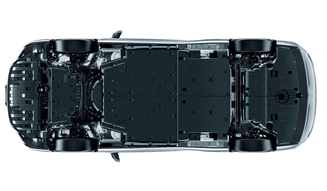
Body rigidity was also a priority to enhance driving enjoyment. "In addition to a body structure that incorporates the FC unit, the stack frame uses thermoplastic carbon resin, achieving both high rigidity and weight reduction," said Mr. Tanaka. Furthermore, by adding braces to the rear suspension, rigidity was increased, and suspension movement was smoothed out to absorb road imperfections, resulting in a ride quality comparable to luxury sedans.
"With its motor drive, low center of gravity, high-rigidity body, balanced front-rear weight distribution, exceptional quietness, and aerodynamic performance, the MIRAI achieves not only environmental performance but also the joy of driving – 'FUN TO DRIVE,'" Mr. Tanaka stated with pride.
TOYOTA MIRAI
FUN TO DRIVE, Even as an FCV
Toyota Unveils the MIRAI Fuel Cell Vehicle (3)
A Design That Never Seeks to Be Eccentric
The MIRAI's design, with the concept of "embodying ingenuity," aims to create a new value that is instantly recognizable. The exterior design expresses the advanced nature unique to FCVs by shaping the function of inhaling air (oxygen) and exhaling water.
The front features two bold grilles on either side to intake air. The headlights utilize newly developed ultra-thin LED lamps, contributing to a stylish and distinctive appearance.


The side view evokes a water droplet, symbolizing the flow of water. A striking character line extends from the side sills, where the FC unit and hydrogen tanks are housed, to the rear fenders, creating an upward sweep. The design, with the pillars and the area below the hood rendered in black, makes the hood and roof appear to float, becoming an iconic element of the MIRAI's exterior.


The interior features a core three-dimensional form that curves from the sides to the front, enveloped by thin, hard panels above and below, expressing a new, instantly recognizable value. The seats are designed with pads that three-dimensionally wrap around this core, achieving both an advanced aesthetic and a comfortable, supportive ride. Toyota emphasizes these points as crucial to the MIRAI's interior design.
"A major objective was to create a design that is advanced and fitting for the future. However, we never wanted it to be eccentric. We meticulously focused on creating a design that people would aspire to own, a design that showcases the coolness of a hydrogen-powered car," said Mr. Tanaka.
TOYOTA MIRAI
FUN TO DRIVE, Even as an FCV
Toyota Unveils the MIRAI Fuel Cell Vehicle (4)
A Unique Water Release Switch
A unique feature of the MIRAI, characteristic of FCVs, is its power supply system. By connecting an external power supply unit, it can provide up to 9 kW of electricity. In emergencies such as disasters, the MIRAI can serve as a generator, supplying a substantial amount of power to homes or shelters, offering significant peace of mind.
This vehicle also has another unique function: the water release switch. While the water generated during power production is automatically drained, this switch allows for manual drainage at any desired time.
According to Mr. Tanaka, "We envisioned practical uses, such as draining the water before entering an underground parking garage. Initially, we thought it might be fun to show friends the water coming out and get them talking about it."


Development Began Even Before the Prius
In the 1960s, long before global environmental and energy issues became as prominent as they are today, Toyota began developing hybrid vehicles. After initially working on gas turbine hybrids, the development of the first hybrid car, the Prius, started in 1993, leading to its public release in 1997. Today, hybrid models are available across all vehicle categories.
However, according to Mitsuhisa Kato, Vice Chairman of Toyota Motor Corporation, FCV development actually began in 1992, preceding the Prius. In December 2002, Toyota globally introduced the SUV-type Toyota FCHV in Japan and the US. The 2005 model achieved type certification in Japan for the first time. Through repeated trials and errors, Toyota has diligently pursued development, accumulating over 2 million kilometers of driving data with its introduced FCVs.
"We have continuously strived to improve quality by feeding back data from our research and market experience into development. Toyota develops its core FC system, including the FC stack and high-pressure hydrogen tanks, which are often sourced from external manufacturers, in-house. This commitment stems from Toyota's dedication to manufacturing, constantly pursuing what can be achieved as an automotive manufacturer. The MIRAI marks the dawn of further innovation, surpassing even the Prius," Mr. Kato stated emphatically.
TOYOTA MIRAI
FUN TO DRIVE, Even as an FCV
Toyota Unveils the MIRAI Fuel Cell Vehicle (5)
The Future Cannot Be Realized by Toyota Alone
The MIRAI will be sold at Toyota and Toyopet dealerships, initially in areas with hydrogen refueling stations and where customer support can be reliably provided. Sales areas will gradually expand in line with the development of hydrogen infrastructure.
Regarding customer care, Makio Maekawa, Vice Chairman of Toyota Motor Corporation, stated, "As the MIRAI utilizes new fuels and technologies for the first time, we want to establish a comprehensive system to ensure users can drive with confidence. Therefore, we are preparing facilities capable of MIRAI-specific inspections and maintenance, as well as unique inspection programs."
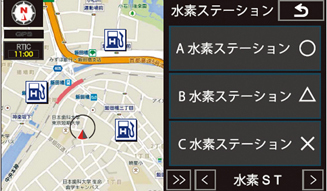
Additionally, as a "connected service," a dedicated navigation system for the MIRAI was announced. By subscribing to the T-Connect DCM package, users can check the location and operational status of hydrogen refueling stations. Furthermore, a remote monitoring function for the FC system will be implemented, allowing for the detection and response to any vehicle anomalies by dealerships and the manufacturer.

At the press conference, Vice Chairman Kato remarked, "We are truly at the starting line today. This is not the culmination, but rather the beginning of our ongoing efforts. Many challenges remain. Nevertheless, Toyota has decided to launch this car, which will change the future, and take this first step."
"The name MIRAI embodies our hopes for the future of automobiles, the future of the planet, and the future of the children who will carry it forward. However, such a future cannot be realized by Toyota alone. It is a journey we must take together, and it will undoubtedly present greater challenges than ever before for Toyota. This announcement is a declaration of Toyota's resolve and challenge spirit to conquer this long road ahead," he concluded.
Indeed, the real test begins now. Issues such as CO2 emissions during hydrogen production and the ongoing development of infrastructure remain. Yet, Toyota has bravely taken the "first step" that Vice Chairman Kato spoke of.