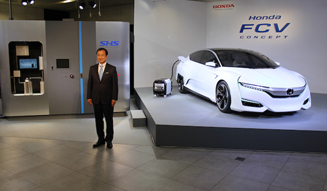
Honda unveils the concept for its fuel cell vehicle to be released in fiscal year 2015 | Honda
Honda FCV Concept
Aiming for release in fiscal 2015
Honda Unveils Fuel Cell Vehicle Concept
The "FCV Concept" fuel cell vehicle announced by Honda is positioned as the successor to the "FCX Clarity," which has been available for lease since 2008. This model refines the design of the concept car unveiled at last year's Los Angeles Auto Show, bringing it closer to a production vehicle.
Text & Event Photographs by SHUNICHI UCHIDA
Honda's Vision for a Future Hydrogen Energy Society
Announced by Honda on November 17th, the "FCV Concept" is a prototype fuel cell vehicle scheduled for release in 2015, serving as the de facto successor to the FCX Clarity.
The most distinctive feature of this concept model is its adoption of an advanced aerodynamic body design that prioritizes airflow, while also realizing a five-seater sedan package based on Honda's "MM concept" (Maximum space for people, Minimum space for mechanicals).——Maximum space for people, Minimum space for mechanicals)—achieving a five-seater sedan package.
The exterior design concept is "Advanced Clean Dynamic."
Kiyoshi Shimizu, head of FCV development at Honda R&D Center, explained, "The form suggests a low and wide stance, and by channeling air from the front intake through to the front wheel arches, we've streamlined the airflow around the front tires.
We achieve a similar effect at the rear fenders, thus harmonizing design with aerodynamic performance. We truly aimed for an advanced aerodynamic body brimming with functional beauty."
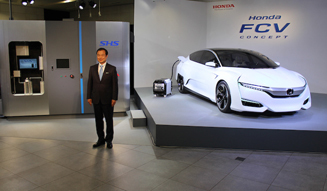
Honda President Takanobu Ito, with a jointly developed hydrogen station with Iwatani Corporation displayed behind him.
Meanwhile, the interior design concept is "Advanced Clean Comfort." Shimizu added, "Aiming for harmony between advanced technology and a fulfilling space, we've created a spacious interior that extends to the rear seats. As a sedan-type FCV further evolved from the FCX Clarity, we've achieved seating for five."
Fuel Cell Powertrain Compacted for Comfortable Cabin Space
Technologically, the miniaturization of the fuel cell powertrain is noteworthy. While the fuel cell stack (an assembly of cells) was housed in the center tunnel of the FCX Clarity, this new model, through miniaturization, has successfully integrated both the fuel cell stack and the drive motor under the hood for the first time in a production vehicle worldwide. Simultaneously, output has been increased to over 100 kW, with a power density of 3.1 kW/L, a roughly 60% improvement over previous models.
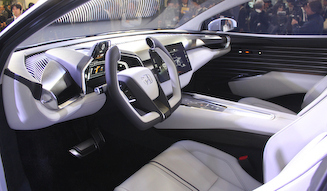
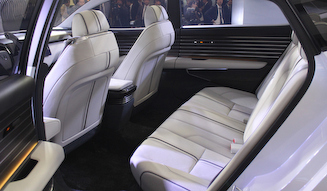
Furthermore, this concept car is equipped with a 70 MPa high-pressure hydrogen storage tank, achieving a cruising range of over 700 km. Refueling the hydrogen tank takes approximately three minutes, enabling usability comparable to current gasoline vehicles.
Additionally, it features an external power supply function, proven through extensive testing with the FCX Clarity. By combining the FCV with an external power conditioner, it can serve as a "mobile power source," providing electricity generated by the car to the community during emergencies.
This new FCV is slated for release in Japan within fiscal 2015, followed by expansion into the United States and Europe.
Honda FCV Concept
Aiming for release in fiscal 2015
Honda Unveils Fuel Cell Vehicle Concept (2)
Pride in Being a Leading Company in FCV Development
Hydrogen, which can be produced from inexhaustible water and diverse primary energy sources, is one of the most promising next-generation energies due to its transportability and storability.
At the press conference, President Takanobu Ito commented, "Honda is committed to developing electrified mobility and technologies for a low-carbon society, aiming to realize the joy of free mobility and a prosperous, sustainable society. To continue sharing the joy and inspiration of movement, we at Honda focused early on hydrogen energy as a solution to challenges such as global warming and fossil fuel depletion."
He continued, "Towards the coming hydrogen society, we want to share Honda's vision of a hydrogen energy society with our users, and have been developing hydrogen-related technologies based on three core concepts: 'Create,' 'Use,' and 'Connect.'"
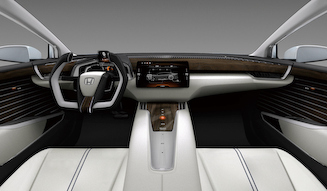
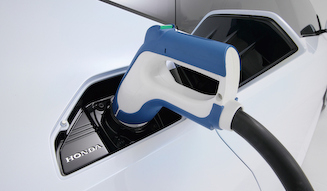
The Honda FCV Concept features an external power supply function.
Regarding "Create," he explained, "We are conducting demonstration tests of smart hydrogen stations in cooperation with Iwatani Corporation, aiming for decentralized hydrogen energy supply using renewable energy sources such as solar and wind power." For "Use," he stated, "We are developing fuel cell vehicles, FCVs, that offer not only the ultimate in clean driving but also exciting and exhilarating performance, and are currently used by customers in Japan and the US."
And concerning "Connect," he expressed his ambition: "By using the FCV as a mobile power source to supply electricity to homes and public facilities, we aim to connect cars with the local community and be of service to everyone, which has driven our development of the external power conditioner. Through these three concepts, we intend to actively contribute to the expanded use of hydrogen energy."
Regarding FCVs, Mr. Ito reflected on the past: "The FCX developed in 2002 was the world's first to receive US certification, and we began lease sales in Japan and the US. In 2003, we independently developed the Honda FC Stack, a fuel cell stack capable of sub-zero starts, also a world first.
In 2008, we launched lease sales of the FCX Clarity, which offered new value and appeal as a car, featuring an innovative sedan package and an extraordinary driving feel, another world first. By combining this FCX Clarity with an external power conditioner, we have accumulated practical experience as a mobile power source."
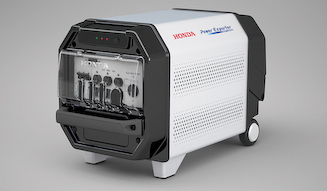
The "Power Exporter CONCEPT," announced alongside the vehicle, can be connected to the FCV to serve as a power source, with a maximum output of 9 kW.
He concluded, "Through the lease sales of FCVs, Honda has accumulated data on usability and driving performance from general users in real-world conditions, and we are proud to be a leading company in FCV development."
With Honda's FCV, refined through repeated demonstration tests with models like the FCX Clarity, and with hydrogen fuel cell vehicles also being introduced by competing manufacturers, the sales competition that will unfold after the Honda FCV goes on the market is eagerly anticipated.