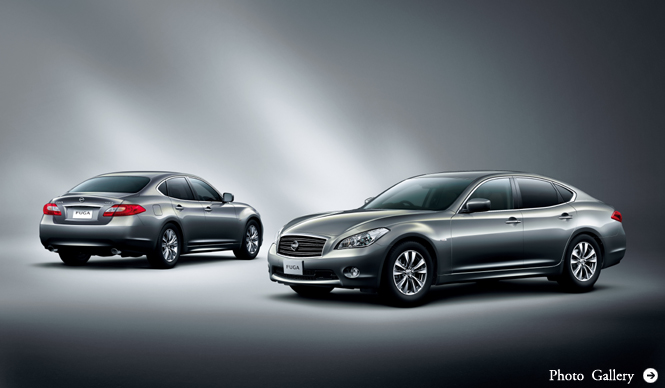
Nissan Fuga | Hybrid Model Debuts Fall 2010
NISSAN FUGA
Hybrid Model Debuts Fall 2010
Nissan Motor Co., Ltd. will unveil the new Fuga at the 41st Tokyo Motor Show, held from October 24th.
Text by Giraffe
A Lower, Wider Body
The model to be unveiled is expected to be quite close to the production version scheduled for release soon.
The engine lineup includes the familiar VQ series: the 3.7-liter VQ37VHR and the 2.5-liter VQ25HR. A hybrid model combining a 3.5-liter V6 engine with an electric motor is also planned for release in the fall of 2010.
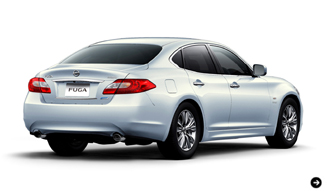
Compared to the current model, the exterior design features a lower overall height and wider body, creating a characteristic low-and-wide form. The generous use of curves and the flared fenders, reminiscent of the Skyline series, evoke a sense of confident performance.
Cutting-Edge Safety Features
In terms of safety, advanced features such as the 'Intelligent Pedal,' which assists braking, and 'Cornering Stability Assist,' which stabilizes cornering behavior, are incorporated to reduce the driver's burden.
Sales of the new Fuga in Japan are expected to begin within the next few months, with the Fuga Hybrid scheduled to follow about a year later.
BRAND HISTORY
Nissan began producing the Cedric under its own name in 1960. The company's origins trace back to 1937, and it has a history of handling knock-down manufacturing of Austin vehicles after World War II.
In 1966, it merged with Prince Motor Company. Between 1983 and 1987, it established a joint venture with Alfa Romeo, producing passenger cars in Italy. At one point, Nissan rivaled Toyota in market share, but faced a management crisis in the 1990s. In 1999, it received capital investment from France's Renault, leading to its current state.
Nissan's distinctiveness may lie in its approach to car manufacturing that resonated with the Japanese lifestyle. The dream of owning a personal car, the aspiration to enjoy high-performance vehicles, pride in Japanese cars with global value, and a penchant for luxury… Nissan has skillfully translated the automotive desires of the Japanese people, evolving with the times and the development of motorization, into its products.
In 1966, during the dawn of motorization, it offered the dream of owning a 'my car' with the small Sunny. In 1967, it emphasized high performance with the Bluebird. Against the backdrop of growing youth interest in motorsports, it launched the Skyline in 1968, followed by the Fairlady Z in 1969 as a sports car 'recognized in America,' all in rapid succession.
Furthermore, during the so-called bubble economy, driven by the market's demand for luxury cars, the Cima achieved great success in 1988. Simultaneously, embodying the high performance of Japanese cars, the Skyline GT-R was released in 1989, solidifying the legend of the GT-R. This legacy continues to the present-day NISSAN GT-R.
The company's genuine human touch, evident in its efforts to connect with consumers by featuring developers prominently in advertising, remains strong today. The image of an anthropomorphized corporation, driven by purpose like a living person towards the future, reflecting an era that championed performance and technology, is Nissan's unique characteristic.
It is true that Nissan has lagged behind competitors like Toyota in developing new-generation technologies. It is said that among the many businesses closed during the capital alliance with Renault in 1999 was hybrid technology, which was more advanced than that of other companies at the time. While the Leaf, a four-door electric vehicle, is scheduled for release in the fall of 2010, Nissan's direction in environmental technology remains somewhat unclear.
(Updated August 2010)